


Disease outbreaks threaten Papua New Guinea’s quake-hit communities – UN
New York, Apr 11 (IBNS): In earthquake-hit Papua New Guinea, United Nations agencies on the ground are warning of a new looming threat: water-borne disease outbreaks, such as that of diarrhoea and measles.
According to the UN Children’s Fund (UNICEF) and the World Health Organization (WHO), there is a “high potential” of such outbreaks amid water contamination due to landslides, poor sanitation and personal hygiene management, and generally low vaccination coverage.
“At this stage of the emergency response, it is critical to restore the delivery of basic health services to the affected communities, such as the immunization of children,” said Dr. Luo Dapeng, the head of WHO operations in Papua New Guinea.
“We will continue to work closely with [national and provincial authorities] and partners to respond to these risks and to prevent a secondary emergency arising from disease outbreaks,” he added.
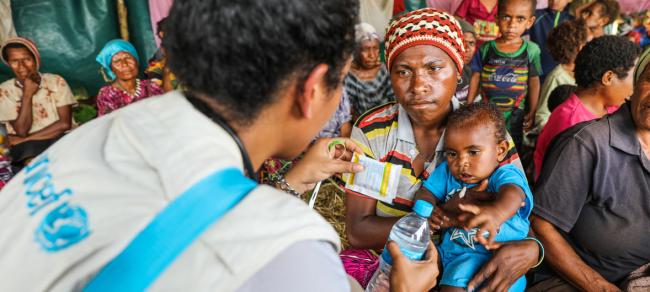
UNICEF and WHO are also stepping up the effort to improve water and sanitation systems and hygiene practices in affected areas. Specific projects include distribution of hygiene kits and water purification tablets, and setting up emergency pit latrines and rain water collection tanks.
The agencies have also created child-friendly spaces at temporary shelters so children can learn about good hygiene practices and ways to protect themselves from diseases.
Supporting the Government to conduct a measles and rubella immunization campaign in the earthquake-hit areas for children under the age of five is also a part of the multi-agency effort to curb the risk of potential outbreaks.
However, with children living in crowded shelters, ensuring their overall health is a major concern.
“We are really worried because a majority of children in the affected areas already have low immunity,” said Karen Allen, the head of UNICEF programmes in the country.
“Now, as they are living in the crowded shelters with poor-hygiene conditions, inadequate clean water and little knowledge to protect themselves, children are becoming much more vulnerable to diseases, including vaccine-preventable and water-borne diseases.”
More than 270,000 people – of them 125,000 children – remain dependent on humanitarian assistance across the Pacific island nation after it was hit by a devastating 7.5 magnitude earthquake in February.
The temblor was followed by a series of severe aftershocks throughout March, causing widespread damage to infrastructure and health services.
UNICEF/Bell
Support Our Journalism
We cannot do without you.. your contribution supports unbiased journalism
IBNS is not driven by any ism- not wokeism, not racism, not skewed secularism, not hyper right-wing or left liberal ideals, nor by any hardline religious beliefs or hyper nationalism. We want to serve you good old objective news, as they are. We do not judge or preach. We let people decide for themselves. We only try to present factual and well-sourced news.
Support objective journalism for a small contribution.


