 Union Budget
Biggest ever Capex push? ₹12.2 lakh crore proposed in budget
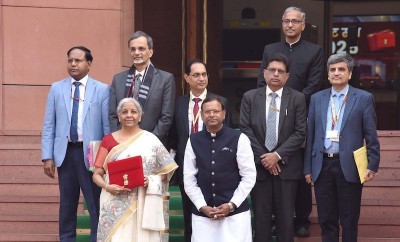
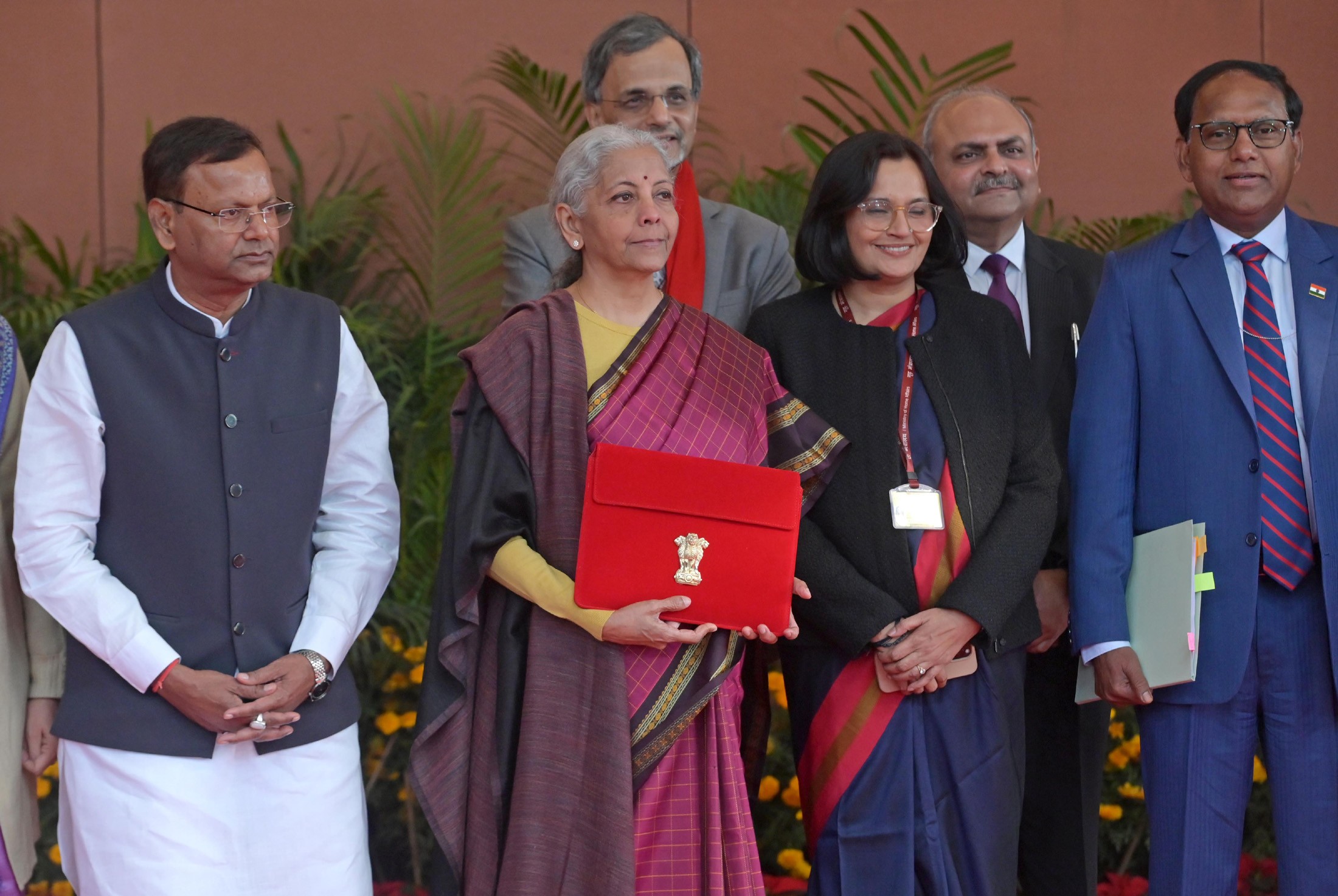
Indian Finance Minister Nirmala Sitharaman in her budget speech on Sunday said that the Public capex has increased manifold from Rs. 2 lakh crore in FY2014-15 to an allocation of Rs.11.2 lakh crore in BE 2025-26.
In FY2026-27, the Minister proposed to increase it to ₹12.2 lakh crore to continue the momentum. She further told the Parliament that during this past decade, the Government has undertaken several initiatives for large-scale enhancement of public infrastructure including through new financing instruments such as Infrastructure Investment Trusts (InVITs) and Real Estate Investment Trusts (REITs) and institutions like NIIF and NABFID.
Over the years, REITs have emerged as a successful instrument for asset monetisation.
The Budget 2026-27 proposes to accelerate recycling of significant real estate assets of CPSEs through the setting up of dedicated REITs.
Infrastructure Risk Guarantee Fund
To strengthen the confidence of private developers regarding risks during infrastructure development and construction phase, the Finance Minister proposed to set up an Infrastructure Risk Guarantee Fund to provide prudently calibrated partial credit guarantees to lenders.
Environmentally Sustainable Movement of Cargo
To promote this objective, the Budget proposes to establish new Dedicated Freight Corridors connecting Dankuni in the East, to Surat in the West and it also proposes to operationalise 20 new National Waterways (NW) over next 5 years. This is envisaged to start with NW-5 in Odisha to connect mineral rich areas of Talcher and Angul and industrial centres like Kalinga Nagar to the Ports of Paradeep and Dhamra. To increase the share of inland waterways and coastal shipping from 6 % to 12 % by 2047, the Finance Minister proposed to launch a Coastal Cargo Promotion Scheme for incentivizing a modal shift from rail and road.
Smt. Nirmala Sitharaman said that Training Institutes will also be set up as Regional Centres of Excellence for development of the required manpower, which will benefit youth in the entire stretch of the waterways to train and acquire skills. Further, a ship repair ecosystem catering to inland waterways is also proposed to be set up at Varanasi and Patna.
7 High-Speed Rail corridors
In order to promote environmentally sustainable passenger systems, in her Budget speech, the Finance Minister proposed to develop seven High-Speed Rail corridors between cities as ‘growth connectors’, namely i) Mumbai-Pune, ii) Pune-Hyderabad, iii) Hyderabad-Bengaluru, iv) Hyderabad-Chennai, v) Chennai-Bengaluru, vi) Delhi-Varanasi, vii) Varanasi-Siliguri.
Seaplane VGF Scheme
To enhance last-mile and remote connectivity, and promote tourism, Smt. Nirmala Sitharaman proposed to give incentives to indigenize manufacturing of seaplanes and said that a Seaplane VGF Scheme will be introduced to provide support for operations.
Carbon Capture Utilization and Storage (CCUS)
Aligning with the roadmap launched in December 2025, CCUS technologies at scale will achieve higher readiness levels in end-use applications across five industrial sectors, including, power, steel, cement, refineries and chemicals, said the Finance Minister. The Budget proposes an outlay of ₹20,000 crore over the next 5 years for the same.
City Economic Regions
The Finance Minister said that the cities are India’s engines of growth, innovation and opportunities. It proposes to now focus on Tier II and Tier III cities, and even temple-towns, which need modern infrastructure and basic amenities. In order to deliver the economic power of agglomerations, city economic regions (CER) will be mapped based on their specific growth drivers. The Finance Minister proposed an allocation of ₹ 5000 crore per CER over 5 years for implementing.
Support Our Journalism
We cannot do without you.. your contribution supports unbiased journalism
IBNS is not driven by any ism- not wokeism, not racism, not skewed secularism, not hyper right-wing or left liberal ideals, nor by any hardline religious beliefs or hyper nationalism. We want to serve you good old objective news, as they are. We do not judge or preach. We let people decide for themselves. We only try to present factual and well-sourced news.
Support objective journalism for a small contribution.