

Who Approved Nationwide SIR? Rahul Gandhi-Led Oppn Puts 48 Questions To Election Commission, Seeks Replies On Affidavit
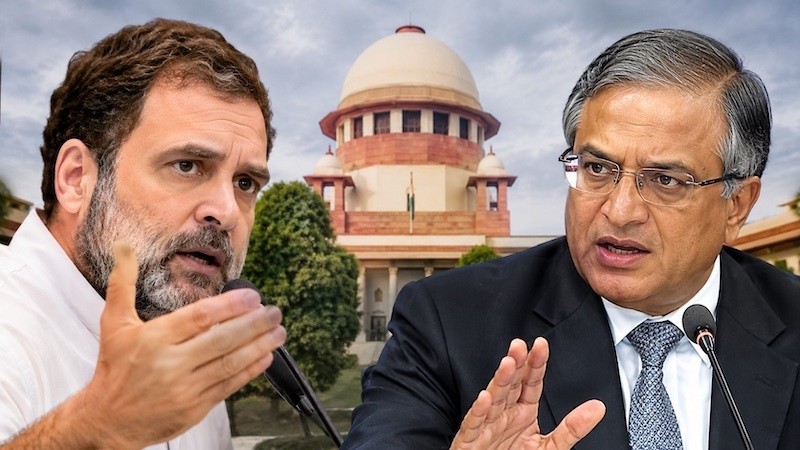
NEW DELHI/IBNS: Leader of Opposition Rahul Gandhi and several INDIA bloc leaders have approached the Supreme Court seeking permission to put 48 formal questions to the Election Commission of India (ECI), seeking to establish how the nationwide Special Intensive Revision (SIR) of electoral rolls was authorised and implemented.
In an application filed in the pending proceedings, the opposition leaders asked the court to direct specific Election Commission officials to answer the questions through sworn affidavits, bringing the poll body's internal decision-making process under closer scrutiny.
At the centre of the dispute is whether Chief Election Commissioner Gyanesh Kumar took decisions concerning the SIR independently or whether the three-member Election Commission approved them collectively, as the ECI has maintained.
The questions are directed at Chief Election Commissioner Gyanesh Kumar, Election Commissioners Sukhbir Singh Sandhu and Vivek Joshi, Deputy Election Commissioner Bhanu Prakash Yeturu and the Commission's Director General (IT).
The petitioners contend that the ECI's earlier affidavits asserted unanimity without producing the underlying records, including meeting minutes, file numbers, approval notes and details of deliberations.
Questions over dissent and decision-making
Among the 48 questions, the opposition leaders want Sandhu and Joshi to disclose every instance between February 2025 and October 2026 when they recorded objections, disagreements or reservations concerning the SIR, ECINET, Form 6 or the Commission's court appeals.
They also sought details on whether SIR decisions were taken at formal meetings, through circulation of files or by electronic communication, and when each commissioner approved the relevant orders.
The application further questions whether the counter-affidavit filed by the ECI before the Supreme Court was individually approved by all three commissioners and seeks documentary evidence of such approval.
ECINET, Form 6 and West Bengal voter appeals
A significant section of the questions concerns ECINET and ERONET, the digital platforms used for electoral roll management.
The petitioners want the ECI's IT chief to clarify whether private contractors or vendors had access to voter databases, whether bulk deletions could take place without orders from Electoral Registration Officers and whether proper audit trails were maintained.
They also sought details about who authorised an additional declaration on the online Form 6 voter registration process, how many applications were rejected or kept pending and how many voters were excluded from draft and final electoral rolls.
Another set of questions concerns appeals filed in West Bengal against judicial officers' orders allowing voters' names to be included in electoral rolls. The petitioners want the names and designations of officials who authorised those appeals and the procedures followed.
They additionally asked whether urgent approvals were obtained through WhatsApp, personal email or other electronic communications.
ECI maintains decisions were unanimous
The Election Commission has rejected allegations that the Chief Election Commissioner acted unilaterally.
In its Supreme Court affidavits, the poll body maintained that its three orders relating to the SIR, dated June 24, 2025, October 27, 2025 and May 14, 2026, were approved unanimously by all three commissioners.
It has also maintained that the statutory Form 6 was not amended and defended the additional declaration required in the online registration process.
The opposition leaders, however, argue that the Commission must produce documentary evidence to support its assertions.
The Supreme Court is scheduled to hear the underlying SIR petitions on November 17 before a bench headed by Chief Justice of India Surya Kant.
If permitted, the interrogatories would require the identified officials to address specific questions on oath, potentially bringing the Commission's internal decision-making and electoral database management into sharper judicial scrutiny.
Support Our Journalism
We cannot do without you.. your contribution supports unbiased journalism
IBNS is not driven by any ism- not wokeism, not racism, not skewed secularism, not hyper right-wing or left liberal ideals, nor by any hardline religious beliefs or hyper nationalism. We want to serve you good old objective news, as they are. We do not judge or preach. We let people decide for themselves. We only try to present factual and well-sourced news.
Support objective journalism for a small contribution.