 SIR
SIR
Supreme Court takes 'extraordinary' step, puts Bengal SIR under judicial oversight
New Delhi/IBNS: The Supreme Court of India on Friday issued what it described as an “extraordinary order”, directing the Calcutta High Court to appoint judicial officers to assist West Bengal in completing the Special Intensive Revision (SIR) of electoral rolls.
The move came amid a prolonged standoff between the state government and the Election Commission of India, which has stalled the voter roll clean-up exercise.
The top court said judicial officers would examine claims and objections arising from discrepancies identified during the revision process, noting that the exercise had reached an impasse.
‘Trust deficit’ between constitutional authorities
Chief Justice of India Surya Kant observed that the situation reflected a deepening lack of trust between two constitutional functionaries—the West Bengal government and the Election Commission.
“There is an unfortunate scenario of allegations and counter-allegations which shows a trust deficit,” the Chief Justice said, adding that the process had become stuck at the stage of adjudicating claims and objections from voters whose names appeared on discrepancy lists.
The court said it had been left with no alternative but to intervene, stressing that the order was necessitated by “extraordinary circumstances”.
Judges to handle claims and objections
Directing the Calcutta High Court to free up serving and even retired judicial officers of the rank of district judge, the Supreme Court said these officers could assist district authorities in disposing of pending claims linked to the SIR exercise.
To finalise the operational details, the court asked the State Election Commissioner, the state’s chief secretary, the director general of police and other senior officials to meet the Chief Justice of the Calcutta High Court the following day.
The bench noted that disputes had arisen over whether officers of appropriate rank had been deployed by the state to perform quasi-judicial functions as Electoral Registration Officers and Assistant Electoral Registration Officers.
Sharp remarks on lack of cooperation
The Supreme Court expressed clear dissatisfaction with the pace and quality of compliance by the West Bengal government.
Chief Justice Kant questioned delays in responding to earlier court directions, remarking that the court had expected cooperation rather than vague assurances.
“We are not micro-observers. We are disappointed to see this,” he said, adding that the court did not seek private explanations but effective action.
The bench warned that without competent officers, the fate of voters could not be fairly decided, underlining the seriousness of the exercise.
Heated exchanges in court
Senior advocates Kapil Sibal and Menaka Guruswamy, appearing for the West Bengal government, argued that sufficient Group B officers had been deployed for the SIR process.
However, senior counsel Dama Seshadri Naidu, representing the Election Commission, countered that officers competent to discharge quasi-judicial responsibilities had not been provided.
The court observed that there appeared to be hesitancy on both sides and reiterated that judicial officers could help take the process to a “logical conclusion”.
Warning to state government
Emphasising the need for cooperation, the Supreme Court urged the West Bengal government to create an enabling environment for the judicial officers nominated by the High Court.
“Please cooperate with the High Court. Please create an environment for them to function,” the bench said, cautioning that failure to complete the SIR exercise could have serious consequences.
Political overtones to the SIR dispute
The controversy has unfolded against the backdrop of intense political campaigning ahead of the West Bengal Assembly elections.
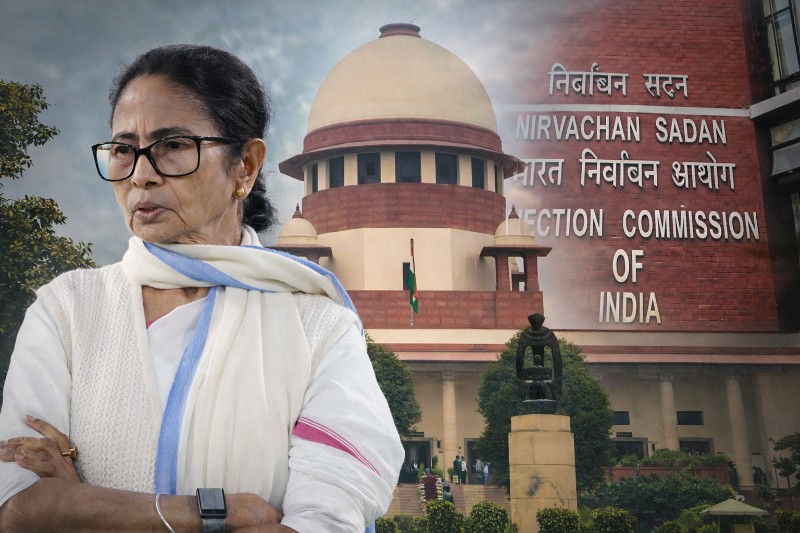
Bengal Chief Minister Mamata Banerjee earlier took the issue to the national capital, meeting senior Election Commission officials and publicly warning that she could mobilise “lakhs of people” to protest in Delhi.
Election Commission sources have alleged that the chief minister made repeated accusations during the meeting, claims that Banerjee has denied.
Banerjee has accused the poll body of selectively targeting West Bengal and Kerala through the SIR exercise while sparing BJP-ruled Assam, alleging political bias and branding the Election Commission an agent of the ruling party at the Centre.
Support Our Journalism
We cannot do without you.. your contribution supports unbiased journalism
IBNS is not driven by any ism- not wokeism, not racism, not skewed secularism, not hyper right-wing or left liberal ideals, nor by any hardline religious beliefs or hyper nationalism. We want to serve you good old objective news, as they are. We do not judge or preach. We let people decide for themselves. We only try to present factual and well-sourced news.
Support objective journalism for a small contribution.