

 Rakesh Asthana
'Sonia Gandhi's memoir claim is wrong': Ex-CBI officer says Godhra train fire was deliberate
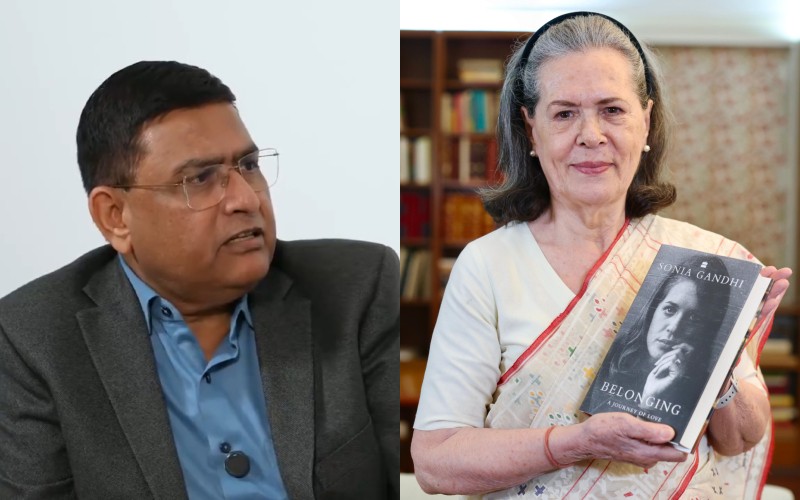
Former CBI special director Rakesh Asthana, who led the Gujarat Police investigation into the 2002 Godhra train burning, has rejected Congress leader Sonia Gandhi’s description of the cause of the fire as “disputed”, insisting that the investigation and subsequent judicial proceedings established that it was a deliberate act.
In an interview with news agency ANI, Asthana said investigators had examined multiple theories before gathering evidence linking the accused to the incident.
He maintained that the findings were subsequently scrutinised by the Nanavati Commission, a Supreme Court-appointed Special Investigation Team (SIT) and the courts.
Reacting to the passage in Gandhi’s memoir, Belonging: A Journey of Love, Asthana said: "That is completely wrong; the investigation is authentic. It has been proved in the court of law. Even now, if someone is creating doubt about it, then it is for political reasons; there can be no other explanation for it."
#WATCH | On Sonia Gandhi's statement in her memoir on 2002 Sabarmati Train burning, Rakesh Asthana, who headed the Gujarat Police SIT probing the incident, says in an interview to ANI, "Investigations have been completed; conviction has been secured... It has been an intentional fire caused by an inflammable liquid... I disagree with the statement that the cause of fire is still uncertain. Secondly, only S6 bogie was targeted and set on fire..."
— ANI (@ANI) November 14, 2026
In her book, Gandhi wrote: "The riots were triggered when four coaches of the Sabarmati Express were set on fire, and 59 pilgrims died. The train was returning to the state capital Ahmedabad from Ayodhya, carrying Hindu karsevaks, volunteers for the Ram temple.
"The cause of the fire remains disputed, but the turmoil that followed spread to many parts of the state."
Asthana rejects claims of political motivation
Asked whether doubts over the Godhra investigation were being raised for vote-bank politics, Asthana said the police had approached the deaths as a criminal case, without considering the victims’ religious identities.
#WATCH | Explaining the sequence of events of the 2002 Sabarmati Train burning, Rakesh Asthana, who headed the Gujarat Police SIT probing the incident, says, "A total of 59 people died in the incident, including 27 women, 10 children and 22 men. They died inside the coach because they could not get out... The investigation stated that some people had managed to jump out of the coach. The mob chased them, killing or injuring them and attempting to kill them. Therefore, the claim that it was an accidental fire and that there was no mob violence is not supported by the investigation..."
— ANI (@ANI) November 14, 2026
"All the people who died in Godhra were Hindus. And whoever's death it may be—whether a Hindu's, a Muslim's, a Christian's, or a Sikh's—death is death, murder is murder. So we investigated it as a criminal act. But unfortunately, the issue was made out in such a way that an attempt was made to investigate the case to benefit Mr. Modi," he said.
Asthana argued that the investigation had undergone extensive scrutiny and that its findings were supported by subsequent inquiries and judicial decisions.
Supreme Court-appointed SIT examined police probe
Asthana said the Gujarat Police investigation, initially conducted by the CID Crime unit, continued until 2008 before a Supreme Court-appointed SIT reviewed the case in detail.
The team was headed by then CBI Director RK Raghavan, with former Uttar Pradesh Director General of Police CB Satpathy also involved.
According to Asthana, Satpathy led the SIT whenever Raghavan was unavailable.
He said the team revisited the crime scene, examined the evidence and questioned the officers who had conducted the original investigation.
"They examined the entire investigation again. In fact, they examined us as well. We explained to them what investigation we had carried out. They visited the site and examined everything. They then concluded that they could not find any flaw in the investigation conducted by the Gujarat Police," Asthana said.
He added that Raghavan and Satpathy submitted their findings to the Supreme Court, which accepted the report. The subsequent trial proceeded based on the investigation, resulting in convictions in 2011, he said.
Nanavati Commission found evidence of conspiracy
Asthana also cited the findings of the Nanavati Commission, established by the Gujarat government in 2002 to investigate the Godhra train burning and the communal violence that followed.
The commission was initially headed by Justice KG Shah before Justice Nanavati joined in May 2002.
It examined the train fire and the subsequent riots separately.
#WATCH | Was there Media Pressure during the Godhra tragedy investigation and who was the journalist who barged into his room for a reaction? Rakesh Asthana responds. https://t.co/cJQo3cJ1EV
— ANI (@ANI) November 14, 2026
According to Asthana, the commission’s report on the Godhra incident, submitted in 2008, concluded that the fire was the result of a pre-planned conspiracy and had been deliberately set.
He said the commission received around 44,000 affidavits and examined more than 1,000 witnesses during its proceedings.
Asthana contrasted these findings with those of a committee headed by Justice UC Banerjee, constituted in 2004 by then Railway Minister Lalu Prasad Yadav.
#WATCH | Rakesh Asthana, who headed the Gujarat Police SIT probing 2002 Sabarmati Train fire, says, "After the government changed in 2004, the then Railway Minister, Lalu Prasad Yadav, appointed a committee headed by Justice U.C. Banerjee to examine the same incident that was already being investigated... The committee conducted its own investigation and concluded that the fire was accidental. Its report suggested that the karsevaks were carrying a stove, which caught fire. In 2005 or 2006, a victim challenged the committee's findings before the Gujarat High Court. The High Court rejected the committee's validity and held that it was illegal... The fact remains that the investigation established that the fire was deliberately set and the cause of the fire was also identified. The Commission of Inquiry established this, the Supreme Court-appointed SIT also established it, and the courts convicted the accused on the basis of the same evidence...”
— ANI (@ANI) November 14, 2026
The committee concluded that the fire was accidental and suggested that a stove carried in the coach occupied by the karsevaks could have caused it.
Asthana said the Banerjee Committee’s report was challenged in the Gujarat High Court, which ruled that the committee was illegal because a commission constituted under the Commission of Inquiry Act was already investigating the incident.
He added that the report was subsequently set aside.
"The fact is that the investigation established that the fire was deliberate. The commission established it, the Supreme Court-appointed SIT established it, and the courts convicted the accused based on the same evidence," he said.
'Muslim officers played crucial role'
Rakesh Asthana said that then Gujarat Chief Minister Narendra Modi provided him with Muslim police officers to assist in the investigation.
Speaking to ANI, Asthana said he faced no pressure during the probe and had specifically requested Muslim officers because Muslims predominantly inhabited the area where the incident occurred.
"There was no pressure. On the contrary, I would like to say that in the initial investigation, I saw that the area in which the incident took place was totally inhabited by the Muslims. So to conduct an investigation in the Muslim area, you need Muslim officers, practically speaking, professionally speaking. I requested him to give me a few Muslim officers to be attached to the investigation team," he said.
#WATCH | On being asked if he was under political pressure from the then CM Narendra Modi, Rakesh Asthana, who headed the Gujarat Police SIT probing 2002 Sabarmati Train fire, says, "There was no pressure... The area of the incident was predominantly inhabited by Muslims... I requested that a few Muslim officers be assigned to the investigation team and all the names I suggested were provided to us without any hesitation or objection. These Muslim officers played a very crucial role in our investigation...”
— ANI (@ANI) November 14, 2026
Asthana added that the officers played a crucial role in the investigation.
He cited the example of two Muslim constables who spent around six weeks working undercover as bangle and sari sellers to trace an accused who had subsequently fled to Pakistan.
"For a month and a half, they did this very diligently, honestly and sincerely. Undercover. And we could locate. The second thing is that the day we raided, he slipped. Mob assault was done on the police. But this work was done by the Muslim officers. And any restriction, be it the Chief Minister or Home Minister or Gujarat government, I was given the free hand to investigate," he said.
59 people killed in Sabarmati Express fire
On February 27, 2002, coach S-6 of the Sabarmati Express caught fire near Godhra railway station in Gujarat, killing 59 people, including women and children.
The train was carrying Hindu karsevaks returning from Ayodhya.
The incident was followed by widespread communal violence in several parts of Gujarat, in which hundreds of people were killed.
In 2011, a special court convicted 31 people in connection with the train burning. The Gujarat High Court, in 2014, upheld the convictions of 11 accused while acquitting 20 others.
The Supreme Court subsequently upheld the Gujarat High Court’s verdict and dismissed appeals filed by the convicts in the case.
Support Our Journalism
We cannot do without you.. your contribution supports unbiased journalism
IBNS is not driven by any ism- not wokeism, not racism, not skewed secularism, not hyper right-wing or left liberal ideals, nor by any hardline religious beliefs or hyper nationalism. We want to serve you good old objective news, as they are. We do not judge or preach. We let people decide for themselves. We only try to present factual and well-sourced news.
Support objective journalism for a small contribution.