 AI
AI
'Second group? no chance': Ashwini Vaishnaw says India is a top AI power, slams IMF at Davos
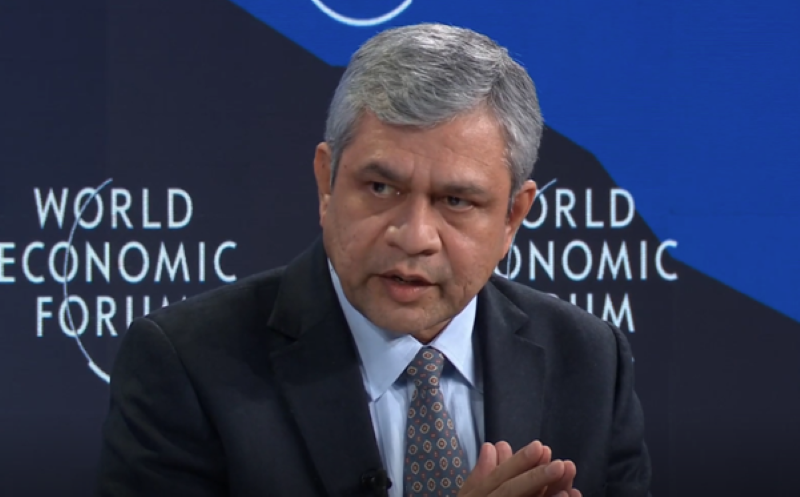
Davos/IBNS: Union Minister for Electronics and Information Technology Ashwini Vaishnaw on Tuesday strongly rejected International Monetary Fund (IMF) Managing Director Kristalina Georgieva’s assessment that placed India in the “second grouping” of global Artificial Intelligence (AI) powers.
Speaking on the sidelines of the World Economic Forum (WEF) annual meeting in Davos, Vaishnaw asserted that India is advancing across the entire AI value chain.
“We are working on all the five layers,” Vaishnaw said, referring to the AI architecture comprising application, model, chip, infrastructure and energy. “We are making very good progress in all the five layers.”
Highlighting India’s strength in AI-driven services, the minister said the country is poised to emerge as a global leader in application-based AI deployment.
“India will probably be the biggest supplier of services to the world on the application layer,” he said, adding that New Delhi’s focus is on ensuring AI diffusion at scale.
Questioning the basis of the IMF’s classification, Vaishnaw said, “I don’t know what the IMF criteria has been, but Stanford places India as third in terms of AI penetration, preparedness and talent.”
India is working on all 5 layers of the AI architecture: application, model, chip, infra and energy. We are building the foundation for global AI services.
— Ashwini Vaishnaw (@AshwiniVaishnaw) January 21, 2026
World Economic Forum, Davos pic.twitter.com/27lIbUBOl0
Emphasising the commercial viability of AI, the minister said real value creation lies in enterprise adoption rather than building ultra-large foundational models.
“Our focus is very much on providing service using AI applications—helping enterprises understand how it works—and that’s going to be the biggest factor of successful deployment of AI because that’s where ROI comes from,” he said.
“ROI doesn’t come from creating a very large model. Ninety-five percent of the work can happen with models which are 20 billion or 50 billion parameters,” Vaishnaw added.
He said India is already deploying a range of such models across sectors. “We are creating a bouquet of such models—we already have a bouquet of such models—which are now being deployed in multiple sectors to increase productivity, efficiency and effective use of technology.”
Rejecting India’s placement in the second tier of AI nations, Vaishnaw said, “I don’t think your classification in the second bouquet is right. It’s actually in the first.”
The remarks come after IMF Managing Director Kristalina Georgieva recently grouped countries based on their AI capabilities, placing the US and China in the top tier, while categorising India among the second set of AI-ready nations.
The classification triggered debate in India’s policy and technology circles, given the country’s expanding AI ecosystem.
India has been aggressively pushing its AI agenda through initiatives such as the IndiaAI Mission, investments in AI compute infrastructure, domestic semiconductor manufacturing, and sector-specific AI applications in healthcare, agriculture, governance and finance.
Global studies, including those by Stanford University, have consistently ranked India among the leading countries in AI talent availability and adoption readiness.
Support Our Journalism
We cannot do without you.. your contribution supports unbiased journalism
IBNS is not driven by any ism- not wokeism, not racism, not skewed secularism, not hyper right-wing or left liberal ideals, nor by any hardline religious beliefs or hyper nationalism. We want to serve you good old objective news, as they are. We do not judge or preach. We let people decide for themselves. We only try to present factual and well-sourced news.
Support objective journalism for a small contribution.