 Delhi Terror Plot
Red Fort blast plot uncovered: 32 cars prepped for 'Babri revenge’ attacks, sources say
Delhi/IBNS: In a chilling revelation, investigators probing the Delhi Red Fort blast have uncovered a vast terror network involving 32 vehicles, allegedly intended for a series of coordinated “revenge” attacks across Delhi and beyond.
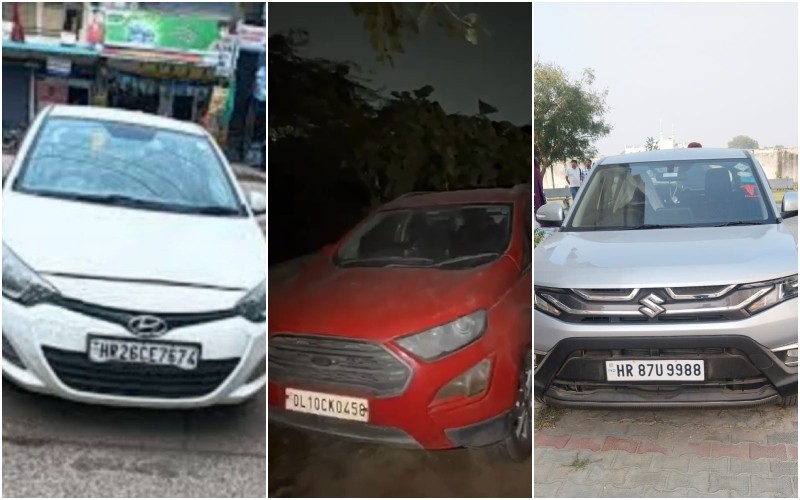
According to sources, these vehicles—including a Maruti Suzuki Brezza, Swift Dzire, and Ford EcoSport—were modified to carry explosives and deliver bombs on December 6, the anniversary of the Babri Masjid demolition.
The Hyundai i20 that exploded outside the Red Fort on November 10 was reportedly one among these cars.
The moment of Delhi car blast near Red Fort Metro Station#Delhi #DelhiCarBlast #CarBlast #RedFort #RedFortBlast pic.twitter.com/IeKG0kc21J
— India Blooms (@indiablooms) November 13, 2025
The blast, which killed at least 13 people and injured dozens, was meant to be part of a larger chain of attacks that terrorists linked to the Pakistan-based Jaish-e-Mohammed (JeM) had been planning.
Old cars, new tricks
Investigators revealed that the chosen vehicles were old, re-sold multiple times, and nearly impossible to trace—making them ideal for a covert operation.
All four vehicles linked so far to the case have been recovered.
The Brezza (HR87 U 9988) was found on the premises of Al-Falah School of Medical Sciences and Research Centre in Faridabad, Haryana, which officials now describe as the epicentre of the terror cell’s operations.
Red Ford EcoSport (DL10CK0458) linked to #DelhiBlast found abandoned inside a farmhouse in Khandavali village, Haryana. pic.twitter.com/0S7R0SH8Nd
— India Blooms (@indiablooms) November 12, 2025
The Ford EcoSport (DL10 CK 0458) was discovered abandoned in the same area late Wednesday, with an unidentified young man found asleep in the back seat. He has since been detained for questioning.
Earlier this week, authorities also seized the Swift Dzire, which was found to contain an assault rifle and ammunition—further confirming suspicions of a massive, coordinated plot.
Premature explosion exposes plot
According to initial findings, the Hyundai i20 used in the Red Fort blast was packed with high-grade explosives mixed with ammonium nitrate fuel oil (ANFO).
However, investigators believe the detonation was prematurely triggered by one of the suspects, Umar Mohammed alias Umar un-Nabi, killing him instantly. DNA tests have since confirmed his identity.
Officials stated that the i20 entered Delhi through the Badarpur border early Monday morning, circulating around central Delhi for several hours.
The group’s original plan, investigators believe, was to detonate the car inside the Red Fort parking area.
When the terrorists discovered that the Red Fort was closed to visitors on Mondays, Umar reportedly panicked.
Fearing exposure after the arrests of his associates, he detonated the bomb near a traffic signal outside the Red Fort and close to a metro station, triggering widespread panic and chaos.
Diwali attack and earlier plans foiled
Investigators have also confirmed that the group had earlier discussed carrying out an attack during Diwali on October 20, targeting crowded public spaces in Delhi.
Those plans were abandoned after the network suffered multiple setbacks following early arrests in Jammu and Kashmir.
JeM-linked 'White-Collar' terror module
The National Investigation Agency (NIA), which is now leading the probe, has described the group as part of a new breed of “White-Collar Terrorists”—radicalised professionals who used their education and access to plan and execute terror operations.
Several of the suspects, including Adil Ahmad Rather, Mujammil Shakeel, and Shaheen Saeed, were medical students and professionals associated with the Al-Falah Medical College in Faridabad and the Government Medical College in Anantnag, Jammu and Kashmir.
These individuals allegedly leveraged their positions to transport explosives, gather intelligence, and recruit others under the guise of legitimate professional activities.
A turning point in the investigation came after CCTV footage captured Rather putting up Jaish-e-Mohammed posters in Nowgam, Jammu and Kashmir.
His arrest in Saharanpur, Uttar Pradesh, subsequently led investigators to uncover the entire terror network and its chilling plans for December 6.
Explosive stockpile discovered
During raids conducted in both Faridabad and Anantnag, officials recovered nearly 3,000 kilograms of explosive materials, several assault rifles, and detailed blueprints outlining targeted locations across Delhi and northern India.
The Al-Falah Hospital was reportedly used as a storage site for these weapons and explosives.
Al-Falah distances itself
Following the revelations, the Al-Falah institution issued a statement condemning the terror activities and distancing itself from those arrested.
“We want to make it loud and clear that as a responsible institution, we stand in solidarity with the nation and reaffirm our unwavering commitment to the country,” the statement read.
However, the website of Al-Falah University has been taken down, media reports said on Thursday, after the institute received a show-cause notice from NAAC for claiming a false accreditation.
In the notice, NAAC has asked why no legal action should be taken against the university for "misleading the public" about its accreditation status, according to reports.
Meanwhile, Javed Ahmed Siddiqui, the founder and the managing trustee of the university, has come under the scanner after it was found that two of the three prime suspects, Dr Shaheen Saeed and Dr Mujammil Shakeel, are faculty members of the institution.
A dark new pattern in terrorism
Officials have warned that this case represents a disturbing new trend in India’s fight against terrorism—where educated, urban, and professionally trained individuals are being radicalised and recruited by foreign terror organisations.
These “White-Collar” extremists use their knowledge, networks, and access to resources to design operations that are technically sophisticated and socially deceptive.
The Red Fort blast, investigators say, was only the beginning of a much larger terror conspiracy—one that has now been dismantled before it could unleash far greater devastation.
Support Our Journalism
We cannot do without you.. your contribution supports unbiased journalism
IBNS is not driven by any ism- not wokeism, not racism, not skewed secularism, not hyper right-wing or left liberal ideals, nor by any hardline religious beliefs or hyper nationalism. We want to serve you good old objective news, as they are. We do not judge or preach. We let people decide for themselves. We only try to present factual and well-sourced news.
Support objective journalism for a small contribution.