 Waqf
Waqf
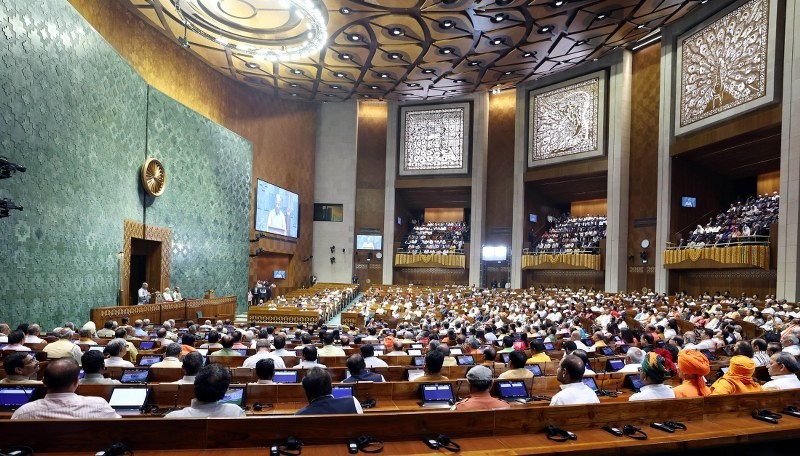
Rajya Sabha passes Waqf (Amendment) Bill 2025 after marathon debate, 128 voted in favour
The Rajya Sabha, or the Upper House of the Indian Parliament, passed the highly debated Waqf (Amendment) Bill 2025 after a marathon discussion on Friday.
128 MPs backed the bill, and 95 voted against it.
After a long discussion, the bill was put to vote at around 2 am.
The Lok Sabha (Indian Lower House) had passed the bill on Wednesday after a lengthy debate that began around noon and continued till 1 am.
While moving the bill in the Rajya Sabha, Union Minister Kiren Rijiju said the bill was aimed at providing transparency in the management of the Waqf properties.
He said the bill was not about religion but property and its management.
He said it aimed to remove corruption.
The Minister said the Muslim community has largely welcomed the bill.
He was quoted as saying by the media, "Prime Minister Narendra Modi has always been saying 'Sabka Saath, Sab Ka Vikas' and this is the spirit of our Constitution."
Opposing Rijiju, Congress's Syed Naseer Hussain was quoted as saying by the media: "They are creating confusion about 123 properties. They are either masjids, burial grounds or dargahs."
BJP President and Parliamentarian JP Nadda said the basic objective of the Waqf (Amendment) Bill-2025 is to bring about reforms and ensure proper management of Waqf property.
Slamming the opposition leaders, he said the bill is in the interest of the nation.
He said the opposition was trying to derail and divert attention from it.
"I want to tell the people of the country through this House that the government, led by Prime Minister Narendra Modi, is moving ahead by fully following democratic norms," he said.
Leader of Opposition Mallikarjun Kharge tried to corner the Centre by saying that the bill is being used by the PM Narendra Modi-led government to systematically weaken the diversity of India.
Lok Sabha
The Lok Sabha had passed the bill on Thursday with 288 votes in favour.
It was opposed by 232 members present and voting in the Lok Sabha.
Waqf Amendment Bill 2024
On August 8, 2024, two bills, the Waqf (Amendment) Bill, 2024, and the Mussalman Wakf (Repeal) Bill, 2024, were introduced in the Lok Sabha with an aim to streamline the Waqf Board's work and ensure the efficient management of Waqf properties.
The objective of the Waqf (Amendment) Bill, 2024, is to amend the Waqf Act, 1995, to redress the issues and challenges in regulating and managing Waqf properties.
The Amendment Bill seeks to improve the administration and management of waqf properties in India. It aims to overcome the shortcomings of the previous act and enhance the efficiency of Waqf boards by introducing changes such as renaming the Act, updating the definitions of waqf, improving the registration process, and increasing the role of technology in managing waqf records.
The primary objective of the Mussalman Wakf (Repeal) Bill, 2024 is to repeal the Mussalman Wakf Act, 1923, a colonial-era legislation that has become outdated and inadequate for managing waqf properties in modern India.
The repeal aims to ensure uniformity, transparency, and accountability in the administration and management of waqf properties under the Waqf Act, 1995, thus eliminating inconsistencies and ambiguities caused by the continued existence of this redundant law.
Support Our Journalism
We cannot do without you.. your contribution supports unbiased journalism
IBNS is not driven by any ism- not wokeism, not racism, not skewed secularism, not hyper right-wing or left liberal ideals, nor by any hardline religious beliefs or hyper nationalism. We want to serve you good old objective news, as they are. We do not judge or preach. We let people decide for themselves. We only try to present factual and well-sourced news.
Support objective journalism for a small contribution.