 Rajnath Singh
Operation Sindoor is a shining example of India’s growing indigenous defence capabilities: Singh
Union Defence Minister Rajnath Singh hailed Operation Sindoor as a shining example of India’s growing indigenous defence capabilities.
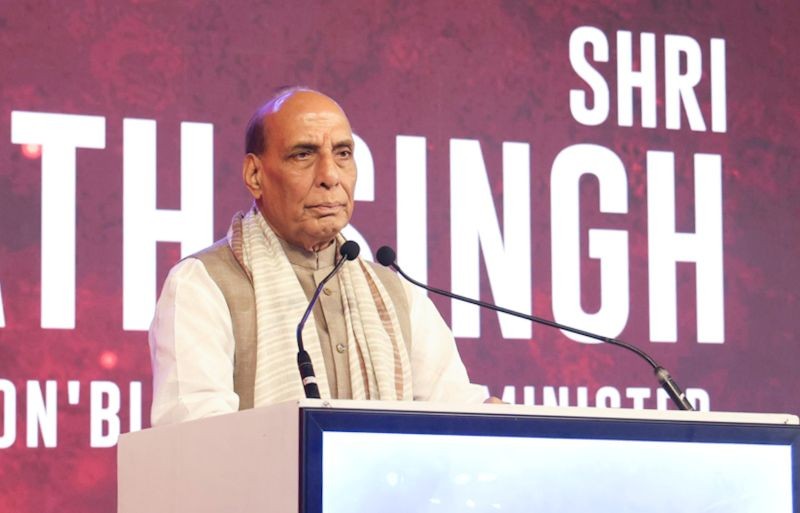
“In today’s era of terrorism, pandemics and regional conflicts, self-reliance in defence is not merely an option, but a condition for survival and progress. It is not about protectionism, it is about sovereignty and national autonomy,” said Rajnath Singh during his address at a Defence Conclave with the theme ‘Warfare in the 21st Century’ in New Delhi on August 30, 2025.
हम अपने देश के वेलफेयर से किसी भी कीमत पर समझौता नहीं कर सकते। चाहे कितना भी दबाव हो, भारत अपने किसानों, छोटे व्यवसायियों, दुकानदारों, पशुपालकों और आम नागरिकों के हितों को हमेशा सर्वोच्च प्राथमिकता देगा। pic.twitter.com/3vQJJDX9Rt
— Rajnath Singh (@rajnathsingh) August 30, 2025
He highlighted that the conclave comes at a significant moment with India’s Armed Forces displaying valour through Operation Sindoor just months ago, while conflicts, trade wars and instability continue to shape the global landscape.
Rajnath Singh underlined that the geopolitical shifts have shown the nation that dependence on others for defence is no longer an option.
He said that the Government, under the leadership of Prime Minister Narendra Modi, has always believed that a self-reliant India alone can safeguard its strategic autonomy.
stated that many developed nations are resorting to protectionist measures, with situations of trade war and tariff war becoming increasingly serious. He stressed that self-reliance in defence should not be confused with isolation.
“This is not protectionism. It is about sovereignty. When a nation of youth, energy, technology and possibilities moves towards self-reliance, the world pauses and takes note. This is the strength that enables India to withstand global pressures and emerge stronger,” he added.
Rajnath Singh hailed Operation Sindoor as a shining example of India’s growing indigenous defence capabilities.
He said that the precise strikes carried out by the armed forces on their targets using indigenous equipment demonstrated that no mission can be successful without vision, long preparation and coordination.
“Operation Sindoor may appear to be a story of a war of a few days, India's victory and Pakistan's defeat, but years of strategic preparation and defense preparedness have played a long role behind it,” he added.
He underscored that India’s forces, through years of hard work and reliance on indigenous equipment, executed the operation effectively and decisively.
Sudarshan Chakra Mission
Singh described the Sudarshan Chakra Mission as a game-changing initiative for India’s future security.
Announced by the Prime Minister, the mission envisions providing complete aerial protection to critical locations across the country within the next decade, using both defensive and offensive technologies.
Citing lessons from Operation Sindoor, he underlined the growing importance of air defence in modern warfare.
Rajnath Singh further mentioned that DRDO successfully tested an indigenous integrated air defence weapon system on August 23, 2025, which hit three targets simultaneously, marking the first step towards realising the Prime Minister’s vision.
He expressed confidence that although full implementation will take time, the Ministry of Defence has already moved decisively forward in this direction.
“All our warships are now being built in India. The recent commissioning of stealth frigates INS Himgiri and INS Udaygiri, equipped with advanced weaponry and electronic warfare systems, reflects our Navy’s resolve not to buy any warship from abroad. These ships are world-class, and will enhance India’s strength in the Indian Ocean Region,” stated Rajnath Singh while highlighting the indigenisation milestones such as complete self-reliance in warship construction.
Addressing India’s transformation from importer to exporter, Singh highlighted that the defence exports have risen from under Rs 700 crore in 2014 to nearly Rs 24,000 crore in 2025.
“India is no longer just a buyer but an exporter. This success is not only due to public sector units but also the contribution of private industry, start-ups and entrepreneurs,” he said.
Rajnath Singh underlined the impact of the Positive Indigenisation Lists in promoting self-reliance in defence, stating that under these lists, it has been decided that more than 5,500 items will no longer be imported but manufactured in India within a fixed timeframe.
He also informed that, so far, over 3,000 such items, which were earlier sourced from abroad, are now being produced indigenously.
On the economic role of defence, Singh underscored that the sector has become a pillar of growth.
“Domestic defence production has crossed Rs 1.5 lakh crore, with 25% from the private sector. Defence is not mere expenditure, it is Defence Economics, a driver of jobs, innovation and industrial growth. Like IT or automobiles, defence today is a growth multiplier,” he added.
He mentioned that lakhs of people are engaged directly and indirectly in manufacturing, R&D and allied activities.
Highlighting reforms to promote defence manufacturing, Rajnath Singh stated that the Government has made significant policy changes.
“The process of defence licensing has been simplified, the FDI limit has been increased to 74%, and the Make in India process has been streamlined to encourage greater private sector participation,” he stated
Support Our Journalism
We cannot do without you.. your contribution supports unbiased journalism
IBNS is not driven by any ism- not wokeism, not racism, not skewed secularism, not hyper right-wing or left liberal ideals, nor by any hardline religious beliefs or hyper nationalism. We want to serve you good old objective news, as they are. We do not judge or preach. We let people decide for themselves. We only try to present factual and well-sourced news.
Support objective journalism for a small contribution.