Meet Dr G Madhavi Latha, the IISc professor who helped shape world’s highest Chenab railway bridge
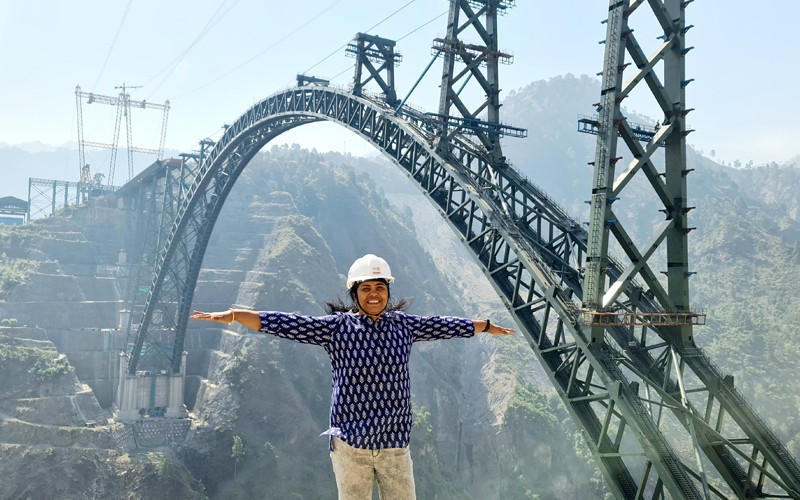
New Delhi: As Prime Minister Narendra Modi inaugurated the Chenab Bridge—the world’s tallest railway bridge—on Friday, a key figure behind the engineering feat quietly came into the spotlight—Dr G Madhavi Latha, a geotechnical engineering expert and professor at the Indian Institute of Science (IISc), Bengaluru.
Dr Latha was associated with the project for 17 years, working closely with Afcons, the bridge’s main contractor, as a geotechnical consultant, according to an NDTV report.
Her expertise was instrumental in navigating the extreme terrain and unpredictable geological conditions that challenged the construction of the bridge, which forms part of the ambitious Udhampur-Srinagar-Baramulla Railway Link (USBRL).
We are proud of Prof Madhavi Latha & her team's contribution to the #ChenabBridge inaugurated by Hon'ble PM Narendra Modi🎉
— IISc Bangalore (@iiscbangalore) June 6, 2025
The team worked on stability of slopes, design & construction of foundations, design of slope stabilisation systems incl. rock anchors to withstand hazards. pic.twitter.com/BApCSJTRZX
The Rs 1,486 crore project was approved in 2003 and is widely regarded as one of India’s most complex railway engineering efforts.
The Chenab Bridge, at 359 metres, stands taller than the Eiffel Tower and has been hailed as a symbol of national pride and connectivity in Jammu & Kashmir.
A civil engineering graduate from Jawaharlal Nehru Technological University (1992), Dr Latha completed her M.Tech in Geotechnical Engineering from NIT Warangal, where she won a gold medal.
She later earned her PhD from IIT-Madras in 2000.
Her work on the Chenab Bridge involved a pioneering “design-as-you-go” methodology—an adaptive approach used to tackle constantly evolving geological surprises such as fractured rocks and concealed cavities.
This dynamic process required her team to recalibrate designs in real time, adjusting rock anchors and stabilisation methods based on on-site discoveries.
Dr Latha’s contribution has earned her wide recognition. She received the Best Woman Geotechnical Researcher Award from the Indian Geotechnical Society in 2021 and was named among India’s Top 75 Women in STEAM in 2022.
She recently authored a paper titled “Design as You Go: The Case Study of Chenab Railway Bridge” for a women’s special edition of the Indian Geotechnical Journal, where she detailed how the project’s core design had to evolve continuously while responding to on-ground realities.
The bridge is expected to transform rail connectivity in Kashmir, overcoming the region’s long-standing logistical barriers through one of the most ambitious infrastructure projects in modern Indian history.
Support Our Journalism
We cannot do without you.. your contribution supports unbiased journalism
IBNS is not driven by any ism- not wokeism, not racism, not skewed secularism, not hyper right-wing or left liberal ideals, nor by any hardline religious beliefs or hyper nationalism. We want to serve you good old objective news, as they are. We do not judge or preach. We let people decide for themselves. We only try to present factual and well-sourced news.
Support objective journalism for a small contribution.