 Jal Shakti
Jal Shakti Ministry reviews progress of implementation of Jal Jeevan Mission in J&K
Srinagar: Children are the future of every nation and to provide safe water and improved hygiene is essential for their growth and holistic development.
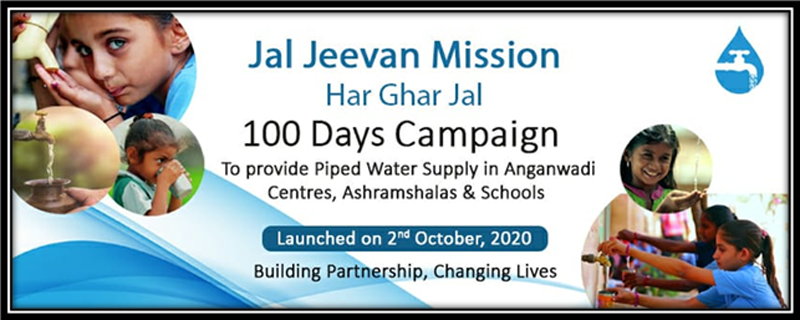
The Ministry of Jal Shakti had launched a 100-day campaign on 2nd October, 2020 based on the vision and under direction of Prime Minister Narendra Modi to ensure potable water supply in all schools and Anganwadi centers across the country, read a government statement.
The Union Territory of Jammu & Kashmir plans to fulfil Prime Minister’s vision by provide safe water in all these institutions within the campaign period, so that the children will have access to potable piped water for drinking, hand washing and for use in toilets when the schools reopen.
In order to assess the progress of implementation of Jal Jeevan Mission (JJM) in States/ UTs, a mid-year review of all States and UTs is being undertaken by the National Jal Jeevan Mission team, Ministry of Jal Shakti through video conferencing where States/UTs are presenting the status of the provision of tap water connection to rural households as well as the institutional mechanisms in place and the way forward to ensure universal coverage. Jammu & Kashmir presented their progress on implementation of JJM in the Union Territory today.
The Union Territory of J&K has 18.17 lakh households, out of which 8.38 lakhs (46%) are already provided with tap water connections.
The UT is allocated Rs 681.77 Crore as Central share under JJM for this financial year.
The UT is eligible for additional allocation based on physical and financial performance. UT is planning 100% coverage by December’ 2022 ahead of national goal by 2023-24. By doing so, J&K will be a leading example to accomplish the ambitious target of providing tap connection to every rural home.
"Jammu & Kashmir has finalized the Village Action Plan (VAP) in respect of 4,038 villages. VAP comprises of components such as source strengthening, water supply, grey water management and operation & maintenance," read the government statement.
Convergence planning to be done at the lowest level i.e. village/ Gram Panchayat, for source strengthening, water harvesting, aquifer recharge, water treatment and grey-water management, etc., for which dovetailing of resources from MGNREGS, 15th Finance Commission Grants for PRIs, SBM (G), CSR funds, Local Area Development funds, etc could be used for judicious use of funds," read a government statement.
Stress was given on the constitution of Village Water & Sanitation Committees so that the local village community/ Gram Panchayats and or its sub-committee/ user groups to be involved in planning, implementation, management, operation and maintenance of water supply systems in villages to ensure long-term sustainability of water supply systems to achieve drinking water security in rural areas.
The UT was asked to organize training for capacity building of Gram Panchayat functionaries as well as other stakeholders and also to focus on skill development training in villages to create a pool of trained human resources at village level, which will be very helpful in implementation as well O&M of water supply systems.
Support Our Journalism
We cannot do without you.. your contribution supports unbiased journalism
IBNS is not driven by any ism- not wokeism, not racism, not skewed secularism, not hyper right-wing or left liberal ideals, nor by any hardline religious beliefs or hyper nationalism. We want to serve you good old objective news, as they are. We do not judge or preach. We let people decide for themselves. We only try to present factual and well-sourced news.