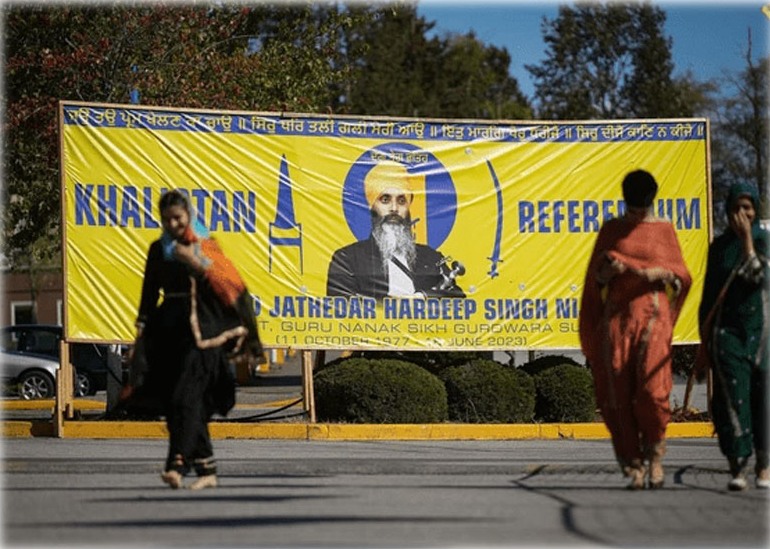
 Khalistan
Faith and politics: Decoupling Sikhism from Khalistan
In recent times, a narrative has emerged in certain Western media outlets suggesting a deep-rooted connection between the Khalistan movement and Sikhism, the faith of the Sikh community.
This assertion, however, demands a closer examination of the historical context and theological foundations of both Sikhism and the Khalistan movement.
Sikhism, established in the 15th century by Sri Guru Nanak Dev Ji, is a monotheistic religion that champions principles of equality, justice, and universal brotherhood.
At its core, Sikhism promotes peace, tolerance, and harmonious coexistence with all faiths and communities. Conversely, the Khalistan movement, calling for an independent Sikh state, surfaced in the late 20th century, significantly detached from Sikhism’s fundamental tenets.
The demand for a separate Sikh state gained traction in the 1980s in Punjab, India, fueled by a complex interplay of factors such as perceived political and economic marginalization, religious tensions, and the rise of radical Sikh groups.
These groups, claiming to represent Sikh aspirations, often employed violence and extremist rhetoric, departing from Sikhism’s peaceful and inclusive teachings.
Those asserting that Khalistan is rooted in Sikhism often point to the concept of ‘Khalsa,’ a term in Sikhism referring to the collective body of initiated Sikhs.
However, it’s crucial to distinguish between the spiritual meaning of ‘Khalsa’ and its political appropriation to justify a separatist movement.
Guru Nanak’s vision of Khalsa aimed at creating a community committed to spiritual enlightenment, social justice, and humanity’s betterment, not at establishing a separate political entity.
The concept was never intended to endorse territorial division or political separatism. Tenth Guru Sri Guru Gobind Singh Ji also echoed the same.
Furthermore, Sikh scriptures, notably the Guru Granth Sahib, do not advocate for the creation of a separate Sikh state. Instead, they emphasize spiritual liberation, universal brotherhood, and service to humanity, prioritizing these over political power or territorial boundaries.
The Khalistan extremist elements openly promote violence, engage in terror activities, and perpetuate the drug trade. Most recently a self-proclaimed champion of the Khalistan separatist movement openly threatened attack on Air India flights, followed by another threat to attack the Indian parliament. These were not regrettably highlighted by the Western media. These violent and terror activities stand in stark contrast to the principles of Sikhi, the religion’s teachings founded on peace, tolerance, and universal brotherhood.
The assertion that Khalistan is rooted in Sikhism not only distorts the religion’s core teachings but also risks perpetuating stereotypes and divisions within the Sikh community. It’s vital to recognize that the Khalistan movement is a political ideology, not a religious one, with origins in complex historical and socio-political factors rather than Sikhism’s tenets.
(Image and text courtesy: Khalsavox.com)
Support Our Journalism
We cannot do without you.. your contribution supports unbiased journalism
IBNS is not driven by any ism- not wokeism, not racism, not skewed secularism, not hyper right-wing or left liberal ideals, nor by any hardline religious beliefs or hyper nationalism. We want to serve you good old objective news, as they are. We do not judge or preach. We let people decide for themselves. We only try to present factual and well-sourced news.
Support objective journalism for a small contribution.