


How Liquid Cooling Handles Heat in High-Density Data Centers
Artificial intelligence and high-performance computing are placing greater demands on data center infrastructure. As rack-level processing power rises, managing the resulting heat becomes increasingly important. Could liquid cooling provide a practical way to meet this growing thermal challenge? Understanding how the technology works reveals why it is becoming an important consideration for high-density data centers.
What Is Liquid Cooling and Why Is It the Future?
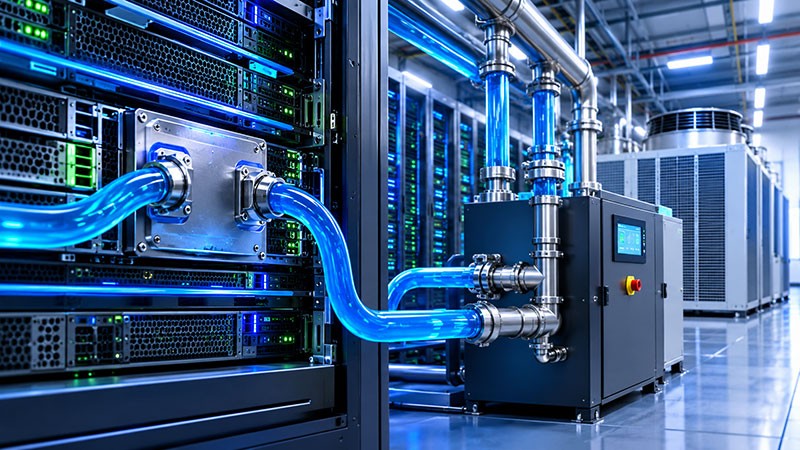
Liquid cooling uses circulating coolant to absorb and transport heat away from IT equipment. Because liquids carry heat more effectively by volume than air, they can handle concentrated thermal loads with less airflow. The coolant may flow through cold plates attached to processors, a rear-door heat exchanger, or an immersion tank containing compatible hardware.
Direct-to-chip systems are increasingly important for AI and high-performance computing. ASHRAE identifies direct-to-chip cold-plate systems as a mature, scalable, and reliable approach for dense computing environments. However, the transition does not always require a facility redesign. Hybrid architectures can use liquid for CPUs and GPUs while existing air systems cool memory, power supplies, storage, and networking components.
The future of liquid cooling:
- Modular Expansion: Scalable CDUs and prefabricated cooling blocks will let operators add capacity in planned stages as computing demand grows.
- Hybrid Infrastructure: Data centers will increasingly combine liquid and air systems to support equipment with different thermal requirements.
- Integrated Design: Cooling, power distribution, rack layouts, controls, and heat rejection will be planned as one coordinated system.
- Digital Twin Adoption: The virtual models will allow testing of the coolant flow, temperature, power consumption, and failure conditions before physical deployment.
- Smarter Operations: Monitoring through AI can be able to predict failures and make dynamic changes in pumps, valves, and coolant flow.
How Liquid Cooling Handles High-density Heat
- Transfers Heat Through Controlled Loops
The heated coolant moves from the server to the Coolant Distribution Unit (CDU). The CDU employs a heat exchanger to move thermal energy from the technology cooling loop to the facility water loop while ensuring that the two systems are isolated from one another. The CDU is responsible for controlling temperature, pressure, flow rate, and chemical balance of the coolant.
- Rejects Heat Beyond the Data Hall
Heat, once it gets to the loop in the facility, goes through chillers, cooling towers, dry coolers, or any heat rejection process. Warm water designs may have more options for economizing and mechanical cooling demand reduction. Under the right conditions, captured heat may be used for heat reuse.
- Supports Dense and Hybrid Racks
According to the American Society of Heating, Refrigerating and Air-Conditioning Engineers (ASHRAE), liquid-cooled or liquid-assisted cooling is suggested for AI clusters ranging from 50 kW/rack to 100+ kW/rack. The rear-door heat exchanger can take away heat from the exhaust of racks, and direct-to-chip cooling can take away heat from the processor.
- Captures Heat at Its Source
Direct-to-Chip cooling systems have their cold plates located on the heat-producing devices like the CPUs and Graphics Processing Units (GPUs). The coolant in the tubes absorbs the heat before it spreads to the entire server room. This method of heat dissipation ensures that the processors keep steady temperatures during operation.
- Improves Resource Efficiency
Since liquid cooling is highly efficient in heat transfer, it can save energy used for fans as well as the use of normal room cooling. In closed-loop cooling, the coolant constantly circulates, which means that there will be minimal evaporation of water in that loop. Performance will largely be determined by many factors, including climate and the building itself.
Building an AI-ready Cooling Strategy
Liquid cooling technology could be applied in order to manage increased thermal loads due to growing rack density and higher processor power in data centers. Planning cooling capacity, IT hardware, leak detection, water purity, and electrical infrastructure will enable companies to implement solutions that fit existing and future needs.
Partnering with experienced cooling specialists, IT manufacturers, and facility teams can help businesses coordinate system design, deployment, and ongoing monitoring. With the right planning and scalable infrastructure, data centers can improve cooling efficiency, maintain reliable operations, and prepare for the evolving demands of AI computing.
Support Our Journalism
We cannot do without you.. your contribution supports unbiased journalism
IBNS is not driven by any ism- not wokeism, not racism, not skewed secularism, not hyper right-wing or left liberal ideals, nor by any hardline religious beliefs or hyper nationalism. We want to serve you good old objective news, as they are. We do not judge or preach. We let people decide for themselves. We only try to present factual and well-sourced news.
Support objective journalism for a small contribution.