 ASUS
ASUS
From Ultrasound to Smartwatch: ASUS unveils AI healthcare revolution at COMPUTEX 2026
ASUS on Tuesday unveiled a new AI-powered healthcare ecosystem designed to help medical professionals make faster and more informed clinical decisions in real time.
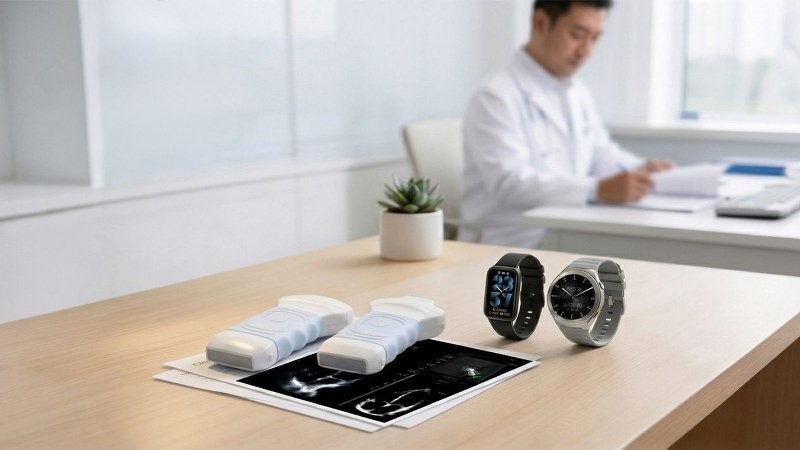
The ecosystem integrates two newly launched medical devices — the ASUS Handheld Ultrasound DuoScan and the ASUS VivoWatch 6 Plus — through the ASUS AI Agent healthcare platform and computing infrastructure. Together, they are designed to transform patient data into actionable clinical insights.
According to a recent ASUS survey of frontline healthcare professionals, more than 68% of respondents believe AI agents will have a measurable impact on clinical workflows, highlighting growing confidence in AI-driven healthcare solutions.
As AI agents emerge as a transformative force in healthcare, ASUS said it is building the foundation required for their deployment in real-world clinical environments. By combining sensing hardware, intelligent software platforms, and scalable computing infrastructure, the company has developed a closed-loop system capable of continuously capturing, processing, and acting on clinical data.
From Data Collection to Clinical Action
ASUS describes AI agents as the next major evolution in healthcare, shifting the focus from generating insights to directly influencing patient care and clinical outcomes.
To support this transition, the company has created a vertically integrated "medical sandbox" that combines data collection, AI-powered analytics, and computing infrastructure. The ecosystem incorporates the ASUS Handheld Ultrasound DuoScan and VivoWatch 6 Plus as sensing devices, alongside ASUS-exclusive No-Code AI technologies and advanced computing systems.
Within this unified framework, clinical data is continuously collected, structured, and analyzed, enabling AI agents to interpret information and execute actions in real time. ASUS says the approach can improve clinical workflows, enhance decision-making, and strengthen patient monitoring through faster and more precise interventions.
The company believes this closed-loop architecture can help transform fragmented healthcare processes into an intelligent and scalable system suitable for hospitals, emergency care facilities, and remote healthcare settings.
ASUS Handheld Ultrasound DuoScan
The ASUS Handheld Ultrasound DuoScan is designed to deliver high-definition imaging in a compact and portable form factor. Equipped with 192-element imaging technology, the device provides detailed visuals to support point-of-care diagnostics across a variety of clinical settings.
The ultrasound device is available in two dual-probe configurations: linear-plus-convex and linear-plus-phased array.
The linear-plus-convex configuration is designed for abdominal, musculoskeletal, peripheral vascular, and thyroid examinations. Meanwhile, the linear-plus-phased-array version supports cardiac, abdominal, musculoskeletal, and peripheral vascular imaging.
ASUS said the dual-probe design offers greater diagnostic flexibility across emergency medicine, critical care, and general practice applications.
Built for demanding clinical environments, DuoScan features IP68-rated water and dust resistance and a fully wireless design. With up to three hours of continuous battery-powered operation, the device enables healthcare professionals to perform real-time diagnostics in emergency rooms, intensive care units, and home-care settings without relying on fixed infrastructure.
ASUS VivoWatch 6 Plus
ASUS also introduced the VivoWatch 6 Plus, a next-generation health monitoring wearable designed to provide continuous health tracking and personalized wellness insights.
The smartwatch features a 1.43-inch AMOLED display protected by sapphire-crystal glass and housed within a titanium alloy case, delivering a lightweight yet durable design.
In addition to blood pressure and electrocardiogram (ECG) monitoring, the VivoWatch 6 Plus introduces new health metrics, including sleep breathing movement analysis and gait assessment. ASUS says these capabilities can provide deeper insights into chronic disease risks and long-term health trends.
The device also delivers real-time health feedback and personalized wellness guidance, transforming continuous biometric data into actionable recommendations that help users maintain healthier lifestyles.
By combining advanced medical devices, AI-powered analytics, and scalable computing infrastructure, ASUS aims to create a more connected healthcare ecosystem capable of supporting both clinicians and patients with faster, data-driven decision-making.
Support Our Journalism
We cannot do without you.. your contribution supports unbiased journalism
IBNS is not driven by any ism- not wokeism, not racism, not skewed secularism, not hyper right-wing or left liberal ideals, nor by any hardline religious beliefs or hyper nationalism. We want to serve you good old objective news, as they are. We do not judge or preach. We let people decide for themselves. We only try to present factual and well-sourced news.
Support objective journalism for a small contribution.