 Apple
Apple
Apple’s new M6 and M5 ultra chips could change Mac performance forever
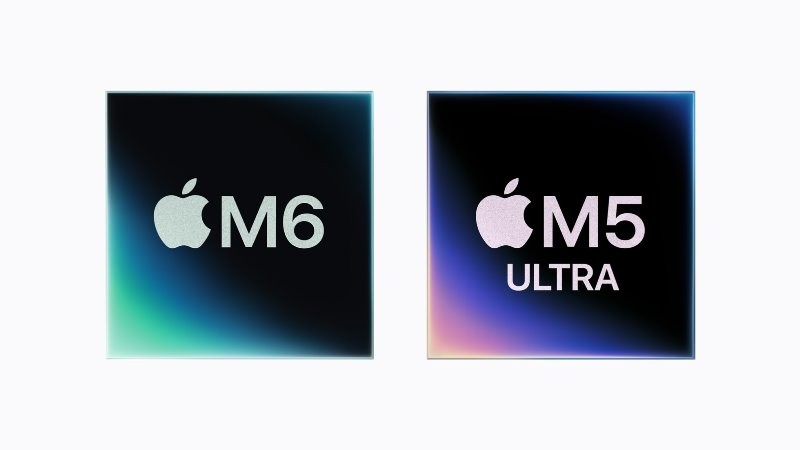
Apple has unveiled its next-generation M6 and M5 Ultra chips, bringing major gains in performance and AI capabilities to the new Mac mini and Mac Studio.
The M6, Apple’s first chip built using a cutting-edge 2-nanometre process, advances virtually every major computing component. It features a larger 12-core CPU, which includes what Apple describes as the world’s fastest CPU core, a 12-core GPU with Neural Accelerators, a dual 16-core Neural Engine and up to 170GB/s of unified memory bandwidth.
Meanwhile, the M5 Ultra is designed as Apple’s most powerful M-series chip yet for professional and AI workloads. It uses next-generation UltraFusion technology to create a quad-die architecture for the first time in an Apple silicon system-on-chip (SoC).
The M5 Ultra features up to a 36-core CPU and 80-core GPU, along with up to 1.2TB/s of unified memory bandwidth—50% more than the M3 Ultra.
Apple said the new chips deliver significant computing power while maintaining industry-leading power efficiency, enabling users to handle demanding workloads on desktop devices.
“Today, we’re debuting the next giant leap in performance and AI compute for Apple silicon with the incredibly advanced M6 and the most powerful M-series chip yet, M5 Ultra,” said Sri Santhanam, Apple’s vice president of Silicon Engineering Group.
“Built using the cutting-edge 2nm process, M6 combines a new CPU complex, two additional CPU and GPU cores, a Dual 16-core Neural Engine, and more unified memory bandwidth to power through workloads with amazing energy efficiency,” Santhanam said.
“For the ultimate desktop performance and the ability to run massive AI models, M5 Ultra features a massive GPU, now with Neural Accelerators, and more unified memory bandwidth, pushing the boundaries of what a desktop can do,” he added.
M6: Optimised Design and Enhanced Performance
Designed for everyday users, students, developers, AI enthusiasts and enterprises, the M6 is aimed at delivering a balance of performance, power efficiency and on-device AI capabilities.
Built using 2nm process technology, the chip packs greater transistor density into a smaller die, enabling improvements in both performance and power efficiency.
The M6 also introduces a Dual 16-core Neural Engine, delivering up to twice the peak compute performance of previous generations, according to Apple. System frameworks can automatically use both engines simultaneously, allowing compatible applications to execute AI models faster.
The chip features a new 12-core CPU complex, with two more cores than the M5. It comprises two super cores, four performance cores and six efficiency cores.
Apple says the M6 delivers the world’s fastest single-threaded performance and up to 1.2x faster multithreaded performance than the M5, while being up to 2.4x faster than the M1.
The super cores are designed to handle demanding single-threaded workloads, while the performance cores take on intensive multithreaded tasks. The efficiency cores manage everyday background workloads while helping maintain power efficiency.
As a result, tasks such as image editing, code compilation, file indexing and agentic AI workloads can be completed faster, Apple said.
Accelerated GPU and Faster Memory Bandwidth
The M6 features a 12-core GPU, two more cores than the M5, with a Neural Accelerator built into each core.
Apple says the design delivers nearly 30% higher peak GPU compute for AI than the M5 and more than eight times the performance of the M1, enabling faster prompt processing when interacting with on-device large language models (LLMs).
The M6 also incorporates Apple’s latest graphics technologies, including an updated shader core architecture, Dynamic Caching and hardware-accelerated ray tracing.
Together, these technologies are designed to improve visual realism, rendering speeds and gaming frame rates. The chip also delivers up to 50% higher geometry rates for complex graphics workloads.
The M6 supports up to 32GB of unified memory, allowing users to multitask across demanding applications and run LLMs locally for secure, private AI workloads. It offers up to 170GB/s of unified memory bandwidth, a 10% increase over the M5 and 2.5 times the bandwidth of the M1.
M5 Ultra: Apple’s Most Powerful M-Series Chip Yet
The M5 Ultra uses UltraFusion technology to connect two dual-die M5 Max chips, creating a quad-die architecture—a first for Apple silicon.
UltraFusion increases inter-die bandwidth to more than 4.4TB/s and connection density by more than six times. According to Apple, the ultra-low-latency, high-bandwidth interconnect allows the four dies to operate as a single unified processor.
The M5 Ultra features up to a 36-core CPU, comprising 12 super cores and 24 performance cores. Apple says it delivers up to 1.25x higher single-threaded performance and up to 1.3x higher multithreaded performance than the M3 Ultra.
Its next-generation GPU has up to 80 cores, with a Neural Accelerator incorporated into each core. Apple says the GPU delivers up to 4.5x higher peak AI compute than the M3 Ultra and more than six times the performance of the M1 Ultra.
The GPU also features Apple’s latest shader core with second-generation Dynamic Caching, hardware-accelerated mesh shading and third-generation ray tracing. These technologies deliver up to 40% faster graphics performance than the M3 Ultra, according to Apple.
The M5 Ultra also includes an enhanced Media Engine with dedicated hardware for H.264 and HEVC, four ProRes encode and decode engines, and hardware-accelerated AV1 decoding, making it suited to high-resolution video editing.
A 32-core Neural Engine powers complex AI workloads and Apple Intelligence features directly on the device while maintaining energy efficiency.
The chip supports up to 512GB of unified memory and delivers up to 1.2TB/s of unified memory bandwidth, 50% more than the M3 Ultra.
This large, high-bandwidth memory pool allows users to keep huge datasets in local memory, improve token-generation speeds and run LLMs containing hundreds of billions of parameters entirely on the device.
Unleashing Power for Developers
Apple’s developer frameworks and tools—including Core AI, Core ML, Metal and Xcode—are designed to take advantage of the advanced hardware in the M6 and M5 Ultra.
Developers can leverage the M6’s dual 16-core Neural Engine, as well as the Neural Accelerators in the M5 Ultra’s GPU, its 512GB unified memory capacity and 1.2TB/s memory bandwidth to power demanding AI workloads.
Apple said developers can use its frameworks and tools to run and fine-tune large AI models locally on Mac devices. The tools automatically optimise workloads across the CPU, GPU and Neural Engine.
Developers can also use Apple Foundation Models and App Intents to tap into Apple Intelligence capabilities, or deploy their own proprietary AI models to build and run advanced AI workloads entirely on-device.
Support Our Journalism
We cannot do without you.. your contribution supports unbiased journalism
IBNS is not driven by any ism- not wokeism, not racism, not skewed secularism, not hyper right-wing or left liberal ideals, nor by any hardline religious beliefs or hyper nationalism. We want to serve you good old objective news, as they are. We do not judge or preach. We let people decide for themselves. We only try to present factual and well-sourced news.
Support objective journalism for a small contribution.