


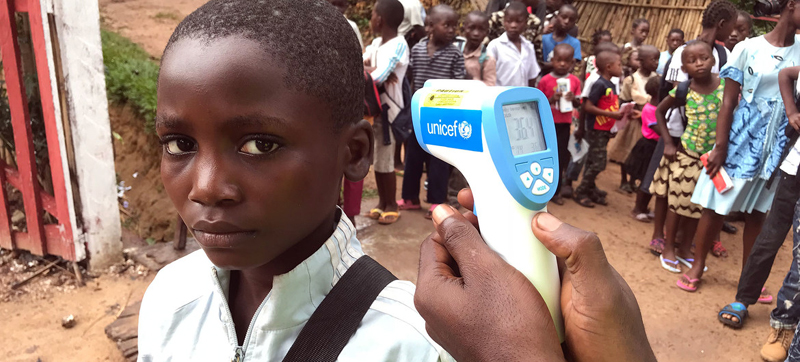
WHO concerned about growing Ebola outbreak in DR Congo
New York: The World Health Organization (WHO) and partners are concerned about the growing Ebola outbreak in the northwestern province of Equateur, in the Democratic Republic of the Congo (DRC), as they face critical funding gaps amid the COVID-19 pandemic, the UN health agency said on Thursday
The outbreak was declared on 1 June and there have been 56 cases, 53 of which are confirmed, surpassing the total number recorded during the province’s last Ebola outbreak, two years ago.
Scattered cases, costly response
“Responding to Ebola in the midst of the ongoing COVID-19 pandemic is complex, but we must not let COVID-19 distract us from tackling other pressing health threats”, said Dr. Matshidiso Moeti, WHO Regional Director for Africa.
“The current Ebola outbreak is running into headwinds because cases are scattered across remote areas in dense rain forests. This makes for a costly response as ensuring that responders and supplies reach affected populations is extremely challenging.”
This latest outbreak is the 11th for the DRC, which last month celebrated the end of Ebola in the restive eastern part of the country, following a nearly two-year battle.
The disease killed 2,280 people, making it the world’s second-deadliest Ebola outbreak.
Lessons learned inform response
WHO has mobilized $1.75 million for response in Equateur province but warned that this sum will last only a few more weeks.
The UN agency called for a scale-up in support to ensure affected communities are provided with key services, including health education, vaccination, testing, contact tracing and treatment.
The current response builds on lessons learned from the DRC’s previous Ebola outbreaks, underscoring the importance of working with local communities.
More than 12,000 people have been vaccinated in the six weeks since the outbreak began, with roughly 90 per cent of vaccinators coming from local areas.
WHO reported that vaccinations started within four days of the outbreak being declared, compared to two weeks during the 2018 outbreak.
Meanwhile, community health workers have visited more than 40,000 households, and more than 273,000 people have been provided with health and safety information.
Support Our Journalism
We cannot do without you.. your contribution supports unbiased journalism
IBNS is not driven by any ism- not wokeism, not racism, not skewed secularism, not hyper right-wing or left liberal ideals, nor by any hardline religious beliefs or hyper nationalism. We want to serve you good old objective news, as they are. We do not judge or preach. We let people decide for themselves. We only try to present factual and well-sourced news.
Support objective journalism for a small contribution.


