 Ebola
Ebola
Ebola spreads exponentially in DR Congo: UN sounds alarm
As the deadliest Ebola outbreak in DR Congo’s history continued spreading on Friday, UN responders renewed their urgent appeal for immediate international support, with existing funding for lifesaving work critically low.
“We're only covered for the next weeks, and very soon funding will run out,” said Julien Harneis, UN Senior Ebola Coordinator. “Every delay in funding and implementation makes this epidemic more deadly, more difficult to stop and more expensive. So, we need that international support immediately.”
Since the outbreak was declared on 15 May, 5,290 people have been infected 2,516 have died, according to latest health authority data published on Friday.
Of the total confirmed number of cases, 1,152 people have recovered and nearly 840 people remain in isolation or hospitalized. The fatality rate is 47.6 per cent and contact follow-up is 82.9 per cent.
Deadly progression
Briefing journalists from the Ebola epicentre in Bunia, Ituri province, Harneis warned that the disease is “growing exponentially”, with half of all deaths occurring in just the last 20 days.
“The epidemic is spreading to an area that is bigger than France. And the outbreak is growing faster and wider than the Ebola response,” he stressed, as “brutal” operating conditions continue to impede the progress of frontline workers.
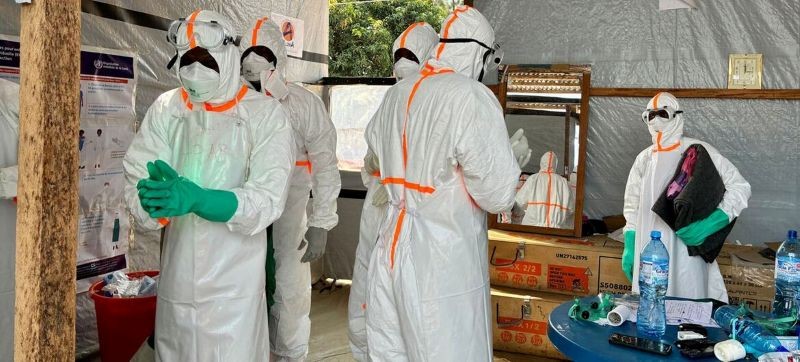
Three months into the outbreak, 160 healthcare workers have contracted Ebola and 43 of them have died. “And then when we do respond, apart from the threat from the virus, healthcare workers and frontline workers have been attacked by youths, ambulances have been burned and stoned and the healthcare facilities have been attacked,” Harneis explained.
“Conditions on the ground are extremely difficult, but we will continue deploying all the humanitarian and medical assistance needed until the job is done,” the veteran aid official said.
“Last week, I was trying to get into an Ebola hotspot, and it took three hours to drive 60 kilometres (37 miles),” he added.
Another key obstacle to the response is the lack of basic social services in the six eastern, provinces where the virus is spreading (Ituri, North Kivu, South Kivu, Haut-Uélé, Tshopo, and Bas-Uélé), a direct result of decades of violence in the resource-rich area.
Gaps in government-run, coordinated healthcare services and a limited number of banks have created further problems.
“In this area, the banking system barely functions,” Harneis explained. “We're unable to bring in the amount of money that is required to pay the workers, which has led to great unhappiness amongst frontline workers.”
US aid boost
And although the United States has contributed $80 million to the DRC Government to boost bed capacity and safe burial practices, among other support, cuts to aid work - especially in the last two years - have reduced the capacity of humanitarian organizations by more than 30 per cent, he added.
Despite these challenges, multiple specialist UN agencies continue to work alongside the DRC authorities to push back Ebola. They include the World Health Organization, the World Food Programme, the UN Children’s Fund (UNICEF), the UN migration agency (IOM) and partners including Médecins Sans Frontières.
“It's a disease, it's an invisible threat which comes into your community and suddenly people start falling sick around you and your loved ones die,” Harneis said. “And that generates a lot of fear in any community.”
Support Our Journalism
We cannot do without you.. your contribution supports unbiased journalism
IBNS is not driven by any ism- not wokeism, not racism, not skewed secularism, not hyper right-wing or left liberal ideals, nor by any hardline religious beliefs or hyper nationalism. We want to serve you good old objective news, as they are. We do not judge or preach. We let people decide for themselves. We only try to present factual and well-sourced news.
Support objective journalism for a small contribution.