


-1503216528.jpg)
Water Activists call for setting up a National Water Literacy Mission
Hundreds of water activists under the leadership of Magsaysay and Stockholm Water Awards winner Dr. Rajendra Singh, popularly known as the Waterman of India, had launched nationwide “Water Literacy Yatras”on May 28 this year – from Kanyakumar to Kashmir; and from Goa to Gauhati.
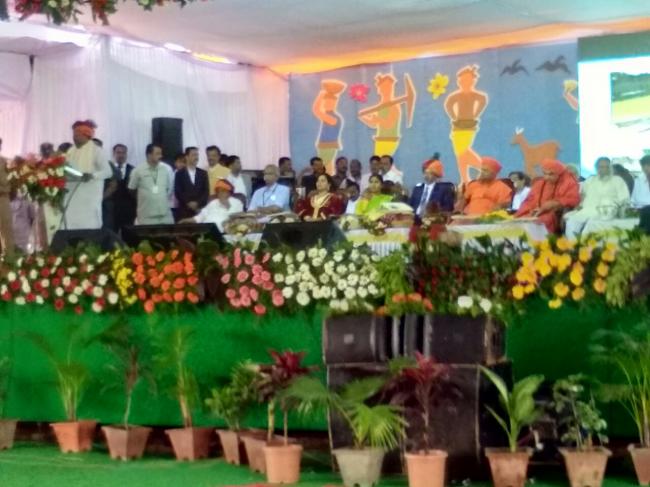
They converged here for three day deliberations to draft the Declaration at the National Convention for Drought Free India organized by the state Ministry of Water Resources & District Administration of Vijayapura as well as Singh’s Rashtriya Jal Biradari.
Karnataka Chief Minister K. Siddaramaiah, who released the Declaration in the presence of over 5000 people who had gathered here from different partso of the country and state, referred to the acute drought situation in Karnataka and endorsed the Covention’s demand that a ‘one day special session on the Vijayapura Declaration be held - at Niti Ayog, at a Parliament Session and in State Assemblies - to discuss and deliberate upon implementing its contents’.
He later tweeted: “I support the demand for an exclusive session of @NITIAayog to discuss the Vijayapura Declaration 2017, for water, food & livelihood security.”
The Vijayapura Declaration is the third major declaration adopted since February this year by water activists under the guidance of Dr. Rajendra Singh. The other two declarations were the Patna Declaration which was released by Bihar CM Nitish Kumar in Patna in February that called for holding further deliberations on siltation issues to ensure incessant flow of river Ganga. Subsequently the Delhi Declaration, released in May, called for formulation of a comprehensive National Silt Management Policy for Himalayan and alluvial rivers, as well as review of the Farakka barrage on river Ganga.
Singh termed Vijayapura as the Water Heritage City of the country. The Adil Shahis of Bijapur (Vijayapura) Sultanate (1490-1686) were recognized for excellent water management and conservation works. The Vijayapura Declaration states that “Water security alone will ensure food & livelihood security & mankind’s resilience in the face of climate change.”
Among other things, the Vijayapura Resolution resolved to
a) See the river as ‘a natural resource for the basin-population to protect and share’;
b) Form a National Water Literacy Mission to make school & college students water-sensitive and skilled in water-conservation under the Skill India Mission;
c) Free the river from pollution, exploitation, and encroachment and act against the sand-mining mafia. It demanded the government ensure continuous ecological flow of the river – “People must stop filling up nalas/small streams to create land.”
Besides, the resolution sought separate land and water-rights to ensure equity in ground-water distribution. Water conflicts must be resolved through river-basin-parliament dialogue before approaching courts and tribunals,”it stated and termed Government handing over control & ownership of water to private hands as “unconstitutional and illegal”.
It called for preventing droughts and floods in the river basin through aforestation & improved soil and water conservation.
Support Our Journalism
We cannot do without you.. your contribution supports unbiased journalism
IBNS is not driven by any ism- not wokeism, not racism, not skewed secularism, not hyper right-wing or left liberal ideals, nor by any hardline religious beliefs or hyper nationalism. We want to serve you good old objective news, as they are. We do not judge or preach. We let people decide for themselves. We only try to present factual and well-sourced news.
Support objective journalism for a small contribution.


