


Simple urine test could improve early detection of bladder cancer – WHO study
New York/IBNS: A new study conducted by researchers from the United Nations health agency revealed that bladder cancer mutations can be detected in urine up to 10 years before clinically diagnosing the disease.
The test is based on detecting mutations in the telomerase reverse transcriptase (TERT) gene – a crucial element for cancer genesis and progression – the most common mutations in bladder cancer, according to the report conducted by the UN World Health Organization’s (WHO) International Agency for Research on Cancer (IARC) and international partners.
The new evidence is detailed in an article published by The Lancet, which highlights the potential of early detection.
“A simple urine test has recently been developed, and these new results are another exciting step towards the validation of a non-invasive early detection tool,” maintained Florence Le Calvez-Kelm, IARC scientist and principal investigator of the study.
“This test could significantly improve and simplify the way in which bladder cancer is detected.”
This test could significantly improve and simplify the way in which bladder cancer is detecte – IARC scientist
A possible game-changing breakthrough
Because there is a lack of evidence on early detection efficiency, urine tests are not currently recommended by urological societies – relegating the diagnosis of bladder cancer to relying largely on invasive and expensive procedures, such as cystoscopy.
In this context, the ability to detect the TERT mutations in pre-diagnostic urine samples may also offer cost-effective screening to those at high risk of developing the disease.
Breaking down the science
To assess the test’s ability to detect the mutations in urine samples before any clinical symptoms of bladder cancer occur, IARC researchers collaborated with the Tehran University of Medical Sciences in Iran and the United States National Cancer Institute to design a unique pilot study within the Golestan Cohort Study.
Their evaluation of the performance of TERT promoter mutations as early detection biomarkers for bladder cancer in urine samples revealed detection in 46.7 per cent of the asymptomatic individuals who later developed bladder cancer. And this was up to 10 years before being clinically diagnosed.
“Our results provide the first evidence from a prospective population-based cohort study of the potential of urinary TERT promoter mutations as promising non-invasive biomarkers for the early detection of bladder cancer,” the study’s co-first author Ismail Hosen said.
IARC scientists are now collaborating with other large prospective cohort studies to confirm these findings.
“If the findings are validated, large trials conducted in individuals at high risk of developing bladder cancer should be designed to address the health and cost benefits of screening for TERT promoter mutations for the global bladder cancer burden,” says Mahdi Sheikh, a postdoctoral scientist at IARC and the co-first author of the study.
Photo caption and credit:
UNICEF/Karel Prinsloo
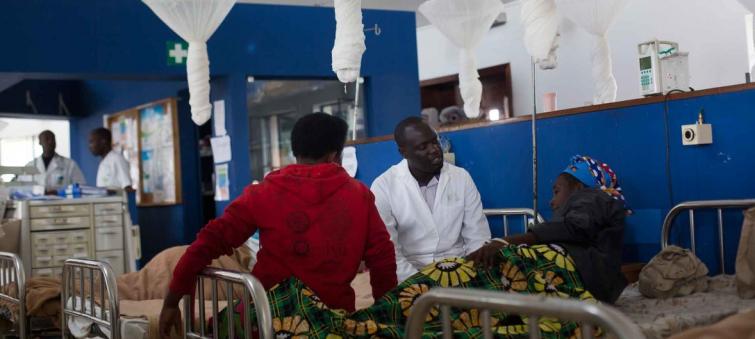
A nurse chats with a woman receiving chemotherapy in a hospital in Burera District, Rwanda.
Support Our Journalism
We cannot do without you.. your contribution supports unbiased journalism
IBNS is not driven by any ism- not wokeism, not racism, not skewed secularism, not hyper right-wing or left liberal ideals, nor by any hardline religious beliefs or hyper nationalism. We want to serve you good old objective news, as they are. We do not judge or preach. We let people decide for themselves. We only try to present factual and well-sourced news.
Support objective journalism for a small contribution.


