


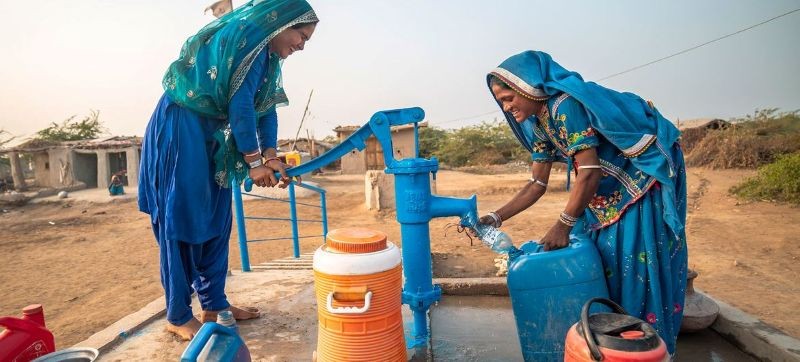
 Drinking water
One in four still lacks access to safe drinking water and sanitation: UN report
Despite progress over the past decade, billions worldwide still lack access to safe drinking water, sanitation, and hygiene, leaving them vulnerable to disease and social exclusion, according to a UN report released on Tuesday.
The report from the World Health Organization (WHO) and children’s agency (UNICEF) issued as World Water Week gets underway, highlights persistent gaps in access, with vulnerable communities facing the greatest disparities.
Some 2.1 billion people still lack access to safely managed drinking water, while 106 million worldwide are forced to rely on untreated surface sources.
“Water, sanitation and hygiene are not privileges, they are basic human rights,” said Ruediger Krech, Director of WHO’s Environment, Climate Change and Health Department.
Clear disparities
The report finds that people in least developed countries are more than twice as likely as people in other countries to lack basic drinking water and sanitation services, and over three times as likely to go without basic hygiene.
“These inequalities are especially stark for girls who often bear the burden of water collection and face additional barriers during menstruation,” said Cecilia Scharp, UNICEF’s head of water, sanitation and hygiene services.
Data from 70 countries reveal that while most women and adolescent girls have menstrual materials and a private place to change, many still lack sufficient supplies to manage their needs safely and with dignity.
‘We must act faster’
Some 1.7 billion people still lack basic hygiene services at home, including 611 million with no facilities at all.
“We must accelerate action, especially for the most marginalised communities, if we are to keep our promise to reach the Sustainable Development Goals,” said Krech.
“At the current pace, the promise of safe water and sanitation for every child is slipping further from reach – reminding us that we must act faster and more boldly to reach those who need it most,” said Scharp.
Support Our Journalism
We cannot do without you.. your contribution supports unbiased journalism
IBNS is not driven by any ism- not wokeism, not racism, not skewed secularism, not hyper right-wing or left liberal ideals, nor by any hardline religious beliefs or hyper nationalism. We want to serve you good old objective news, as they are. We do not judge or preach. We let people decide for themselves. We only try to present factual and well-sourced news.
Support objective journalism for a small contribution.


