 El Nino
Brace for Impact: Massive El Niño event likely in 2026, scientists warn
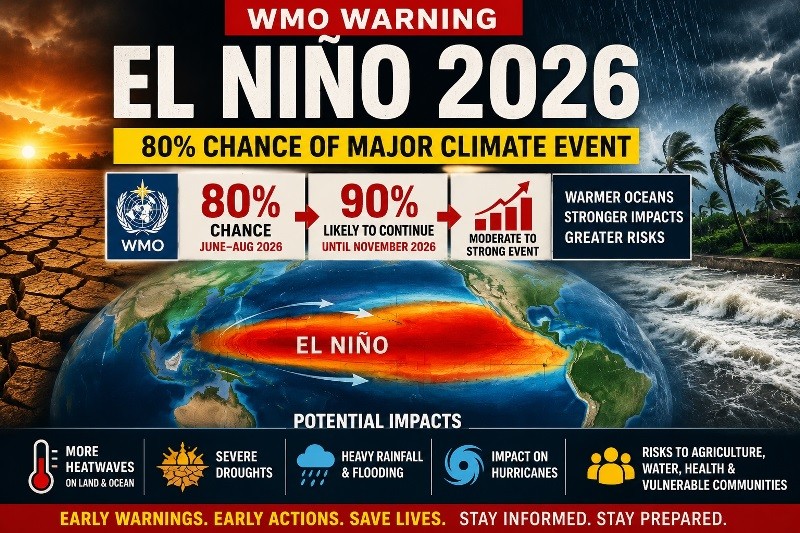
A new World Meteorological Organization (WMO) El Niño/La Niña update indicates an approximately 80% probability of an El Niño event developing during June–August 2026, with the likelihood rising to around or above 90% through at least November.
While some uncertainty remains regarding the timing and peak intensity, most climate models suggest the event will likely reach moderate to potentially strong strength.
The WMO update, regarded as one of the most authoritative global climate outlooks, is based on a consensus of forecasts from leading global producing centres, national meteorological and hydrological services, and international climate research institutions, in collaboration with the International Research Institute for Climate and Society (IRI).
United Nations Secretary-General António Guterres warned that El Niño conditions are expected to arrive in the coming months, describing it as a significant climate signal that could intensify global warming impacts.
He stressed the need for urgent climate action, including accelerated renewable energy adoption, protection of vulnerable populations, and strengthened early warning systems.
Recent ocean observations show sea-surface temperatures in the central and eastern equatorial Pacific approaching El Niño thresholds. These warming conditions are being reinforced by unusually warm subsurface waters, with anomalies exceeding 6°C above average, creating a substantial reservoir of heat that is contributing to surface warming.
In addition, the Southern Oscillation Index—an atmospheric indicator of El Niño development—also aligns with emerging El Niño conditions.
WMO Secretary-General Celeste Saulo noted that preparations should be made for a potentially strong event, warning that El Niño can intensify droughts, heavy rainfall, heatwaves, and ocean warming. She highlighted that the previous 2023–24 El Niño event was among the strongest on record and contributed to record global temperatures in 2024.
She further emphasized the importance of continuous monitoring and early warning systems to support governments, humanitarian agencies, and climate-sensitive sectors in reducing risk and economic impact.
El Niño and La Niña represent opposite phases of the El Niño–Southern Oscillation (ENSO), one of the most influential natural climate patterns on Earth. El Niño is characterized by warming of ocean surface temperatures in the central and eastern equatorial Pacific and typically occurs every two to seven years, lasting around nine to twelve months.
Events generally begin developing between March and June and peak between November and February, with global climate impacts often extending into the following year. The intensity, duration, and timing of El Niño events determine regional impacts, which vary widely across the globe.
Typically, El Niño is associated with increased rainfall in parts of southern South America, the southern United States, the Horn of Africa, and central Asia, while bringing drier conditions to Central America, northern South America, the Caribbean, Australia, Indonesia, and parts of South Asia.
During the boreal summer, El Niño conditions can enhance hurricane activity in the central and eastern Pacific while suppressing Atlantic hurricane formation. As a result, the US National Oceanic and Atmospheric Administration (NOAA) has forecast a below-normal Atlantic hurricane season.
Regional climate outlook forums indicate varying impacts, including below-normal rainfall in parts of the Greater Horn of Africa, weaker monsoon conditions in South Asia, and warmer and drier conditions across Central America.
The WMO’s complementary Global Seasonal Climate Update also incorporates other climate drivers such as the North Atlantic Oscillation, the Southern Annular Mode, and the Indian Ocean Dipole, which may align with El Niño conditions and influence regional climate patterns.
For the June–August period, forecasts suggest a near-global dominance of above-normal temperatures, increasing risks of heat stress, drought development, and compounding climate hazards in vulnerable regions.
Rainfall patterns consistent with El Niño are expected to increase the likelihood of extreme weather events, including both heavy rainfall and flooding in some areas, and prolonged dry conditions and drought in others.
WMO continues to emphasize that even moderate El Niño events can significantly increase the risk of climate extremes, underscoring the importance of preparedness and early warning systems worldwide.
Support Our Journalism
We cannot do without you.. your contribution supports unbiased journalism
IBNS is not driven by any ism- not wokeism, not racism, not skewed secularism, not hyper right-wing or left liberal ideals, nor by any hardline religious beliefs or hyper nationalism. We want to serve you good old objective news, as they are. We do not judge or preach. We let people decide for themselves. We only try to present factual and well-sourced news.
Support objective journalism for a small contribution.