 12 Cheetahs
Madhya Pradesh: Second batch of 12 cheetahs released to Kuno National Park
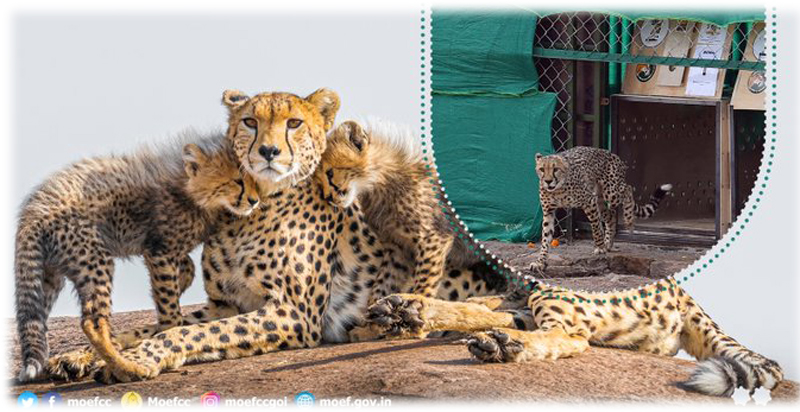
Indore: The second batch of 12 cheetahs, which were brought to India from South Africa, were released to the Kuno National Park in Madhya Pradesh on Saturday.
Madhya Pradesh CM Shivraj Singh Chouhan, who released the cheetahs, described the arrival of animals to the state as a 'historical' moment.
The cheetah will join eight of the mammals relocated to India’s Kuno National Park from Namibia in September 2022.
चीतों का आना एक ऐतिहासिक घटना है, सारा देश इसका साक्षी बन रहा है। पूरा मध्यप्रदेश प्रसन्नता और उत्साह के साथ चीतों का स्वागत कर रहा है। चारों ओर उत्सव का वातावरण है। सभी देशवासियों को इस अद्भुत और अनुपम क्षण के लिए बधाई! https://t.co/250P5wXDlQ#MPWelcomesCheetah#CheetahStateMP pic.twitter.com/opJnK73atF
— Shivraj Singh Chouhan (@ChouhanShivraj) February 18, 2023
Earlier this year, the governments of South Africa and India signed a Memorandum of Understanding (MoU) on Cooperation on the Re-introduction of Cheetah to India.
The MoU facilitates cooperation between the two countries to establish a viable and secure cheetah population in India; promotes conservation and ensures that expertise is shared and exchanged, and capacity built, to promote cheetah conservation.
This includes human-wildlife conflict resolution, capture and translocation of wildlife and community participation in conservation in the two countries.
Conservation translocations have become a common practice to conserve species and restore ecosystems. South Africa plays an active role in providing founders for the population and range expansion of iconic species such as cheetahs.
“It is because of South Africa’s successful conservation practices that our country is able to participate in a project such as this - to restore a species in a former range state and thus contribute to the future survival of the species,” said the Minister of Forestry, Fisheries and the Environment, Barbara Creecy.
The Cheetah, Acinonyx jubatus, is the world’s fastest mammal, and is endemic to the savannahs of Africa.
The cheetah was declared extinct in India in 1952.
#WelcomeHome
— Indian Air Force (@IAF_MCC) February 18, 2023
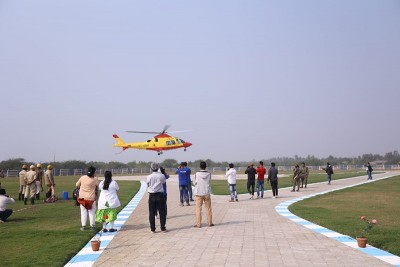
An #IAF C-17 aircraft carrying the second batch of 12 #Cheetahs landed at AF Station Gwalior today, after a 10 hour flight from Johannesburg, South Africa.
These Cheetahs will now be airlifted in IAF helicopters and released in the #KunoNationalPark. pic.twitter.com/Pk0YXcDtAV
Restoring cheetah populations is considered by India to have vital and far-reaching conservation consequences, which would aim to achieve a number of ecological objectives, including re-establishing the function role of cheetah within their historical range in India and improving the enhancing the livelihood options and economies of the local communities.
Following the import of the 12 cheetahs in February, the plan is to translocate a further 12 annually for the next eight to 10 years. Scientific assessments will be undertaken periodically to inform such translocations.
Worldwide, cheetah numbers have declined from an estimated 15 000 adults in 1975 to a current global population of less than 7 000 individuals.
In South Africa, the transition to democracy had substantial implications for wild cheetah conservation.
The Game Theft Act (No. 105 of 1991) was responsible for a major change in land use from agriculture to ecotourism.
Since 1994 cheetahs have been reintroduced into 63 newly established game reserves that currently support a combined metapopulation of 460 individuals.
The Department of Fisheries, Forestry and the Environment has approved the export of up to 29 wild cheetah per annum to support conservation efforts for the species outside of the country.
Support Our Journalism
We cannot do without you.. your contribution supports unbiased journalism
IBNS is not driven by any ism- not wokeism, not racism, not skewed secularism, not hyper right-wing or left liberal ideals, nor by any hardline religious beliefs or hyper nationalism. We want to serve you good old objective news, as they are. We do not judge or preach. We let people decide for themselves. We only try to present factual and well-sourced news.
Support objective journalism for a small contribution.