


 Health Expenses
Increase health expenditure to 5% of GDP to fight Covid-19: Expert
Kolkata, Sep 02 (UNI) Overall public expenditure should be increased to at least 5 percent of GDP as India is witnessing the highest number of Covid cases in the world, an expert observed today.
'India has been witnessing the highest number of new Covid cases in the world in the last couple of days and so public health care should be significantly strengthened and enhanced with overall public expenditure to be increased to at least 5 percent of the GDP,' Dr. Naresh Purohit, Epidemiologist and Visiting Professor at the Kolkata based West Bengal University of Health Sciences, School of Public Health told UNI here.
'The focus of increased health expenditure should be on primary healthcare and human resource and infrastructure strengthening rather than opening and strengthening tertiary care centers.The ongoing pandemic is fast worsening existing health inequities. It is not a law and order problem and should be dealt with empathy and meaningful community engagement,' Dr. Purohit said.
The way forward needs to take into account contextual constraints and community interests and design optimal interventions that require technical competence blended with good judgment, clarity, and trust, he maintained.
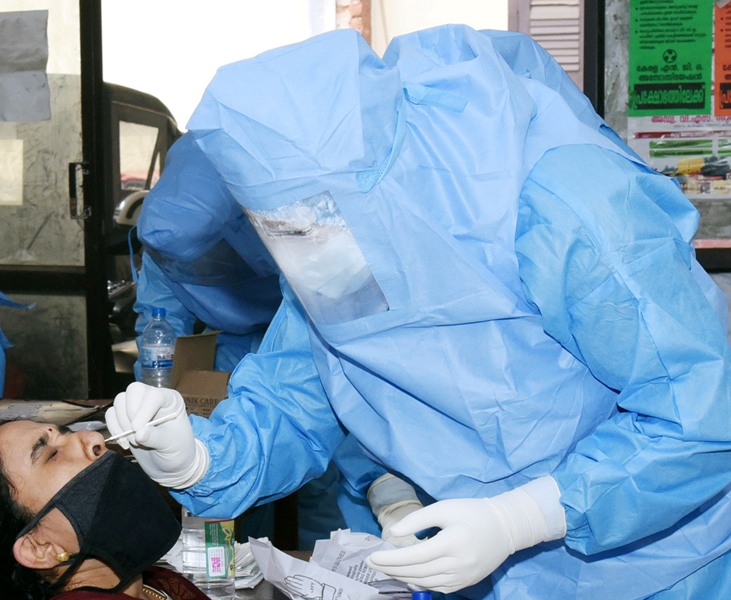
'The testing strategy needs to be pragmatic from a public health perspective, promoting differential targeted testing of high-risk individuals and discontinuing universal testing at this stage,' Dr. Naresh Purohit told this correspondent over the phone.
'We must avoid a false sense of hope that this panacea will be controlled by an effective vaccine will be available in the near future. A vaccine has no role in current ongoing pandemic control. However, whenever available, the vaccine may play a role in providing personal protection to high-risk individuals like health care workers and the elderly with co-morbidities,' he pointed out.
Speaking against lockdowns the renowned physician said, "Lockdown as a strategy for control should be discontinued. Geographically limited restrictions for short periods may be imposed in epidemiologically defined clusters. Cluster restrictions should be considered only in areas with no community transmission."
Incidentally, the West Bengal government has been implementing lockdowns to break the Covid chain following the advice of experts.
Even cluster restrictions should be imposed after weighing the impact of the same on the livelihood of the target population.
With adequate health system preparedness, including facility care for severe cases, cluster restrictions can be totally done away with and should be the ideal way to address this pandemic, Dr. Purohit observed.
'In metro cities where there already has been a substantial spread of viral infection, there is no advantage of creating containment zones and aggressive testing. The focus should be to prevent deaths from coronavirus and not on containing the infection,' he said.
Dr. Purohit, who is an executive member of the Indian Federation of Hospital Administrators, pointed out that the primary, secondary, and tertiary health care services, including outpatient and inpatient services and routine and emergency surgeries, should resume as early as possible, in at least those areas that are progressing towards higher levels of immunity and in towns and districts with no coronavirus cases.
'Adequate safety measures should be put in place for the safety of the health care staff engaged with optimal PPE and testing of patients for coronavirus as may be appropriate,' he said.
Dr. Purohit said that national-level sero-surveillance surveys need to be undertaken to monitor the pandemic and modify the control strategies accordingly.
He stated that in the future, the use of an already existing sero-surveillance platform could be a cost-effective way to do sero-surveillance. All the sero-surveillance must be supervised by a trained public health specialist (MD Community Medicine) from local medical colleges, and public health institutions.
Support Our Journalism
We cannot do without you.. your contribution supports unbiased journalism
IBNS is not driven by any ism- not wokeism, not racism, not skewed secularism, not hyper right-wing or left liberal ideals, nor by any hardline religious beliefs or hyper nationalism. We want to serve you good old objective news, as they are. We do not judge or preach. We let people decide for themselves. We only try to present factual and well-sourced news.
Support objective journalism for a small contribution.


