
December 13, 2025 06:50 pm (IST)
Follow us:
facebook-white sharing button
twitter-white sharing button
instagram-white sharing button
youtube-white sharing button
Caught in Thailand! Fugitive Goa nightclub owners detained after deadly fire kills 25 | After Putin’s blockbuster Delhi visit, Modi set to host German Chancellor Friedrich Merz in January | Delhi High Court slams govt, orders swift compensation as IndiGo crisis triggers fare shock and nationwide chaos | Amazon drops a massive $35 billion India bet! AI push, 1 million jobs and big plans revealed at Smbhav Summit | IndiGo’s ‘All OK’ claim falls apart! Govt slaps 10% flight cut after weeklong chaos | Centre finally aligns IndiGo flights with airline's operating ability, cuts its winter schedule by 5% | Odisha's Malkangiri in flames: Tribals rampage Bangladeshi settlers village after beheading horror! | Race against time! Indian Navy sends four more warships to Cyclone Ditwah-hit Sri Lanka | $2 billion mega deal! HD Hyundai to build shipyard in Tamil Nadu — a game changer for India | After 8 years of legal drama, Malayalam actor Dileep acquitted in 2017 rape case — what really happened?

Hubble uncovers a mysterious Hermit

| | Jun 11, 2016, at 02:50 pm
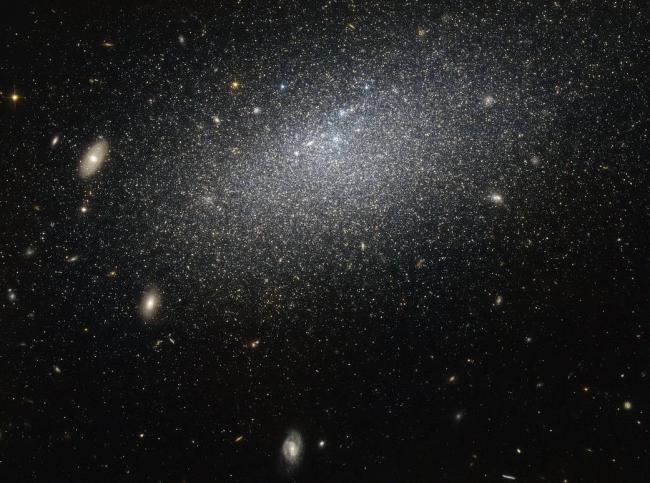
Washington, June 11 (IBNS): The drizzle of stars scattered across this image forms a galaxy known as UGC 4879. UGC 4879 is an irregular dwarf galaxy — as the name suggests, galaxies of this type are a little smaller and messier than their cosmic cousins, lacking the majestic swirl of a spiral or the coherence of an elliptical.

This galaxy is also very isolated. There are about 2.3 million light years between UGC 4879 and its closest neighbor, Leo A, which is about the same distance as that between the Andromeda Galaxy and the Milky Way, read the NASA website.

This galaxy’s isolation means that it has not interacted with any surrounding galaxies, making it an ideal laboratory for studying star formation uncomplicated by interactions with other galaxies. Studies of UGC 4879 have revealed a significant amount of star formation in the first 4 billion years after the Big Bang, followed by a strange 9-billion-year lull in star formation that ended 1 billion years ago by a more recent re-ignition.

The reason for this behavior, however, remains mysterious, and the solitary galaxy continues to provide ample study material for astronomers looking to understand the complex mysteries of star birth throughout the universe.

Image credit: NASA/ESA

Support Our Journalism

We cannot do without you.. your contribution supports unbiased journalism

IBNS is not driven by any ism- not wokeism, not racism, not skewed secularism, not hyper right-wing or left liberal ideals, nor by any hardline religious beliefs or hyper nationalism. We want to serve you good old objective news, as they are. We do not judge or preach. We let people decide for themselves. We only try to present factual and well-sourced news.

Support objective journalism for a small contribution.


