


 Clean Energy
Breakthrough alert: Indians scientists develop ultra-efficient thermal battery for clean energy storage
Indian researchers have developed a cost-effective, efficient thermal energy storage material that can significantly improve the efficiency of thermal batteries used in concentrated solar power plants and industrial waste heat recovery systems.
Effective thermal energy storage (TES) systems are essential for efficient utilization of concentrated solar power (CSP) and capturing industrial waste heat. Scientists are trying to develop materials with enhanced specific heat capacity, thermal conductivity, and operating temperature range for improved performance of the TES system.
Researchers at the International Advanced Research Centre for Powder Metallurgy and New Materials (ARCI), an autonomous institution of the Department of Science and Technology (DST) have developed a cost-effective, scalable process to produce spinel nano composite Phase Change Material (PCM) with an unprecedented increase in specific heat capacity for thermal energy storage applications.
The process developed by ARCI team led by Dr. Mani Karthik, employs a simple co-precipitation method to produce spinel-type metal oxide nanoparticles with controlled particle size. These nanomaterials exhibited excellent thermal stability and uniform dispersion, making them suitable for producing high-performance nanocomposite PCM.
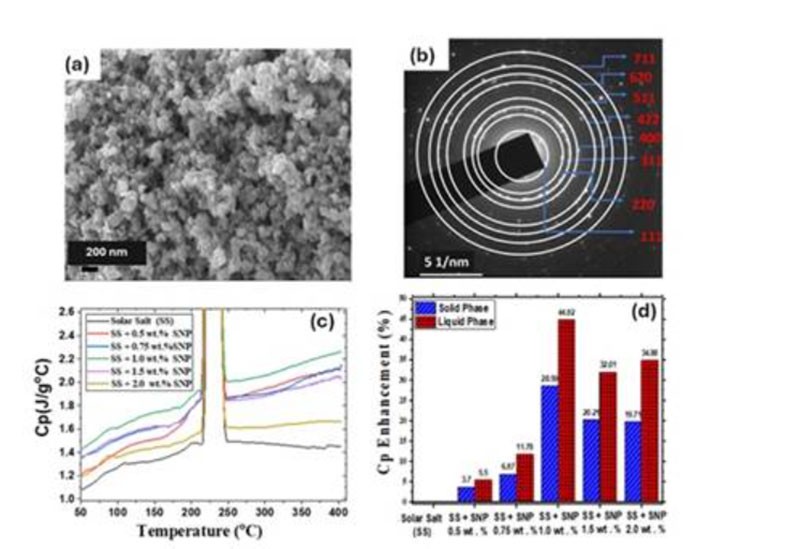
By the addition of only 1% spinel oxide nanoparticles to the PCM, the nanocomposite phase change material showed a remarkable increase in the specific heat capacity (ability to store the thermal energy) as high as 45% when compared to the PCM without nanocomposites.
When these nanoparticles are well dispersed in the PCM, they significantly improve its thermal properties by increasing the specific surface area. This leads to the formation of a stable spinel oxide layer at the interface, which increases surface energy and contributes to the nanocomposite's higher specific heat capacity compared to the base PCM.
As a result, the material can store more thermal energy per unit mass, improving energy storage efficiency. This improvement results in smaller storage tanks with reduced construction materials, which significantly lowers both capital and operational costs.
Overall, this development offers a compact and cost‑effective thermal energy storage solution, paving the way for next‑generation materials with superior performance.
This research published in the Materials Today Chemistry (Elsevier) aligns with India’s clean energy objectives and the Aatma Nirbhar Bharat initiative by advancing indigenous expertise in next-generation energy storage materials. Furthermore, the superior thermal capacity of these materials enables the development of more compact, high-performance, and cost-efficient thermal energy storage systems.
Support Our Journalism
We cannot do without you.. your contribution supports unbiased journalism
IBNS is not driven by any ism- not wokeism, not racism, not skewed secularism, not hyper right-wing or left liberal ideals, nor by any hardline religious beliefs or hyper nationalism. We want to serve you good old objective news, as they are. We do not judge or preach. We let people decide for themselves. We only try to present factual and well-sourced news.
Support objective journalism for a small contribution.


