Holi 2025 to coincide with a total lunar eclipse, but India will miss the spectacle
New Delhi: The vibrant festivities of Holi on March 14 will coincide with a rare celestial phenomenon—a total lunar eclipse.
Holi, celebrated for its colours and the victory of good over evil, will have an added cosmic spectacle as the full moon undergoes a total eclipse on the same day.
A total lunar eclipse occurs when the Earth aligns between the Sun and the Moon, casting its shadow across the lunar surface.
This event will be visible in several parts of the world, offering a captivating experience for sky gazers.
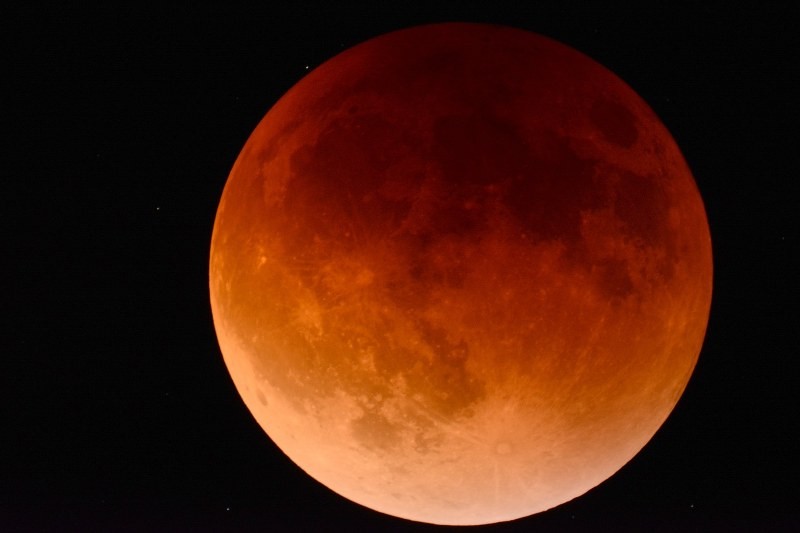
NASA states that this type of eclipse is often referred to as a "blood moon" because the Moon can take on a reddish-orange hue during totality.
This colouring happens as sunlight passes through Earth's atmosphere before reaching the Moon.
Shorter wavelengths, like blue and violet, are scattered and do not reach the lunar surface, while longer wavelengths, such as red and orange, illuminate it.
Consequently, the presence of more atmospheric elements—such as clouds or dust—intensifies the Moon’s red appearance during the eclipse.
"Keep a close eye on the weather forecast leading up to the eclipse," said NASA Chief Scientist Renee Weber in a statement. "That totality will last for close to an hour, so even if it's cloudy, you may still be able to glimpse it if the clouds are scattered."
Where will the eclipse be visible?
The total lunar eclipse will be visible across North and South America, Western Europe, and Western Africa. Prime viewing locations include New York, Los Angeles, Paris, and Madrid.
Some cities that will witness at least a part of the total lunar eclipse include Casablanca, Dublin, Lisbon, Honolulu, São Paulo, Buenos Aires, Guatemala City, Rio de Janeiro, Toronto, Caracas, and Mexico City. The duration of the eclipse is expected to be around 65 minutes.
Meanwhile, a partial lunar eclipse will be visible from cities such as Cairo, Athens, Warsaw, Berlin, London, Madrid, Sydney, Tokyo, and Seoul.
Will India witness the eclipse?
Unfortunately, skywatchers in India will miss out on the total lunar eclipse, as it will occur during daylight hours in the region.
While India won’t experience this Blood Moon event, it remains a significant astronomical occurrence, aligning celestial wonder with cultural celebrations worldwide.
Support Our Journalism
We cannot do without you.. your contribution supports unbiased journalism
IBNS is not driven by any ism- not wokeism, not racism, not skewed secularism, not hyper right-wing or left liberal ideals, nor by any hardline religious beliefs or hyper nationalism. We want to serve you good old objective news, as they are. We do not judge or preach. We let people decide for themselves. We only try to present factual and well-sourced news.
Support objective journalism for a small contribution.