Forensics uncover planetary disks in NASA archive
If astronomers initially miss something in their review of data, they can make new discoveries by revisiting earlier data with new image processing techniques, thanks to the wealth of information stored in the Hubble data archive. This is what Rémi Soummer, of the Space Telescope Science Institute (STScI) in Baltimore, Md., and his team recently did while on a hunt for hidden Hubble treasures.
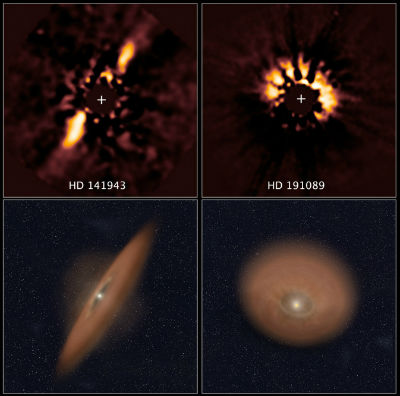
Recently, with improvements in image processing, including algorithms used for face-recognition software, Soummer and his team reanalyzed the archived images. This time, they could unequivocally see the debris disks and even determine their shapes.
"Now, with such new technologies in image processing, we can go back to the archive and conduct research more precisely than previously possible with NICMOS data," said Dean Hines of STScI.
The dust in the disks is hypothesized to be produced by collisions between small planetary bodies such as asteroids. The debris disks are composed of dust particles formed from these grinding collisions. The tiniest particles are constantly blown outward by radiation pressure from the star. This means they must be replenished continuously though more collisions. This game of bumper cars was common in the solar system 4.5 billion years ago. Earth's moon and the satellite system around Pluto are considered to be collisional byproducts.
Hubble found the star exhibits an asymmetrical, edge-on disk. This asymmetry could be evidence the disk is being gravitationally sculpted by the tug of one or more unseen planets.
"We also are working to implement the same techniques as a standard processing method for NASA's upcoming James Webb Space Telescope," said STScI teammate Laurent Pueyo. "These disks will also be prime targets for the Webb telescope."
The Hubble Space Telescope is a project of international cooperation between NASA and the European Space Agency. NASA's Goddard Space Flight Center in Greenbelt, Md., manages the telescope. STScI in Baltimore conducts Hubble science operations. STScI is operated for NASA by the Association of Universities for Research in Astronomy, Inc., in Washington.
Support Our Journalism
We cannot do without you.. your contribution supports unbiased journalism
IBNS is not driven by any ism- not wokeism, not racism, not skewed secularism, not hyper right-wing or left liberal ideals, nor by any hardline religious beliefs or hyper nationalism. We want to serve you good old objective news, as they are. We do not judge or preach. We let people decide for themselves. We only try to present factual and well-sourced news.
Support objective journalism for a small contribution.