 Schools
Coronavirus and schools: Access to handwashing facilities key for safe reopening
New York: Nearly 820 million children worldwide do not have basic handwashing facilities at school, putting them at increased risk of COVID-19 and other transmittable diseases, according to a report published on Thursday by the World Health Organization (WHO) and the UN Children’s Fund, UNICEF.
“Access to water, sanitation and hygiene services is essential for effective infection prevention and control in all settings, including schools", said Tedros Adhanom Ghebreyesus, the WHO Director-General.
“It must be a major focus of government strategies for the safe reopening and operation of schools during the ongoing COVID-19 global pandemic.”
Historic disruption to education
COVID-19 has created the largest disruption to education ever recorded, affecting nearly 1.6 billion students in more than 190 countries, according to UN data.
The study found that last year, 43 per cent of schools globally lacked access to basic handwashing with soap and water: a key condition for schools to be able to operate safely in the midst of the pandemic.
Of the roughly 818 million children worldwide who lack basic handwashing facilities at school, more than one third are in sub-Saharan Africa.
In the 60 countries at highest risk of health and humanitarian crises due to the virus, three-quarters of children lacked the basic ability to wash their hands at school at the start of the outbreak, while half lacked basic water service.
Balancing act for governments
The report stressed that governments seeking to control coronavirus spread must balance the need for implementing public health measures against the social and economic impacts of lockdown measures.
The partners said evidence of the negative impacts of prolonged school closures on children has been well documented.
“Global school closures since the onset of the COVID-19 pandemic have presented an unprecedented challenge to children’s education and wellbeing”, said Henrietta Fore, UNICEF Executive Director. “We must prioritize children’s learning. This means making sure that schools are safe to reopen – including with access to hand hygiene, clean drinking water and safe sanitation.”
Solutions for safe return
The report identifies resources for COVID-19 prevention and control in schools, including 10 immediate actions and safety checklists.
It builds on guidelines on the safe reopening of schools issued in April by UNICEF and partners, geared towards national and local authorities.
The guidelines include several protocols on hygiene measures, use of personal protective equipment, cleaning and disinfection, as well as providing access to clean water, handwashing stations with soap, and safe toilets.
UNICEF and WHO underlined their commitment to achieving equitable access to adequate water, sanitation and hygience services worldwide, including through the Hand Hygiene for All initiative that supports vulnerable communities.
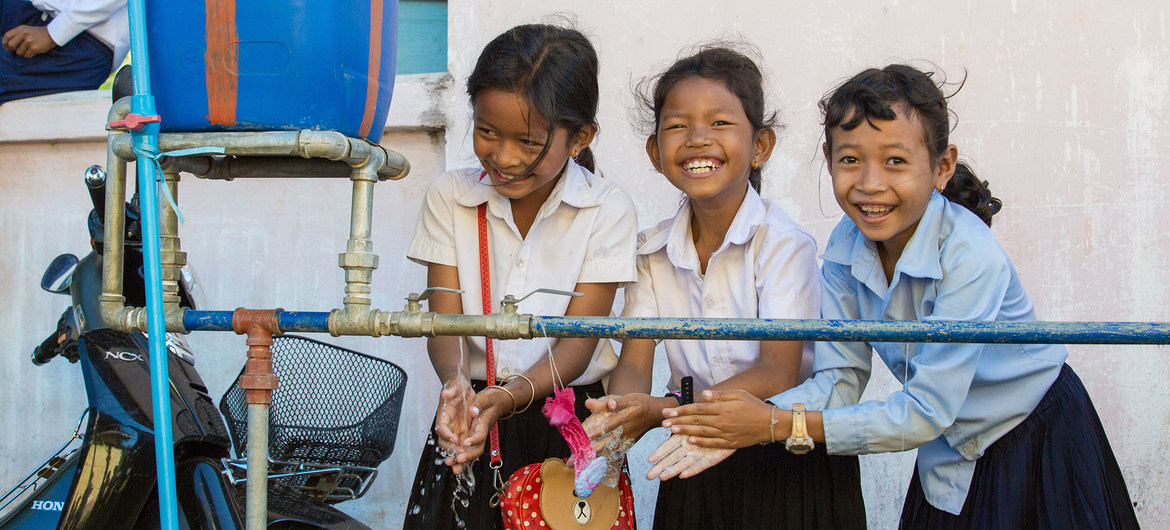
Photo caption and credit: UNICEF/Bona Khoy
Girls at a school in Cambodia wash their hands using water from a school WASH facility.
Support Our Journalism
We cannot do without you.. your contribution supports unbiased journalism
IBNS is not driven by any ism- not wokeism, not racism, not skewed secularism, not hyper right-wing or left liberal ideals, nor by any hardline religious beliefs or hyper nationalism. We want to serve you good old objective news, as they are. We do not judge or preach. We let people decide for themselves. We only try to present factual and well-sourced news.
Support objective journalism for a small contribution.