


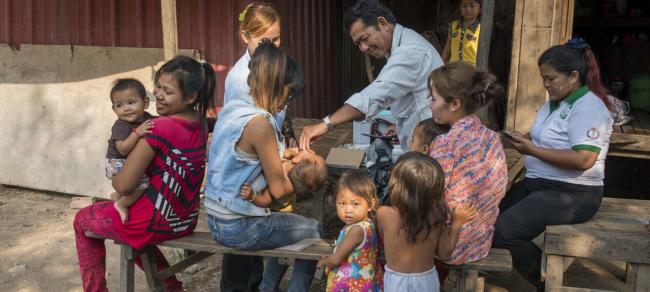
Action needed to find, test, treat millions unknowingly infected with viral hepatitis – UN health agency
New York, July 28 (IBNS): Millions of people globally who have viral hepatitis are unaware or unable to receive treatment, the United Nations health agency said Friday, on the eve of World Hepatitis Day, raising the alarm to “find, test and treat the missing millions.”
Both worldwide and in the South-East Asia Region, less than one-in-10 infected people are estimated to know their status, while less than 10 per cent of those who do know are actually receiving treatment, according to the World Health Organization (WHO).
“This lack of awareness and treatment leads to progressive liver damage and can cause life-threatening conditions, such as fibrosis and liver cancer, resulting in an estimated 410,000 deaths in the Region every year,” said Poonam Khetrapal Singh, WHO Regional Director for South-East Asia.
“It also allows viral hepatitis to spread: Region-wide, an estimated 40 million people live with chronic hepatitis B while an estimated 10 million live with chronic hepatitis C,” she added.
Pointing out that “urgent action is needed to find, test and treat the missing millions,” she highlighted the agency’s Regional Action Plan, which aims to expand the number of people aware of their status to 50 per cent, with at least 75 per cent of those diagnosed with the disease, receiving treatment by 2020.
Greater awareness among the public and high-risk groups is key to eliminating the viral hepatitis health threat by 2030.
She urged health authorities region-wide to send clear messages on the disease’s signs and symptoms, where they can get tested and seek treatment, and how infection can be prevented – such as through hepatitis B vaccinations, practicing safe sex and safe needle usage.
The Regional Director underscored the importance of health workers having better access to quality diagnostics and affordable, quality-assured testing kits.
For people diagnosed with hepatitis B or C, she said “access to effective and affordable treatment is vital.”
World Hepatitis Day
“While treatments have existed for hepatitis B for some time, Directly-acting antiviral drugs can now cure hepatitis C in up to 95 per cent of cases,” she said, noting that dramatic reduction in cost.
World Hepatitis Day marked on Saturday, is focussing on raising awareness of the global burden of viral hepatitis as a major health problem in need of an urgent international response.
Marking World Hepatitis Day, the UN Office on Drugs and Crime (UNODC) called on people globally to take action to find the "missing millions," including intravenous drug users and people in prison.
“Every second person who injects drugs is living with hepatitis C,” said Yury Fedotov, UNODC Executive Director, indicating that women in this category have a 38 per cent higher risk of contracting hepatitis C than men.
“The prevalence of hepatitis B infection among people who inject drugs is 7.5 per cent,” he added.
Due to contaminated equipment and unsafe injection of drugs, along with other risk factors such as unsafe tattooing and skin piercing, a 2016 global review indicated that, of the estimated 10.4 million people incarcerated worldwide, 15.1 per cent have hepatitis C and 4.8 per cent have chronic hepatitis B.
UNICEF/UN060405/Llaurado
Support Our Journalism
We cannot do without you.. your contribution supports unbiased journalism
IBNS is not driven by any ism- not wokeism, not racism, not skewed secularism, not hyper right-wing or left liberal ideals, nor by any hardline religious beliefs or hyper nationalism. We want to serve you good old objective news, as they are. We do not judge or preach. We let people decide for themselves. We only try to present factual and well-sourced news.
Support objective journalism for a small contribution.


