


 Nobel Prize
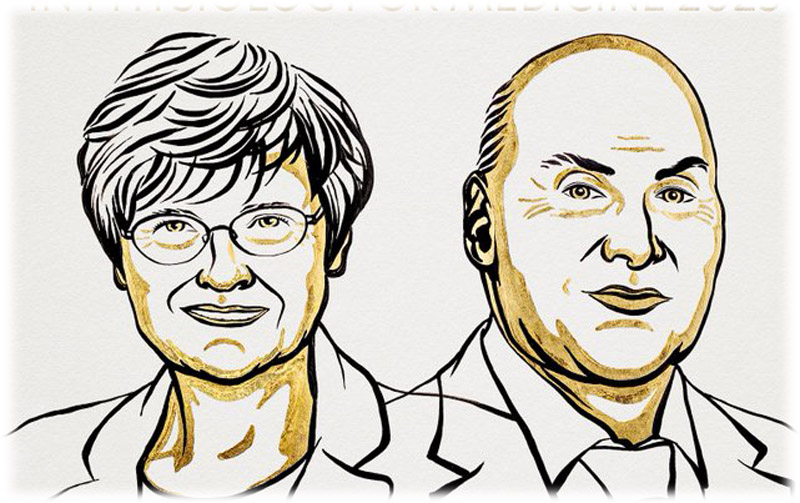
Katalin Kariko, Drew Weissman named Nobel Prize winners in medicine for their work in mRNA COVID-19 vaccines
Katalin Kariko and Drew Weissman got the Nobel Prize for Medicine for developing effective mRNA vaccines against COVID-19 since the pandemic started in 2020.
"Through their groundbreaking findings, which have fundamentally changed our understanding of how mRNA interacts with our immune system, the laureates contributed to the unprecedented rate of vaccine development during one of the greatest threats to human health in modern times," read a statement issued by the Nobel Assembly at Sweden’s Karolinska Institutet.
Karikó and Weissman noticed that dendritic cells recognize in vitro transcribed mRNA as a foreign substance, which leads to their activation and the release of inflammatory signaling molecules.
They wondered why the in vitro transcribed mRNA was recognized as foreign while mRNA from mammalian cells did not give rise to the same reaction. Karikó and Weissman realized that some critical properties must distinguish the different types of mRNA.
BREAKING NEWS
— The Nobel Prize (@NobelPrize) October 2, 2023
The 2023 #NobelPrize in Physiology or Medicine has been awarded to Katalin Karikó and Drew Weissman for their discoveries concerning nucleoside base modifications that enabled the development of effective mRNA vaccines against COVID-19. pic.twitter.com/Y62uJDlNMj
RNA contains four bases, abbreviated A, U, G, and C, corresponding to A, T, G, and C in DNA, the letters of the genetic code. Karikó and Weissman knew that bases in RNA from mammalian cells are frequently chemically modified, while in vitro transcribed mRNA is not.
They wondered if the absence of altered bases in the in vitro transcribed RNA could explain the unwanted inflammatory reaction.
To investigate this, they produced different variants of mRNA, each with unique chemical alterations in their bases, which they delivered to dendritic cells. The results were striking:
The inflammatory response was almost abolished when base modifications were included in the mRNA.
This was a paradigm change in our understanding of how cells recognize and respond to different forms of mRNA.
Karikó and Weissman immediately understood that their discovery had profound significance for using mRNA as therapy.
These seminal results were published in 2005, fifteen years before the COVID-19 pandemic.
In further studies published in 2008 and 2010, Karikó and Weissman showed that the delivery of mRNA generated with base modifications markedly increased protein production compared to unmodified mRNA.
The effect was due to the reduced activation of an enzyme that regulates protein production.
Through their discoveries that base modifications both reduced inflammatory responses and increased protein production, Karikó and Weissman had eliminated critical obstacles on the way to clinical applications of mRNA.
Interest in mRNA technology began to pick up, and in 2010, several companies were working on developing the method. Vaccines against Zika virus and MERS-CoV were pursued; the latter is closely related to SARS-CoV-2.
After the outbreak of the COVID-19 pandemic, two base-modified mRNA vaccines encoding the SARS-CoV-2 surface protein were developed at record speed.
Protective effects of around 95% were reported, and both vaccines were approved as early as December 2020.
Support Our Journalism
We cannot do without you.. your contribution supports unbiased journalism
IBNS is not driven by any ism- not wokeism, not racism, not skewed secularism, not hyper right-wing or left liberal ideals, nor by any hardline religious beliefs or hyper nationalism. We want to serve you good old objective news, as they are. We do not judge or preach. We let people decide for themselves. We only try to present factual and well-sourced news.
Support objective journalism for a small contribution.


