Uber commissioned BCG report says Indian cities are 149% more congested than comparable cities around Asia
Kolkata, Apr 18 (IBNS): Uber on Thursday released the findings of a BCG study “Unlocking Cities: The impact of ridesharing across India”.
The 40-page report was commissioned to better understand the benefits and potential of ridesharing in Delhi, Kolkata, Mumbai and Bangalore.
"Congestion in Indian cities is among the highest in the world. Peak congestion averages 149%. This means that, on average, commuters take 1.5 times longer to travel a given distance in peak hours compared to travel time during non-peak hours. This is currently estimated to cost just the four Indian cities (part of this study) over USD 22 billion per year," the report said.
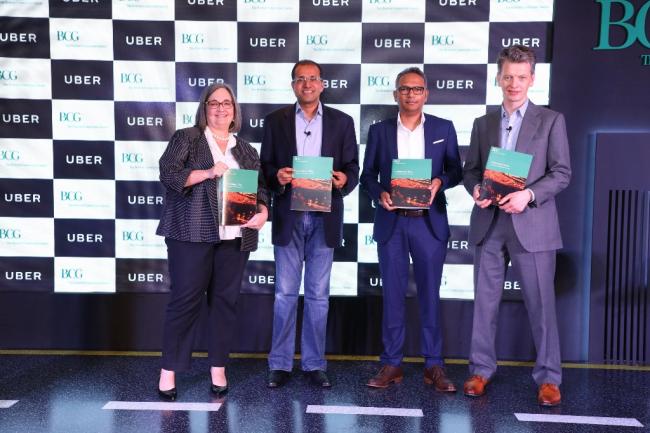
Launched in the presence of Uber’s Global COO, Barney Harford, Amit Jain, President, Uber India SA, Suresh Subudhi, Partner, BCG & Ann Lavin, Senior Director, Public Policy & Government Relations, Uber APAC, this initiative reaffirms the Uber’s resolve to make a difference to congestion in the country by harnessing the promise of ridesharing and shared mobility, pivoting on data-backed solutions.
“For over 9 years now, Uber has been a pioneer in ridesharing, globally. Closer home, we continue to be at the forefront when it comes to unlocking the true potential of ridesharing for India. Through this study, we are hoping to draw the attention of administrators and urban planners on how shared cars and mobility can be part of the solution vs. individual car ownership,” said, Amit Jain, President, Uber India and South Asia.
“In the coming months, we will introduce several India first innovations that will help bring the benefits of ridesharing to many more Indians and enable us to work with the Government towards a common goal: reduce private car ownership and expand access to public transit systems. We are delighted that India has embraced shared mobility in a big way -- but we still have a long way to go. Together with the Government, we aim to continue playing a key role in improving lives and cities,” added Jain.
“Cost of congestion is alarmingly high across Indian cities. We need to creatively think about increasing public transport usage and network while managing private transport growth. On-demand ride sharing is a practical way to reduce no of private vehicles on the road and reduce congestion. It is important to encourage this proactively,” said Suresh Subudhi, Global Sector Head - Infrastructure and Transport, BCG.
Support Our Journalism
We cannot do without you.. your contribution supports unbiased journalism
IBNS is not driven by any ism- not wokeism, not racism, not skewed secularism, not hyper right-wing or left liberal ideals, nor by any hardline religious beliefs or hyper nationalism. We want to serve you good old objective news, as they are. We do not judge or preach. We let people decide for themselves. We only try to present factual and well-sourced news.
Support objective journalism for a small contribution.