 GDP
GDP
Modi government gets IMF backing on 7.8% GDP growth amid data row
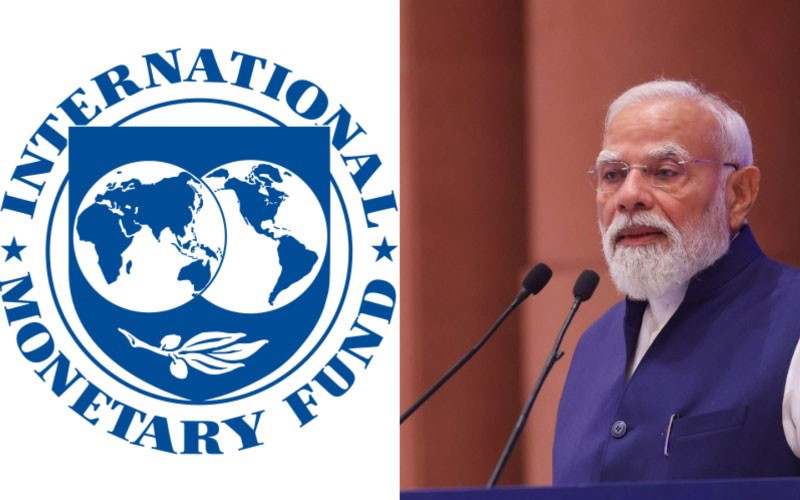
Giving a boost to the Narendra Modi-led government, the International Monetary Fund (IMF) has backed India’s 7.8% GDP growth recorded in the April-June quarter, saying the South Asian nation remains a key growth engine for the world.
The IMF’s observation comes amid an ongoing debate over the credibility of India’s latest GDP estimates.
Julie Kozack, Director of the Communications Department at the IMF, said during a media briefing that India’s real GDP grew by 7.8% in the second quarter, exceeding both the IMF staff’s expectations and the consensus among other observers.
“India’s real GDP in the second quarter grew by 7.8%. That was above our staff expectations and also the consensus among other observers. This upward surprise was driven by stronger-than-expected activity in the services sector and also in exports,” Kozack said.
She said the latest figures underscored the resilience of the Indian economy despite the energy price shock.
“And I think what we would say is the outturn also underscores the resilience of the Indian economy despite the energy price shock. And it also means that, as we’ve been saying for quite some time, that India does remain a key growth engine for the world,” she added.
Kozack also welcomed India’s efforts to modernise its statistical framework, noting that the latest GDP series incorporates a new Index of Industrial Production (IIP) and a new Producer Price Index (PPI) series.
“These two new series should help improve India’s GDP estimates,” she said.
She further described the incorporation of the new IIP and PPI series as a welcome step towards modernising India’s macroeconomic statistics and urged the authorities to continue strengthening the country’s statistical framework and data quality.
India’s real Gross Domestic Product (GDP), or GDP at constant prices, for the first quarter (Q1) of FY 2026-27 was estimated at ₹81.36 lakh crore, compared with ₹75.46 lakh crore in Q1 of FY 2025-26, registering growth of 7.8%.
The strong growth came despite global geopolitical challenges and an energy crisis.
Prime Minister Narendra Modi welcomed the latest GDP figures, describing India’s 7.8% growth in Q1 of FY 2026-27 as a “herculean feat”.
In a post on X, Modi said, “India’s exemplary GDP growth of 7.8% during Q1 of FY 2026-27 is a herculean feat.”
He attributed the strong economic performance to the resilience of Indians in the face of global challenges.
“The collective strength of our people ensured India delivered such growth despite oil price shocks and supply chain issues in the midst of global uncertainties,” the Prime Minister said.
Controversy Over GDP Figures
Former Finance and Economic Affairs Secretary Subhash Chandra Garg, however, questioned the government’s 7.8% real GDP growth estimate for Q1 of FY 2026-27, arguing that the latest numbers warrant closer scrutiny.
Garg raised questions over the revision of India’s GDP figures, particularly the change in the previous year’s nominal GDP estimate.
He argued that the downward revision of the previous year’s current-price GDP — from around ₹86 lakh crore under the earlier series to about ₹80 lakh crore under the revised series — has a significant bearing on the headline growth calculation.
Garg’s calculations suggested that growth could be around 2.6% when certain figures from the earlier and revised series are compared.
His remarks triggered a wider debate over India’s GDP methodology and how the revised figures should be interpreted.
Centre Rejects Garg’s Claims
Government officials, however, disputed Garg’s calculation, saying the 2.6% figure was derived by comparing figures from two different GDP series.
The latest GDP estimates use 2022-23 as the base year, replacing the earlier 2011-12 base year. The new series also incorporates updated data sources and methodological changes, including more detailed price information.
According to government officials, the comparable figures under the new series show nominal GDP rising from ₹80 lakh crore in Q1 FY 2025-26 to ₹88.27 lakh crore in Q1 FY 2026-27. Real GDP, meanwhile, increased from ₹75.46 lakh crore to ₹81.36 lakh crore, resulting in the official 7.8% real growth rate.
The Ministry of Statistics and Programme Implementation (MoSPI) has also defended the methodology, saying the revisions reflect improvements in data sources and estimation techniques rather than an attempt to artificially boost growth.
Against this backdrop, the IMF’s assessment provides an international endorsement of India’s latest GDP figures, while highlighting the resilience of the country’s economy amid global geopolitical and energy-related challenges.
Support Our Journalism
We cannot do without you.. your contribution supports unbiased journalism
IBNS is not driven by any ism- not wokeism, not racism, not skewed secularism, not hyper right-wing or left liberal ideals, nor by any hardline religious beliefs or hyper nationalism. We want to serve you good old objective news, as they are. We do not judge or preach. We let people decide for themselves. We only try to present factual and well-sourced news.
Support objective journalism for a small contribution.