Iran War: India has enough policy buffers to absorb heightened global uncertainties, says RBI Dy Governor
Amid concerns over the economic fallout of the Iran War, including rising inflationary pressures due to supply-side disruptions, RBI Deputy Governor Poonam Gupta on Tuesday said India’s macro fundamentals are strong and it has enough policy buffers to absorb large external shocks.
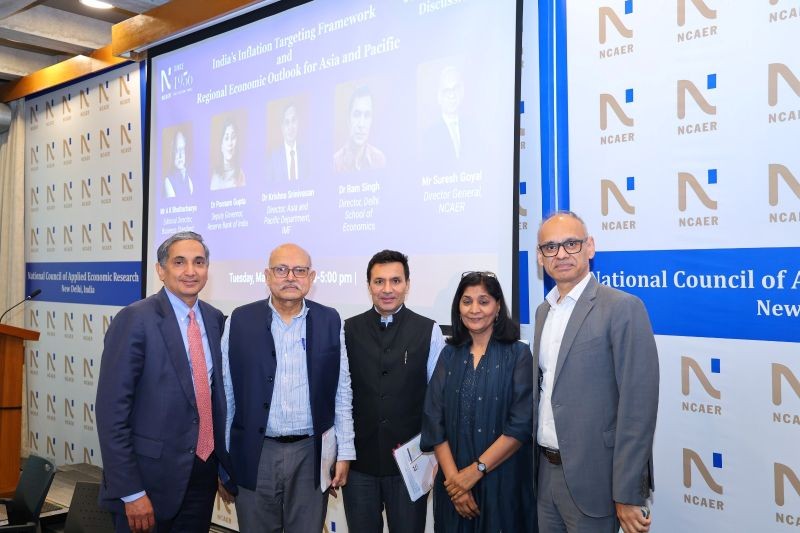
Dr Gupta was speaking at a discussion, organised by National Council of Applied Economic Research (NCAER), at which IMF Asia-Pacific Director Krishna Srinivasan said the new fuel shock will have a significant impact on the policy side as a prolonged conflict could intensify inflationary pressures and lower growth by worsening cost-of-living challenges.
He suggested that monetary policies remain agile and be ready to respond to keep inflation in check.
In his presentation on ‘Regional Outlook for Asia and Pacific’, Dr Srinivasan said, “It’s critical to keep inflation expectations well anchored. Policy responses need to be tailored to different cyclical positions.
Proactively responding to the new energy shock requires policy coordination.
”Explaining ‘India’s Inflation Targeting Framework’, Dr Gupta said it has led to more engaging and transparent monetary policy with better anchored expectations.
Talking of the Indian experience, Dr Gupta justified the inflation tolerance band (2-6%) due to “increased need of flexibility in view of heightened uncertainties and supply-side disruptions and to stabilise growth over the business cycle”.
The band limits the need for frequent changes in the policy rate, thereby reducing the risk of policy-induced volatility, she added.
Regarding suggestions of a narrower band to strengthen policy signal, Dr Gupta said the current 4% target is considered to be suitable for India’s stage of economic development and 2% tolerance band on either side provides for flexibility to absorb large external shocks without sacrificing the credibility of the target.
Dr Srinivasan said energy markets had been severely disrupted by the West Asia conflict, whose scale and duration will shape the global outlook, as he painted three scenarios based on price of oil and the duration of the conflict.
Regarding India, he said prudent macro policies should continue. “Despite an expected inflation increase, monetary policy can look through the shock for now,” he said, adding that oil prices could imply a significant fiscal impact.
He said the pre-war baseline for Asia was for strong growth and largely contained inflation.
Asia’s growth was supported by the global tech cycle and export diversification; recovery in consumption amid weak investment (real investment slowed amid uncertainty, controls, and idiosyncratic shocks); and accommodative financial conditions despite some recent tightening driven by corrections in the equity markets.
Dr Srinivasan said constrained fiscal space due to the sequence of shocks- Pandemic, Ukraine War and Iran War—argues for balancing support with targeted subsidies. In the face of the latest shock, India had followed prudent policy, he said citing excise cut in oil and fertiliser subsidy.
The IMF Director said the energy shocks pose new risks to the region which is highly energy intensive.
“Turning the current shock into resilience requires meaningful structural reforms. Unemployment rates are high for highly-educated youth. Unequal pace in AI adoption could worsen inequality. AI can be a significant tailwind,” he said.
AK Bhattacharya, Editorial Director, Business Standard, chaired the session where Dr Ram Singh, Director, Delhi School of Economics, was one of the discussants.
At the outset, NCAER Director General Suresh Goyal introduced the speakers to set off the discussion.
Support Our Journalism
We cannot do without you.. your contribution supports unbiased journalism
IBNS is not driven by any ism- not wokeism, not racism, not skewed secularism, not hyper right-wing or left liberal ideals, nor by any hardline religious beliefs or hyper nationalism. We want to serve you good old objective news, as they are. We do not judge or preach. We let people decide for themselves. We only try to present factual and well-sourced news.
Support objective journalism for a small contribution.