

 Piyush Goyal
India-Egypt set $12 billion trade target: Piyush Goyal announces major push for economic ties
Union Minister of Commerce and Industry Piyush Goyal and Egypt’s Minister of Investment and Foreign Trade, Mohamed Farid Saleh, co-chaired the 7th session of the India–Egypt Joint Trade Committee (JTC) in Egypt’s New Administrative Capital on Monday, reaffirming both countries’ commitment to expanding bilateral trade, with a target of USD 12 billion.
The meeting marked the first time that this important bilateral institutional mechanism was convened at the ministerial level, underscoring the priority both governments attach to strengthening the economic dimension of the India–Egypt Strategic Partnership.
Both ministers emphasised the need to diversify trade, promote value-added exports and address trade-related challenges.
As a key outcome of the 7th Joint Trade Committee meeting, the two ministers agreed to establish a Joint Working Group to explore the Terms of Reference for a Preferential Trade Agreement (PTA) or Free Trade Agreement (FTA). The proposed framework is expected to facilitate stronger bilateral trade, improve access to both markets and promote investment linkages.
The meeting was preceded by bilateral discussions between the two ministers on expanding trade, facilitating investments and developing long-term industrial and commercial partnerships. The JTC provided an opportunity to review existing trade relations, assess challenges faced by businesses and identify new areas for closer collaboration.
The committee reviewed the growth in India–Egypt trade, which increased by 35 per cent to reach USD 6.5 billion in FY 2025–26 (April 2025–March 2026). Trade during April–September 2026 also grew by 65 per cent to USD 5.04 billion, compared with USD 3.08 billion during the corresponding period in 2025.
The growth reflects increasing momentum in commercial exchanges and the potential for further diversification of the bilateral trade basket. Significant opportunities exist for expanding trade in industrial goods, energy and fertilisers, chemicals, pharmaceuticals, engineering products, textiles and agricultural commodities.
The discussions primarily focused on expanding trade, developing supply chains and establishing predictable trade pathways. Both sides considered measures to address non-tariff barriers, streamline customs procedures, strengthen standards and conformity assessment mechanisms, and improve market access. They also discussed practical issues affecting business operations, including product registrations and trade-related regulatory procedures.
The ministers also discussed strengthening business exchanges and encouraging joint manufacturing and investment. Priority sectors included pharmaceuticals and medical devices, engineering and electrical equipment, fertilisers, textiles, renewable energy and emerging technologies.
Opportunities for Indian investments in Egyptian industrial zones, as well as Egyptian investments in India's expanding manufacturing and services sectors, also featured prominently in the discussions.
Both sides expressed interest in strengthening the framework agreement between Invest India and Egypt’s General Authority for Investment and Free Zones (GAFI), including a proposed digital platform for sharing investment-related information and facilitating business partnerships.
Egypt's strategic location near the Suez Canal and its connectivity with African, Arab and European markets make it an important partner for export-oriented manufacturing and regional supply chains. India, in turn, offers Egyptian investors and exporters access to a large and dynamic market, increasingly competitive infrastructure and opportunities for technology and production partnerships.
Addressing the Joint Trade Committee meeting, Piyush Goyal highlighted five areas of strong complementarity between India and Egypt: pharmaceuticals and healthcare, leveraging India's strengths in affordable medicines, vaccines and medical technology; engineering and automobiles, covering machinery, auto components and industrial manufacturing; agriculture and food processing, including food security, fertilisers, irrigation and cold-chain infrastructure; digital and fintech cooperation, through UPI linkages, local currency trade and India's Digital Public Infrastructure; and culture and museums, through proposed collaboration between the Grand Egyptian Museum and India's upcoming Yuge Yugeen Bharat National Museum in conservation, curation and digitisation.
The ministerial-level JTC meeting represents an important step towards advancing the economic priorities of the India–Egypt Strategic Partnership. It was held against the backdrop of the meeting between Egyptian President Abdel Fattah El-Sisi and Prime Minister Narendra Modi during the BRICS Summit in India in September 2026.
From the Nile to the Ganga, a new chapter of India-Egypt business partnership begins! 🇮🇳🇪🇬 https://t.co/fRsYl61Wxg
— Piyush Goyal (@PiyushGoyal) November 16, 2026
The JTC aims to translate this political momentum into stronger trade flows, fresh investments, joint manufacturing initiatives, greater market access and more resilient supply chains connecting India, Egypt and wider regional markets.
Both sides agreed to hold the next JTC meeting in New Delhi in 2028, or earlier at a mutually convenient date.
India–Egypt Business Forum brings together over 300 companies
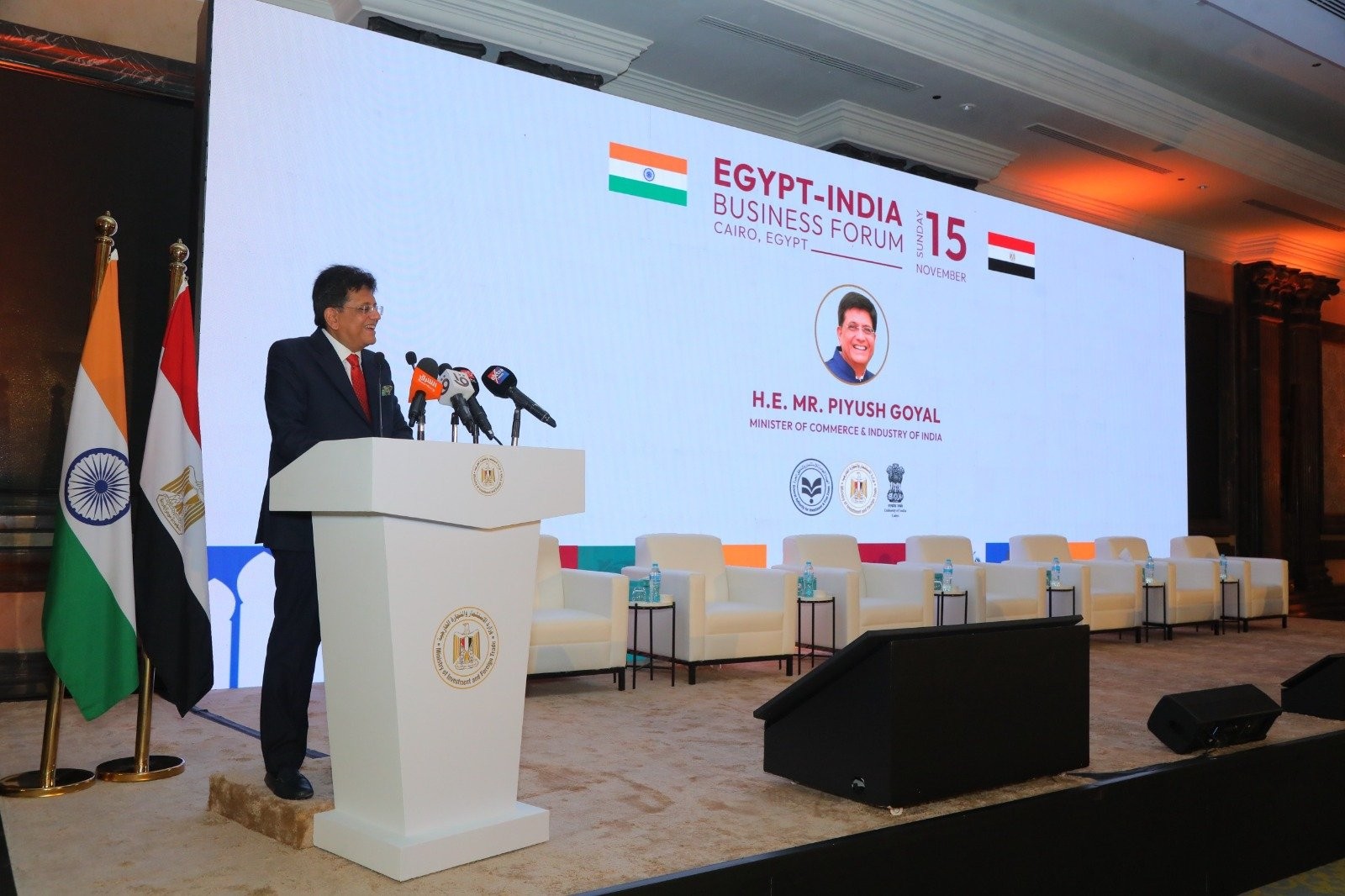
Meanwhile, the India–Egypt Business Forum brought together more than 300 companies from the two countries, providing a platform to strengthen commercial engagement under the India–Egypt Strategic Partnership.
Union Minister of Commerce and Industry Piyush Goyal and Egypt's Minister of Investment and Foreign Trade, Mohamed Farid Saleh, addressed the forum, which was attended by industry leaders and senior business representatives from a wide range of sectors.
The forum was organised on the sidelines of Goyal's official visit to Egypt from November 15 to 16, 2026.
The opening session was addressed by Dr Mohamed Awad, Chief Executive Officer of the General Authority for Investment and Free Zones (GAFI); Vijay Sankar, President of the Federation of Indian Chambers of Commerce and Industry (FICCI) and Chairman of Sanmar Group; and Ahmed ElWakil, President of the Federation of Egyptian Chambers of Commerce.
Addressing the gathering, Goyal proposed a four-point action agenda ahead of the 80th anniversary of diplomatic relations between India and Egypt in 2027.
The agenda included resolving identified trade barriers within a time-bound framework; encouraging Egyptian investments in Indian states and industrial clusters, with Invest India facilitating business opportunities; bringing suppliers of large companies into the partnership to create opportunities for smaller businesses; and institutionalising annual reviews to monitor progress and translate business discussions into concrete contracts.
Highlighting the ambition behind the partnership, Goyal said, "Years from now, when someone studies this decade, let them find factories with labels that say: Made in Egypt, with India. Made in India, with Egypt."
A dedicated session on investment opportunities in Egypt brought together senior representatives of GAFI and the Suez Canal Economic Zone (SCZONE), who presented the country's industrial and investment prospects.
Egypt's strategic location connecting the Mediterranean and Red Seas, its expanding ports and logistics infrastructure, and its access to African, Arab and European markets offer significant opportunities for Indian businesses seeking to establish manufacturing and export-oriented operations.
The forum also featured a session highlighting the experiences of Indian companies operating in Egypt, including TCI Sanmar, Galaxy Chemical and Abdos. Their presence demonstrated the potential of Indian investments to contribute to Egyptian industrial production, employment generation, technology development, exports and integration into regional supply chains.
Representatives of the two business communities explored opportunities for cooperation in engineering and electrical equipment, chemicals and fertilisers, pharmaceuticals, textiles, food processing, automotive components, renewable energy and logistics.
A special panel discussion on the digital economy brought together stakeholders from Egypt's digital technology and transformation ecosystem alongside leading Indian startups and technology companies.
Moderated by Eng. Ayman El Gohary, Chairman of Global for Smart Solutions, the panel featured experts and industry leaders from both countries.
The Egyptian participants included Eng. Mahmoud Sofrata of the Information Technology Industry Development Agency (ITIDA), Fady Ismaeel of AGX, Dr Kareem Hamza of National System and Dr Sideek Ahmed of Eram Holding.
Indian industry representatives included Rajesh Ranganathan of Zoho and Pradeep Gilbile of Datamorphosis.
The discussions focused on opportunities in enterprise technology, digital solutions, innovation and industrial partnerships, highlighting the potential for greater collaboration between the two countries in the rapidly evolving digital economy.
Support Our Journalism
We cannot do without you.. your contribution supports unbiased journalism
IBNS is not driven by any ism- not wokeism, not racism, not skewed secularism, not hyper right-wing or left liberal ideals, nor by any hardline religious beliefs or hyper nationalism. We want to serve you good old objective news, as they are. We do not judge or preach. We let people decide for themselves. We only try to present factual and well-sourced news.
Support objective journalism for a small contribution.