 Economic Survey
AI can cause large-scale labour displacement in middle and lower-income groups, warns Economic Survey
The Indian Economic Survey, which was tabled in the Parliament on Friday, said Artificial Intelligence (AI) promises to usher in a new age but at the same time, it can result in large-scale labour displacement, especially at the middle and lower quartiles of the wage distribution.
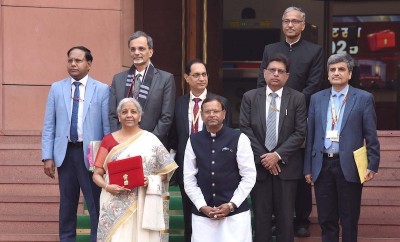
The survey was tabled by Union Finance Minister Nirmala Sitharaman, a day before she will present the Union Budget.
Risks and opportunities for India in adoption of AI
The Economic Survey 2024-25 states that as illustrated by Andrew Haldane, the former Chief Economist of the Bank of England, previous industrial and technological revolutions have been painful, characterized by widespread economic hardships, protracted unemployment for those displaced and widening income inequalities.
In this light, the Economic Survey notes, as policymakers, the possibility of such an outcome materialising in connection with automation must be taken very seriously, especially for a country like India.
India's economy is predominantly service-oriented, with a large portion of its IT workforce engaged in low-value-added services.
These roles are particularly vulnerable to automation, as companies may replace labour with technology to reduce costs.
Necessary measures to leverage AI wave in India
Economic Survey 2024-25 highlights that to minimise the negative impacts of creative destruction a collective societal effort is required, involving the creation of new social infrastructure to promote environments where innovation leads to inclusive growth.
It further adds that India will therefore have to fast-track the creation of robust institutions through a tripartite compact between the government, private sector and academia.
Among the measures to leverage AI, Economic Survey underlines the essentiality of Social Infrastructure encompassing Enabling Institutions, Insuring Institutions and Stewarding Institutions to help graduate our workforce towards medium-and high-skill jobs, where AI can augment their efforts rather than replace them.
But building these institutions as it is a time-consuming process due to need of mobilization of massive amount of intellectual and financial resources towards a singular goal.
The Economic Survey notes there are certain challenges that need to be overcome by AI developers before wide-spread adoption can be achieved. Among those, firstly, Practicality and reliability are core issues that need to be addressed by developers.
Secondly, AI also needs significant infrastructure for scaling, which takes time to build. And lastly, AI models have to target efficiency gains without compromising on performance.
The Economic Survey 2023-24 distinguishes that India‘s employment challenge is not just one of numbers, but also one of raising the overall quality of its workforce.
It observes that labour and technology, when balanced in the right way, can complement one another. As history also shows us, through careful integration and institutional support, automation brought along with it a rise in the employment-to-population ratio over the 20th century.
In this context, the future of work revolves around 'Augmented Intelligence', where the workforce integrates both human and machine capabilities.
This approach aims to enhance human potential and improve overall efficiency in job performance, ultimately benefiting society as a whole.
In this light, by leveraging its young, dynamic, and tech-savvy population, India has the potential to create a workforce that can utilise AI to augment their work and productivity.
Considering above, the Economic Survey suggests that the policymakers must balance innovation with societal costs, as AI driven shifts in the labour market could have lasting effects.
Similarly, the corporate sector also must act responsibly, handling the introduction of AI with sensitivity to India‘s needs, Economic Survey adds.
It acknowledges that due to AI presently being in its infancy, India is afforded the time necessary to address these challenges, strengthen its foundations and mobilise a nation-wide institutional response.
For that, it concludes that a collaborative effort between government, private sector, and academia is essential.
Support Our Journalism
We cannot do without you.. your contribution supports unbiased journalism
IBNS is not driven by any ism- not wokeism, not racism, not skewed secularism, not hyper right-wing or left liberal ideals, nor by any hardline religious beliefs or hyper nationalism. We want to serve you good old objective news, as they are. We do not judge or preach. We let people decide for themselves. We only try to present factual and well-sourced news.
Support objective journalism for a small contribution.