 Economic Survey
India's GDP projected to grow at 6.3-6.8 percent for financial year 2025-26, projects Economic Survey
The Economic Survey 2024-25 estimates that India's GDP growth for the financial year 2025-26 (FY26) is expected to be between 6.3% and 6.8%.
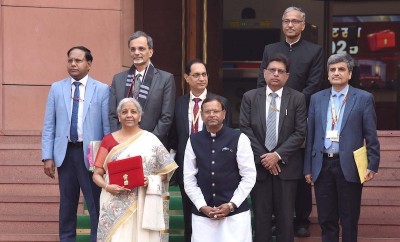
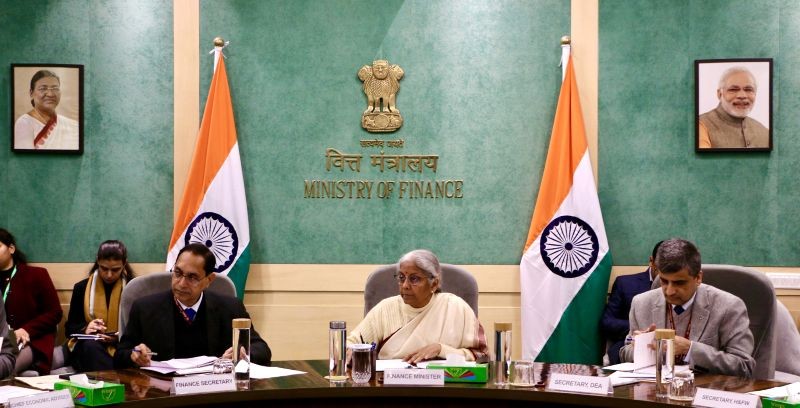
The Economic Survey was tabled in the Parliament by Union Finance Minister Nirmala Sitharaman on Friday.
Retail inflation
The survey said retail inflation in India has reduced from 5.4 per cent in FY24 to 4.9 per cent in FY25 (April-December), aided by various government initiatives and monetary policy measures.
The decline in retail inflation is primarily due to a decrease in core inflation by 0.9 percentage points between FY24 and FY25 (April-December), largely driven by core services inflation and a decrease in fuel price inflation, the survey said.
Economic Survey highlighted that the government’s administrative measures such as strengthening buffer stocks for essential food items, open market releases and efforts to ease imports during supply shortage have been crucial in stabilizing inflation.
Food inflation rate remains firm
The survey says that India's food inflation rate has remained firm, driven by a few food items such as vegetables and pulses. Contribution of vegetables and pulses to the overall inflation stood at 32.3 per cent in FY25 (April to December).
Also Read: Budget 2025 Expectations: Tax relief, capex push, and key announcements await FM Sitharaman’s speech on Feb 1
When these items are excluded, the average food inflation rate for FY25 (April-December) was 4.3 per cent, which is 4.1 per cent lower than the overall food inflation, the survey adds.
The survey underlines that extreme weather conditions such as cyclones, heavy rains, floods, thunderstorms, hailstorms, and droughts impact vegetable production and prices.
These adverse weather conditions also present significant challenges to storage and transportation, resulting in temporary disruptions to the supply chain and causing an increase in vegetable prices, Survey adds.
The survey states that the inflationary pressures in onion remained firm in FY24 and the current year, despite prompt measures by the government to contain prices due to constrained supply resulting from reduced production.
The survey says that the lower production in 2022-23 and 2023-24 has consequently led to inflationary pressures in onions for FY24 and FY25 (April-December).
The price pressures in tomatoes remained intermittently high since FY23 due to constrained supply.
Despite earnest efforts by the government, tomato prices remained high due to its highly perishable nature and production concentrated in few states, the survey mentions.
To increase the production of pulses, oilseeds, tomato and onion, focused research is needed to develop climate-resilient crop varieties, enhancing yield and reducing crop damage, the survey suggested.
Training of the farmers on best practices and high-frequency price monitoring data for essential food items to monitor price are other measures that the survey suggests.
The survey says that the deficient production of tur in 2022-23 and 2023-24 has indeed led to high price pressures in tur dal during FY24 and FY25 (April-December).
To ensure adequate supply, the government periodically imposes stock limits for tur and actively monitors through the stock disclosure portal, the survey adds.
Despite challenges, RBI and the IMF project that India's consumer price inflation will progressively align towards the inflation target of around 4 per cent in FY26, the survey notes.
RBI expects headline inflation to be 4.2 per cent in FY26. IMF has projected an inflation rate of 4.4 per cent in FY25 and 4.1 per cent in FY26 for India.
Support Our Journalism
We cannot do without you.. your contribution supports unbiased journalism
IBNS is not driven by any ism- not wokeism, not racism, not skewed secularism, not hyper right-wing or left liberal ideals, nor by any hardline religious beliefs or hyper nationalism. We want to serve you good old objective news, as they are. We do not judge or preach. We let people decide for themselves. We only try to present factual and well-sourced news.
Support objective journalism for a small contribution.