 Death Penalty
Supreme Court rejects ‘less painful’ death penalty plea, but leaves door open for future change
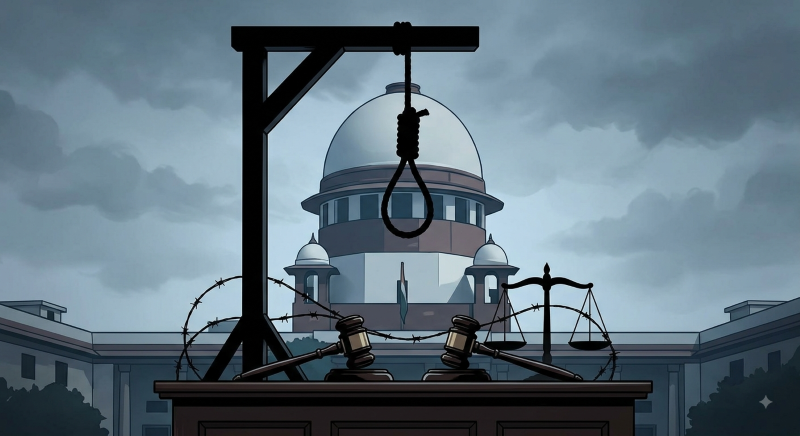
New Delhi/IBNS: The Supreme Court on Tuesday dismissed a petition seeking to replace hanging with a less painful and more dignified method of executing the death penalty, while leaving open the possibility of revisiting the issue if compelling scientific or medical evidence emerges.
A bench of Justices Vikram Nath and Sandeep Mehta declined to refer the constitutional validity of hanging as a method of execution to a larger bench.
The court's ruling effectively retains hanging as the prescribed method for carrying out death sentences in India.
What did the petition seek?
The petition was filed by senior advocate Rishi Malhotra, who challenged the constitutional validity of the provision prescribing hanging as the method of execution.
Malhotra sought alternatives such as lethal injection, shooting and electrocution, arguing that the method of execution should minimise pain and suffering and preserve the dignity of a condemned prisoner.
The plea also sought reconsideration of the Supreme Court's earlier three-judge bench ruling in Deena v Union of India, which had upheld hanging as constitutionally valid.
What did the Supreme Court say?
The bench said it was not persuaded that there was sufficient ground to refer the Deena judgment to a larger bench for reconsideration.
However, the court made it clear that Tuesday's dismissal does not permanently close the door on the issue.
The bench said future constitutional scrutiny could be possible if compelling scientific, medical or empirical evidence demonstrates that the factual and scientific basis of the Deena judgment has been materially displaced by subsequent developments.
Centre can consider expert review
The court also clarified that the Union Government remains free to undertake a comprehensive review of the existing method of execution through an expert body.
Such a committee could examine whether an alternative method would better meet the constitutional objective of minimising pain and suffering while preserving the dignity of death-row prisoners.
What does the law currently say?
The earlier Section 354(5) of the Code of Criminal Procedure prescribed execution by hanging. Its corresponding provision under the Bharatiya Nagarik Suraksha Sanhita (BNSS), Section 393(5), retains hanging as the method for carrying out a death sentence.
The Supreme Court had upheld the constitutional validity of hanging in its 1983 Deena judgment. The Court has now declined to reopen that position on the basis of the material presented in the present petition.
Why is the ruling significant?
The verdict keeps hanging as India's existing method of execution, but it does not rule out a future change.
The Court's observations leave room for the issue to return before it if advances in medical science or other compelling evidence establish that another method can execute a death sentence with less pain and greater dignity.
Support Our Journalism
We cannot do without you.. your contribution supports unbiased journalism
IBNS is not driven by any ism- not wokeism, not racism, not skewed secularism, not hyper right-wing or left liberal ideals, nor by any hardline religious beliefs or hyper nationalism. We want to serve you good old objective news, as they are. We do not judge or preach. We let people decide for themselves. We only try to present factual and well-sourced news.
Support objective journalism for a small contribution.