 Narendra Modi
Bullet train diplomacy: Modi, Shigeru Ishiba travel from Tokyo to Sendai in Shinkansen
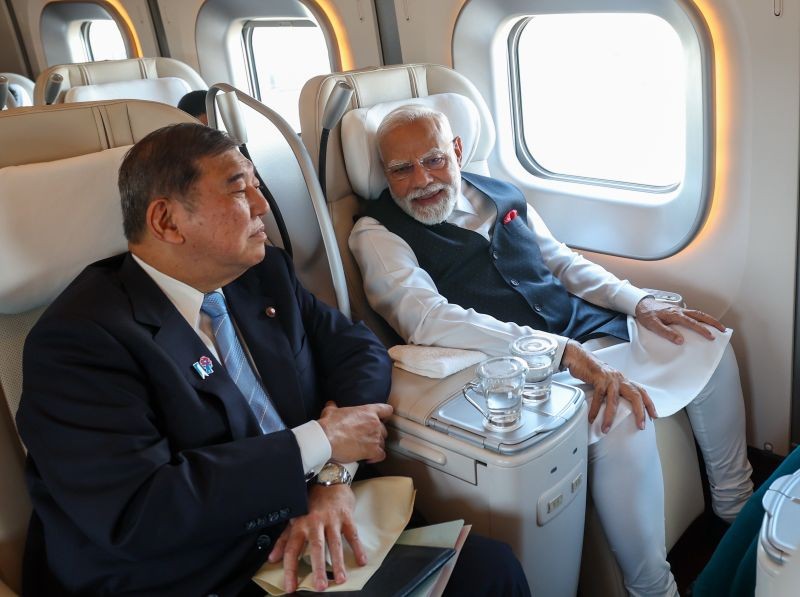
Prime Minister Narendra Modi joined his Japanese counterpart Shigeru Ishiba, to travel in a bullet train from Tokyo to Sendai on Saturday.
Sharing images of his train travel, Modi wrote on X: "Reached Sendai. Travelled with PM Ishiba to this city on the Shinkansen."
Reached Sendai. Travelled with PM Ishiba to this city on the Shinkansen.@shigeruishiba pic.twitter.com/qBc4bU1Pdt
— Narendra Modi (@narendramodi) August 30, 2025
Ishiba shared images of the travel on his X page.
According to the Japanese government's website, the Shinkansen (lit. new trunk line), Japan’s high-speed rail, celebrates its 50th anniversary in 2014, having opened for service between Tokyo and Osaka in 1964.
Marking a significant safety standard, Shinkansens have now operated for 50 years, over 18,000 days, without a single passenger casualty.
Narendra Modi is currently on a two-day visit to Japan from August 29 to August 30.
He is attending the 15th India-Japan Annual Summit.
This is the Prime Minister's eighth visit to Japan.
Modi attended the 15th India-Japan Annual Summit in Tokyo on Friday.
PM Narendra Modi on Friday pitched India as a destination for Japanese business to invest and said the capital not only grows in the South Asian nation but also multiplies.
Addressing the India-Japan Economic Forum in Tokyo, Modi, who arrived in Japan earlier in the day, said: "Japan has always been a key partner in India’s growth journey. Whether it’s metros, manufacturing, semiconductors, or start-ups, our partnership in every area reflects mutual trust."
"Japanese companies have invested more than $40 billion in India. In the last two years alone, there has been private investment of $13 billion. JBIC says India is the most 'promising' destination. JETRO says 80 percent of companies want to expand in India, and 75 percent are already profitable," he said.
"Which means, in India, capital does not just grow, it multiplies!" the PM said.
India's bullet train journey
The E10 Shinkansen, derived from Japan’s ALFA-X experimental train, will be jointly manufactured in India under an agreement in principle between the two countries.
The collaboration will deepen economic cooperation and build on the ongoing 508-km Ahmedabad-Mumbai high-speed rail project.
E10 Shinkansen is a high-speed rail system, akin to those running in countries such as France—India’s first choice for collaboration on the project. Nations like China, South Korea, Turkey, Spain, Germany, Italy, the Netherlands, and Belgium also operate such services.
Commonly known as a 'bullet train', this service requires dedicated tracks and must maintain speeds above 250 km per hour.
The Mumbai–Ahmedabad High-Speed Rail (MAHSR) project was launched in September 2017, when Modi and then Japanese Prime Minister Shinzo Abe laid the foundation stone at Sabarmati in Gujarat.
This followed four years of feasibility studies by Indian Railways and Japan’s International Cooperation Agency. Two years later, a memorandum of understanding was signed, with Japan committing to fund 80 per cent of the project through a soft loan. Progress, however, was stalled for several years.
Construction has since accelerated. The first stretch in Gujarat is scheduled to open in 2027, with the full 508-km route expected to become operational by 2028, cutting travel time to two hours and seven minutes.
Back in 2009, five other high-speed rail corridors—including Pune–Ahmedabad and Delhi–Amritsar via Chandigarh—had been shortlisted.
Support Our Journalism
We cannot do without you.. your contribution supports unbiased journalism
IBNS is not driven by any ism- not wokeism, not racism, not skewed secularism, not hyper right-wing or left liberal ideals, nor by any hardline religious beliefs or hyper nationalism. We want to serve you good old objective news, as they are. We do not judge or preach. We let people decide for themselves. We only try to present factual and well-sourced news.
Support objective journalism for a small contribution.