


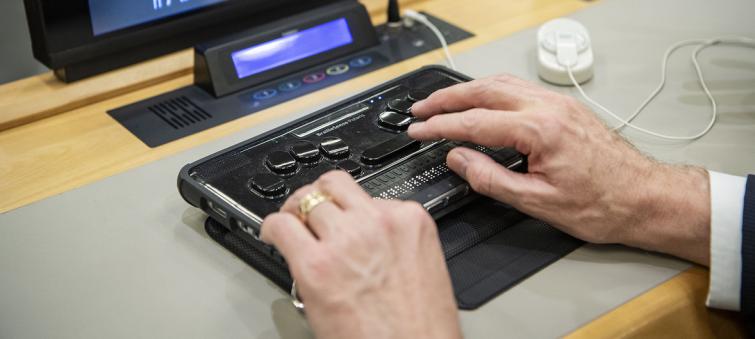
World Braille Day marks key communication tool for millions
New York/IBNS: Being marked for only the second time ever, World Braille Day on Saturday raises awareness of the importance of the tactile global communication system which helps enable blind and visually impaired people, to realize their full human rights.
It is estimated that approximately 2.2 billion people have a vision impairment or blindness, according to the Worth Health Organization (WHO), a billion of whom have either not had their condition addressed, or whose impairment could have been prevented.
People with vision impairment are more likely than those without, to experience higher rates of poverty and disadvantage.
Not meeting their needs, or fulfilling their rights, has wide-reaching consequences: vision loss often represents a lifetime of inequality, poorer health, and barriers to education and employment.
Braille brings written language to the forefront as a critical prerequisite for promoting fundamental freedoms. The system relies on touch to recognize alphabetic and numerical symbols, using six dots to represent each letter and number and even musical, mathematical and scientific symbols.
The 2006 Convention on the Rights of Persons with Disabilities, which has advanced the rights and well-being of persons with disabilities, considers Braille essential for education, freedom of expression and opinion, access to information and social inclusion.
The 2030 Agenda for Sustainable Development, adopted in 2015, further pledges that no one will be left behind in the aim to ensure that all human beings can enjoy prosperous and fulfilling lives.
Looking back in history
World Braille Day is celebrated on 4 January, the day in 1809 when the system’s inventor was born.
Having become blind after a childhood accident, at age 15, Louis Braille created the system we know today as braille.
It has been tweaked over the years and as early as 1949, UN Educational, Scientific and Cultural Organization UNESCO took the initiative to promote a survey of problems aimed at establishing Braille uniformity.
Photo caption and credit:
UN Photo/Manuel Elias
A participant using his Braille display at an event for the International Day of Persons with Disabilities. (2018)
Support Our Journalism
We cannot do without you.. your contribution supports unbiased journalism
IBNS is not driven by any ism- not wokeism, not racism, not skewed secularism, not hyper right-wing or left liberal ideals, nor by any hardline religious beliefs or hyper nationalism. We want to serve you good old objective news, as they are. We do not judge or preach. We let people decide for themselves. We only try to present factual and well-sourced news.
Support objective journalism for a small contribution.


