 Afghanistan
Who are Sepahiyan-e Mihan? Inside the new anti-Taliban group that briefly captured an Afghan district
A newly formed armed group calling itself Sepahiyan-e Mihan, or Soldiers of the Homeland, has drawn attention after briefly taking control of the Yaftali Sufla district headquarters in Afghanistan's northeastern Badakhshan province before Taliban forces regained control within hours.
Although the Taliban dismissed the operation as a limited security incident, the group's appearance has sparked discussion over the emergence of new armed movements in one of Afghanistan's most strategically sensitive regions.
Surprise attack announces a new resistance group
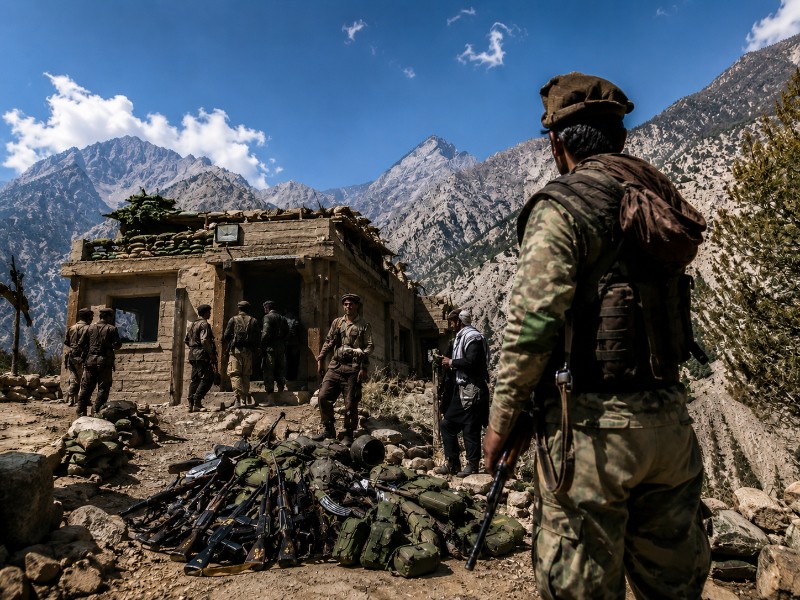
According to local sources cited by Afghanistan International, BBC Urdu, Amu TV and The Kabul Tribune, fighters belonging to Sepahiyan-e Mihan launched an early morning assault on the Yaftali Sufla district headquarters on July 17.
The group reportedly disarmed Taliban personnel, occupied the district administration building and hoisted its own flag before withdrawing several hours later with weapons and military equipment allegedly seized during the operation.
The Taliban acknowledged that an attack had taken place but rejected suggestions that it represented a significant setback.
The Afghan Taliban have started losing territories in Afghanistan. Anti-Taliban Tajik General Abdul Qayum of the Homeland Soldiers Front has conquered Yaftal district in Badakhshan province, where local Taliban troops have surrendered. pic.twitter.com/HppwDLZfEh
— The Blank Page Official (@PageBlank) July 17, 2026
Provincial police said security forces quickly regained control, arrested several suspects and restored order in the district.
If independently verified, the incident would represent the first publicly reported case since the Taliban regained power in August 2021 in which an anti-Taliban group temporarily controlled a district headquarters.
Who are Sepahiyan-e Mihan?
Information about Sepahiyan-e Mihan remains limited, reflecting its recent emergence.
Local sources told Afghanistan International that the organisation consists of residents of Badakhshan from different backgrounds who united amid growing dissatisfaction with Taliban governance in the province.
The group's membership reportedly includes activists, former members of Afghanistan's security forces and local civilians.
Although they are said to maintain contacts with former mujahideen commanders and political organisations, the group describes itself as an independent movement without formal affiliation to any established resistance organisation.
#BREAKING
— Aamaj News English (@aamajnews_EN) July 17, 2026
Five Years of Taliban Rule; First District in Badakhshan Falls
Video obtained by Aamaj News shows intense gunfire in Yaftal district, Badakhshan, in the early hours of Friday, July 17, following an attack by a newly formed anti-Taliban militant group…1️⃣ pic.twitter.com/epZKqELF5X
A member of the group told Afghanistan International that what he described as Taliban "oppression and repression" in Badakhshan motivated its formation.
He said members could no longer watch local communities suffer under Taliban rule and aimed to organise residents to resist the administration.
Leadership still surrounded by uncertainty
Initially, little was publicly known about the leadership of Sepahiyan-e Mihan.
However, BBC Urdu identified the group's leader as Qayum Khan Malang, also known as Abdul Qayum Shikari from Koh Bala village in Yaftal district.
According to the report, Malang served in the former Afghan National Army under the US-backed government and reportedly trained and fought alongside US Delta Force units during operations against the Taliban.
Following the Taliban's return to power in 2021, he reportedly joined Ahmad Massoud's National Resistance Front (NRF) before later breaking away because of differences with its leadership and establishing his own armed group in Badakhshan.
Former Afghan ambassador to the United Nations Mahmood Saikal also identified Malang as a former Afghan National Army officer.
#BREAKING: Yaftal District of Badakhshan was taken from the Taliban control for a few hours this morning. This is the first time in five years that opposition groups can take control of a district from the Taliban. pic.twitter.com/FU9Xgs9fyu
— Tajuden Soroush (@TajudenSoroush) July 17, 2026
Why was Yaftali Sufla chosen?
Observers believe the group's decision to launch its first operation in Yaftali Sufla reflected both strategic opportunity and operational limitations.
Located near the provincial capital Faizabad, the district is considered easier to access than many of Badakhshan's remote mountainous areas.
Security analysts cited by Afghan media believe the operation indicates that Sepahiyan-e Mihan currently lacks the military strength and experience needed for prolonged engagements.
Although the fighters managed to occupy the district headquarters briefly, they withdrew after Taliban reinforcements arrived.
Some security sources also suggested that many members appear to be local civilians who have taken up arms for political and patriotic reasons rather than trained professional soldiers.
Badakhshan's growing role in anti-Taliban resistance
Badakhshan has increasingly emerged as one of Afghanistan's principal centres of armed opposition since the Taliban regained power.
Established groups such as the National Resistance Front and the Afghanistan Freedom Front have repeatedly claimed responsibility for guerrilla attacks, ambushes and assaults on Taliban checkpoints across the province.
The emergence of Sepahiyan-e Mihan suggests that resistance activity in Badakhshan may be broadening, with new actors joining the anti-Taliban movement.
The province has experienced growing tensions over disputes involving local Taliban commanders, competition over mining resources, friction between locally based Taliban members and forces deployed from other provinces, and increasing public dissatisfaction, according to local observers.
Taliban responds to the incident
Taliban authorities sought to minimise the significance of the attack.
According to BBC Urdu and Xinhua, Badakhshan police described the attackers as "a few irresponsible individuals" and said security forces had restored control within hours.
Police spokesperson Ehsanullah Kamgar said several suspects had been arrested while operations continued to locate others.
He also acknowledged possible negligence by local officials, stating, "There was certainly negligence in the performance of duty, and those responsible will have to answer for it."
#Afghanistan: Security sources claim 13 members of the newly formed "#SepahiyaneMihan" group, including its leader Abdul Qayum Malang, have been captured alive. Sources say group had around 20 members, with operations ongoing to apprehend remaining individuals.#Badakhshan pic.twitter.com/JeCI3pNJOe
— Ahsan Junaid (@AhsanJunaidAJ) July 17, 2026
Following the incident, Taliban Army Chief of Staff Qari Fasihuddin Fitrat dismissed Sepahiyan-e Mihan and similar organisations as publicity-driven groups.
"Different groups emerge only to show their presence and occasionally raise a flag somewhere. Whether it is the National Resistance Front, the Freedom Front or Sipahiyan-e-Mihan, they merely want to make their name heard. They cannot confront our security forces," Fitrat was quoted as saying by the BBC.
He also suggested that foreign intelligence agencies "may have played a role", while adding that he could not confirm such involvement.
Why the incident matters
Although the temporary seizure of Yaftali Sufla does not alter the overall balance of power in Afghanistan, analysts say it demonstrates that organised armed resistance continues to evolve nearly five years after the Taliban returned to power.
The emergence of Sepahiyan-e Mihan adds another name to the growing list of groups seeking to challenge Taliban authority, particularly in Badakhshan, a strategically significant province bordering Tajikistan, China and Pakistan-administered Gilgit-Baltistan.
The incident also highlights the continued security challenges facing the Taliban in northeastern Afghanistan, even as the administration maintains overall territorial control across the country.
Support Our Journalism
We cannot do without you.. your contribution supports unbiased journalism
IBNS is not driven by any ism- not wokeism, not racism, not skewed secularism, not hyper right-wing or left liberal ideals, nor by any hardline religious beliefs or hyper nationalism. We want to serve you good old objective news, as they are. We do not judge or preach. We let people decide for themselves. We only try to present factual and well-sourced news.
Support objective journalism for a small contribution.