 Ukraine
War in Ukraine should not be ‘new normal’, say humanitarians
A surge of attacks by Russian forces on the Kharkiv area of Ukraine is causing significant civilian casualties, as well as the destruction of homes and crucial infrastructure, the top UN official in Ukraine said today, in a plea not to “normalize” the dire conditions for Ukrainian civilians.
“There has been a very clear intensification of the war over the past couple of months,” said Denise Brown, UN Resident and Humanitarian Coordinator in Ukraine.
“On my last trip to Ukraine two weeks ago, there were 12 sirens during the day and 12 explosions. There's a constant disruption to daily life in the city of Kharkiv,” she told journalists in Geneva.
The Russian military staged a fresh incursion into the Kharkiv region on 10 May, seizing the town of Vovchansk and intensifying aerial attacks on Kharkiv city, Ukraine’s second largest urban centre, with some one million inhabitants fearing for their lives.
Millions traumatized
A total of nearly ten million people - children included- are estimated by the World Health Organization to be at risk of acute Post-Traumatic Syndrome Disease (PTSD) in Ukraine.
Meanwhile, some four million children across the country have had their education disrupted, and 600,000 of them are unable to access in-person school at all, according to UNICEF, the UN Children’s Fund.
Driven underground
In the city of Kharkiv, the only way children can safely study is in the subterranean tunnels of the metro, Ms. Brown said, having witnessed this recently, when she visited the underground with the city’s mayor.
“My initial reaction was that classrooms look like regular classrooms: full of children, teachers, full of the energy and enthusiasm that children have. My second thought was: ‘but this isn't normal’. It's not normal that children have to study, underground.”
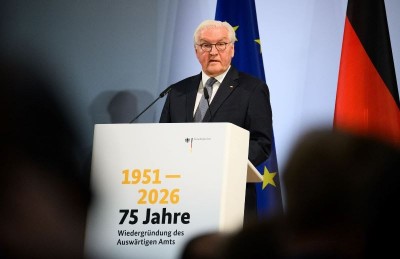
Ms. Brown recently attended the Ukraine Recovery Conference in Berlin, where 14 countries and international organizations renewed their support for recovery, reconstruction and reform in Ukraine.
Asked about her participation in the upcoming Swiss-organized Ukraine peace conference at the Bürgenstock resort this weekend, she clarified that the “UN is an observer, not a member state. So, whoever is going will be in listening mode.”
Hoping for 'a just peace'
She echoed the position of the UN Secretary-General to say that the Russian invasion of Ukraine is “a violation of the UN Charter.”
“We hope for a just peace for Ukraine,” Ms. Brown said, “and as I've said repeatedly in my remarks, the rest of the world should not normalize the war in Ukraine.”
After 28 months of war, the scale of humanitarian needs is vast. More than 32,000 civilian casualties, including 11,000 deaths, have been verified — but the real number is likely much higher.
Thirty per cent of pre-war jobs have been erased and poverty increased from five to 25 per cent. Over 14.6 million people, 40 per cent of the population will need humanitarian assistance in 2024.
The humanitarian community has appealed for $3.1 billion to providing life-saving assistance to 8.5 million of the most vulnerable for 2024.
Support Our Journalism
We cannot do without you.. your contribution supports unbiased journalism
IBNS is not driven by any ism- not wokeism, not racism, not skewed secularism, not hyper right-wing or left liberal ideals, nor by any hardline religious beliefs or hyper nationalism. We want to serve you good old objective news, as they are. We do not judge or preach. We let people decide for themselves. We only try to present factual and well-sourced news.
Support objective journalism for a small contribution.