 US Visa
US weighs new H-1B and OPT fees: Why Indian students and tech workers could bear the brunt
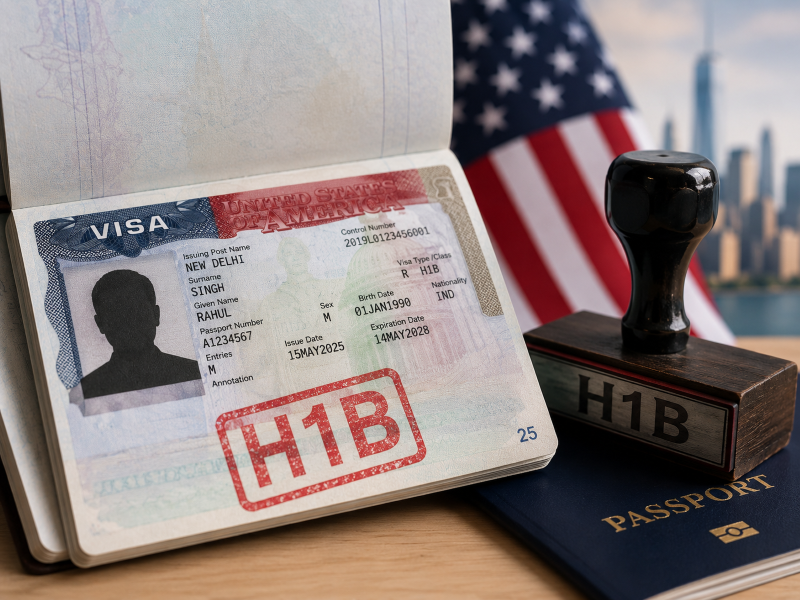
Indian students and technology professionals hoping to study, work and build long-term careers in the United States could face another increase in immigration costs as the Donald Trump administration moves to tighten scrutiny of foreign workers and students.
The US Department of Homeland Security (DHS) has started the regulatory process for introducing new fees connected with the H-1B work visa programme and the F-1 Optional Practical Training (OPT) programme, according to immigration law firm Fragomen.
The proposals are still under review, and their contents have not been made public.
The exact amounts, however, remain unknown.
However, the possibility of substantially higher fees is significant for Indian applicants because India accounts for the largest share of H-1B beneficiaries.
According to US Citizenship and Immigration Services (USCIS) data, beneficiaries born in India accounted for 71 percent of H-1B petitions approved in fiscal 2024.
The development also follows a turbulent period for the H-1B programme, during which the Trump administration attempted to impose a one-time $100,000 payment on certain new H-1B petitions.
DHS begins review of new H-1B, OPT charges
Fragomen said in an August 21 update that DHS had begun the regulatory process for new fees affecting both H-1B and F-1 OPT applicants.
According to the immigration law firm, “a proposed OPT fee rule was sent to the Office of Management and Budget (OMB) on August 20 for review”.
A separate proposal concerning a fee on certain H-1B petitions was received by OMB and cleared for review on August 19, Fragomen said.
The proposals remain confidential while they undergo review. Consequently, there is currently no official confirmation of the amount applicants or employers would have to pay.
Fragomen, however, cited recent reports suggesting that DHS could consider an OPT fee of as much as $100,000.
The potential H-1B charge could also be connected to the administration’s earlier attempt to introduce a $100,000 payment requirement for certain H-1B petitions.
The two programmes serve different purposes.
The H-1B programme allows US employers to hire foreign professionals for specialised occupations, while OPT permits F-1 international students to work temporarily in jobs directly related to their field of study.
For Indian students, the two systems are closely connected because OPT is often an important step between completing a US degree and seeking H-1B sponsorship.
What happened to earlier $100,000 H-1B payment?
The latest proposal comes after the Trump administration suffered a legal setback over its earlier attempt to introduce a $100,000 H-1B payment.
In September 2025, the administration announced a one-time $100,000 payment requirement for certain new H-1B petitions.
The measure primarily targeted cases involving beneficiaries outside the US or applications requiring consular notification.
The requirement generally did not apply to existing H-1B holders, extensions or changes of status.
This meant that the common transition from F-1 student status through OPT to H-1B status was generally outside the scope of the payment.
The policy nevertheless represented a potentially dramatic increase in the cost of hiring foreign workers from outside the US.
A Massachusetts federal district court later vacated the policy on June 8, ruling that the administration had exceeded its authority and that the payment amounted to an unlawful tax.
The administration appealed the decision, but the First Circuit Court of Appeals declined to stay the lower court's order in July.
As a result, USCIS cannot currently collect the $100,000 payment under that policy.
The new DHS proposal is therefore significant because it could represent an attempt to establish an H-1B charge through a separate regulatory process rather than relying on the mechanism struck down by the court.
H-1B hiring already carries several govt fees
Even without the disputed $100,000 payment, the H-1B process can be expensive for employers.
A standard new H-1B petition can involve several government charges, including the H-1B registration fee, Form I-129 filing fee, ACWIA training fee, fraud-prevention and detection fee and asylum programme fee.
Depending on the type of employer and petition, mandatory government charges can already run into several thousand dollars.
Certain employers with at least 50 employees in the US can also face an additional $4,000 fee when more than half of their workforce holds H-1B or L-1 status.
The additional charge can be particularly relevant to some large technology consulting and staffing companies.
Employers may also opt for premium processing and incur legal costs, pushing the overall expense considerably higher.
For Indian H-1B professionals, an important distinction is that most mandatory petition fees are generally employer expenses rather than costs directly paid by the foreign worker.
A new H-1B fee would therefore primarily affect companies sponsoring foreign professionals, although higher employer costs could have wider implications for hiring and sponsorship decisions.
Why a new OPT fee could hurt Indian students more directly
The potential OPT fee presents a different issue because OPT is an individual employment authorisation process.
Many Indian students enter the US on F-1 student visas, complete undergraduate or postgraduate degrees and then apply for OPT to gain professional experience in their field.
Students graduating in science, technology, engineering and mathematics can also qualify for a STEM OPT extension, allowing them to remain eligible for employment for additional time before potentially moving to H-1B status.
Under the current USCIS fee schedule, Form I-765, used to apply for employment authorisation including OPT, costs $470 when filed online and $520 when filed on paper.
A substantial additional OPT charge would therefore directly increase the financial burden on international students.
Unlike the H-1B process, where employers generally cover mandatory petition expenses, the OPT application is made by the student. The direct financial impact of any new OPT fee would consequently fall much more heavily on international students themselves.
This is why reports of a possible $100,000 OPT fee have attracted particular attention.
The figure, however, remains only a reported possibility. DHS has not publicly confirmed that it will introduce a $100,000 OPT charge.
Why Indians could feel the impact disproportionately
US immigration fees are not generally imposed according to nationality.
Any new H-1B or OPT charge would be linked to the relevant immigration category and circumstances rather than an applicant being Indian.
Yet the potential effect on Indians could be disproportionately large because of India's overwhelming presence in the H-1B programme.
USCIS data shows that people born in India accounted for 71 percent of H-1B petitions approved in fiscal 2024, making Indian nationals and Indian-origin professionals a particularly important group within the programme.
The proposed changes therefore come at a sensitive point for Indian technology workers, many of whom rely on H-1B sponsorship to remain employed in the US after completing their studies or entering the country through professional recruitment.
F-1 to OPT to H-1B route faces fresh uncertainty
For Indian students already studying in the US, the potential changes could affect one of the most established pathways from education to long-term professional employment.
The typical route begins with F-1 student status, followed by OPT employment after graduation.
STEM graduates may then use the STEM OPT extension before seeking H-1B sponsorship from an employer.
Each stage carries its own eligibility requirements, costs and administrative procedures.
Any major increase in the cost of OPT could therefore affect students at the first employment stage, while changes to H-1B fees could increase the financial burden on companies sponsoring them later.
The uncertainty is particularly relevant for Indian students and technology professionals because of their large presence in US higher education, STEM employment and the H-1B system.
For now, the proposed fees remain under review, with the final amounts and scope yet to be disclosed by the US government.
The regulatory process, however, signals another potential change to the cost structure surrounding the F-1, OPT and H-1B pathways at a time when the Trump administration is already reshaping US immigration policy.
Support Our Journalism
We cannot do without you.. your contribution supports unbiased journalism
IBNS is not driven by any ism- not wokeism, not racism, not skewed secularism, not hyper right-wing or left liberal ideals, nor by any hardline religious beliefs or hyper nationalism. We want to serve you good old objective news, as they are. We do not judge or preach. We let people decide for themselves. We only try to present factual and well-sourced news.
Support objective journalism for a small contribution.