 West Asia
US bases across West Asia in Iran’s crosshairs as Trump warns of military action
The risk of a direct military confrontation between the United States and Iran appears to be growing, with President Donald Trump declaring that Washington is “ready, willing, and able” to strike Tehran if necessary.
Iran has responded with equally forceful rhetoric, warning that any US attack would be met with a “crushing response.”
Iranian military officials have made it clear that retaliation would likely target American military installations across West Asia, where tens of thousands of US troops are stationed.
Tehran’s army spokesperson has cautioned that numerous US bases fall within the range of Iran’s medium-range missile capabilities.
CENTCOM’s strategic footprint in the region
American forces across West Asia operate under the US military’s Central Command, or CENTCOM, which oversees a vast network of air bases, naval facilities, and logistics hubs critical to US operations in the region.
These installations form the backbone of Washington’s military presence and are central to its ability to project power across the Middle East.
Bahrain: Nerve centre of US naval power
In Bahrain, the United States maintains Naval Support Activity Bahrain, home to the US Navy’s Fifth Fleet and the headquarters of US Naval Forces Central Command.
The facility’s deep-water port is capable of hosting the largest American warships, including aircraft carriers.
The US Navy has operated from Bahrain since 1948, initially under British administration.
Several American vessels, including mine countermeasure ships and logistics support units, are permanently based there, making the kingdom a critical maritime hub.
Iraq: Drawdown amid persistent risks
The US military presence in Iraq is undergoing a transition.
American troops remain in the autonomous Kurdish region as part of the international coalition against the Islamic State group, though their mission is scheduled to conclude by September under an agreement with Baghdad.
US forces have already withdrawn from bases in federal Iraq, whose government maintains close ties with Iran while also engaging strategically with Washington.
During the Gaza conflict that erupted in October 2023, US troops in Iraq and neighbouring Syria were repeatedly attacked by Iran-aligned militias, prompting American retaliatory strikes. Those attacks have since largely subsided.
Kuwait: Logistics and air power hub
Kuwait hosts several key US installations, including Camp Arifjan, which serves as the forward headquarters for the US Army component of CENTCOM.
The country also stores extensive American military equipment and supplies.
Ali al-Salem Air Base houses the 386th Air Expeditionary Wing, described by the US military as the primary airlift gateway for delivering combat power across the region.
The base also supports advanced drone operations, including MQ-9 Reaper aircraft.
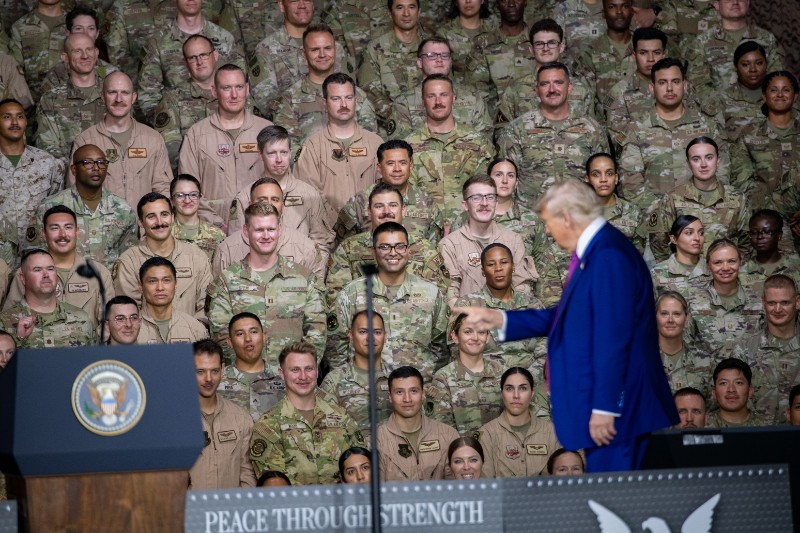 US President Donald J. Trump at Al Udeid Air Base, Qatar, May 15, 2025. Photo: Wikimedia Commons/US Air Force/Staff Sgt. Sean Moriarty
Qatar: CENTCOM’s forward command
Al Udeid Air Base in Qatar is one of the most strategically significant US installations in the region.
It hosts forward elements of CENTCOM, along with US Air Forces Central and special operations units.
The base supports rotating combat aircraft and the 379th Air Expeditionary Wing, which provides airlift, aerial refuelling, intelligence, surveillance, reconnaissance, and medical evacuation capabilities.
Iran demonstrated its reach last June by launching missiles at Al Udeid following US strikes on Iranian nuclear-related targets.
Syria: A persistent flashpoint
American troops have been stationed in Syria for years as part of international efforts to counter the Islamic State group, which emerged from the country’s civil war and once controlled vast territories in Syria and Iraq.
The risks faced by US personnel were underscored in December, when two American soldiers and a civilian interpreter were killed in an attack attributed to Islamic State militants, highlighting the volatile security environment.
UAE: Air warfare and training hub
In the United Arab Emirates, Al Dhafra Air Base hosts the US 380th Air Expeditionary Wing, comprising multiple aircraft squadrons and advanced drone systems such as MQ-9 Reapers.
The base regularly supports rotating combat aircraft and functions as a regional hub for advanced air warfare training, further cementing its role in US military operations across West Asia.
Rising stakes in a volatile region
As rhetoric hardens on both sides, the extensive footprint of US forces across West Asia places American personnel and infrastructure squarely in the firing line should hostilities escalate.
With Iran openly signalling its missile reach and Washington reaffirming its readiness to act, the region faces renewed uncertainty at a time of already heightened geopolitical tension.
Support Our Journalism
We cannot do without you.. your contribution supports unbiased journalism
IBNS is not driven by any ism- not wokeism, not racism, not skewed secularism, not hyper right-wing or left liberal ideals, nor by any hardline religious beliefs or hyper nationalism. We want to serve you good old objective news, as they are. We do not judge or preach. We let people decide for themselves. We only try to present factual and well-sourced news.
Support objective journalism for a small contribution.