October 20, 2026 02:40 pm (IST)

Follow us:


UN: Security tensions threaten Libya's transition
New York, Jun 10 (IBNS): The recent turmoil in Libya has not only slowed the pace of important aspects of the democratic transition but threatens to thrust the North African nation back into conflict and instability, the United Nations envoy to the country told the UN Security Council on Monday.
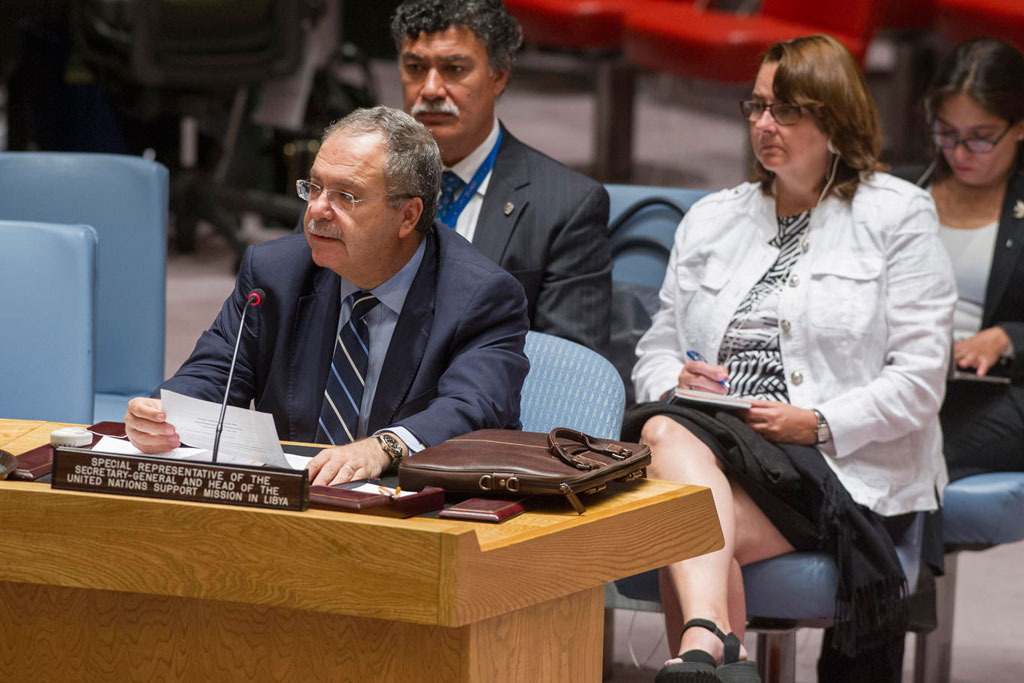
“There is a continuing sense of concern among the Libyan people regarding the prospect of a protracted conflict,” Tarek Mitri, the Secretary-General’s Special Representative and head of the UN Support Mission in Libya (UNSMIL), said in his briefing to the 15-member body.
“The crisis which has dominated the political scene for the past few months poses a threat to their country’s political transition.”
Libya, which has been undergoing a democratic transition since the toppling in 2011 of former leader Muammar al-Qadhafi, has recently witnessed political tensions as well as “significant security developments,” particularly in the eastern part of the country.
Foremost among these has been the move by retired General Khalifa Haftar in mid-May to mobilize some units of the Libyan National Army, as well as other tribally-affiliated armed elements, against groups he has labelled as terrorist and blamed for much of the violence and targeted assassinations in Benghazi and other areas of eastern Libya.
In the midst of these challenges, Mitri said he has redoubled his efforts to urge all parties in Libya to resolve the political impasse through peaceful means, and to impress upon them that a resort to the use of force will have disastrous consequences for the country.
“Following consultations with all concerned parties, I will be convening soon a meeting that brings representatives of the major actors, with the aim of forging an agreement on principles of political interaction, national priorities during the remainder of the transition, and on ways of addressing immediate security, and otherwise divisive, issues,” he stated.
“The stakes are high, and we will spare no effort in helping prevent Libya’s descent into greater instability and violence.”
Notwithstanding the political and security crisis that has engulfed Libya, the constitutional process has made considerable progress since March, the envoy noted. In addition, the country’s election commission is preparing, with UN technical support, the election of the 200-member Council of Representatives that will succeed the General National Congress. There are 1.5 million voters registered for the 25 June polls.
Meanwhile, the security situation continues to impede the proper functioning of the justice system, and has slowed the pace of security sector rebuilding.
(Tarek Mitri, Special Representative and Head of the UN Support Mission in Libya (UNSMIL). UN Photo/Eskinder Debebe)
Support Our Journalism
We cannot do without you.. your contribution supports unbiased journalism
IBNS is not driven by any ism- not wokeism, not racism, not skewed secularism, not hyper right-wing or left liberal ideals, nor by any hardline religious beliefs or hyper nationalism. We want to serve you good old objective news, as they are. We do not judge or preach. We let people decide for themselves. We only try to present factual and well-sourced news.
Support objective journalism for a small contribution.
Latest Headlines
India–New Zealand free trade agreement takes effect on October 20
Mon, Oct 19 2026
Ecuador: Priest dies after giant crucifix falls on him during mass, video goes viral
Sun, Oct 18 2026
Planning a Bali trip? Fuel shortage triggers odd-even rule, Indian tourist shares nightmare
Sat, Oct 17 2026
Air France bans Pakistani pilots from Israel flights after security crackdown; United Airlines follows suit
Wed, Oct 14 2026
flydubai cockpit attack probe widens: Two Maldivian pilots detained in UAE over links to Omani co-pilot
Wed, Oct 14 2026