October 23, 2026 01:57 am (IST)

Follow us:


UN reports Internet well on way to 3 billion users
New York, May 6 (IBNS): Releasing new statistics on Monday, the United Nations International Telecommunications Union (ITU) announced that by end 2014, there will be nearly three billion Internet users - two-thirds of them from the developing world - with mobile-broadband penetration approaching 32 percent.
“The newly released ICT [information and communications technology] figures confirm once again that information and communication technologies continue to be the key drivers of the information society,” said Hamadoun I. Touré, ITU Secretary-General.
Brahima Sanou, the Director of ITU’s Telecommunication Development Bureau, touted this newest record as a watershed moment in the world’s growing affinity for ICT.
“Behind these numbers and statistics are real human stories. The stories of people whose lives have improved thanks to ICTs,” said Sanou, adding “our mission is to bring ICTs into the hands of ordinary people, wherever they live. By measuring the information society, we can track progress, or identify gaps, towards achieving socio-economic development for all.”
Internet users, according to the ITU report, are expected to hit 3 billion by the end of 2014, which accounts for about 40 per cent of the world’s population. Among those users, over three quarters are from developed countries while two-thirds come from the developing world. Moreover, people from developing countries make up for more than 90 per cent of those who are not yet using the Internet.
In Africa, about one-fifth of the population will have access to the Internet; while in the Americas, nearly two-thirds of the population will be online by the end of the year. Further, Europe has the highest Internet penetration rate of 75 per cent, while the Asia-Pacific region has the largest population of Internet users.
Turning to mobile-broadband penetration, the number of its subscriptions will achieve 2.3 billion globally. 55 per cent of them are expected to be in the developing world. As shown in the ITU statistics, mobile-broadband remains the fastest growing market segment, with continuous double-digit growth rates in 2014. In addition, Africa takes the lead in its growth, from 2 percent in 2010 to almost 20 percent in 2014.
Compared to the spike of mobile-broadband, fixed-broadband, however, reflects slowing growth in the developing world. The ITU report expects its penetration to reach 10 per cent by end 2014. Similar to Internet subscriptions, Asia-Pacific region also dominates the most users in fixed-broadband, while Africa has the least, with lower than 0.5 per cent of its population.
Regarding mobile-cellular, a significant step towards which subscriptions is that the number will reach 7 billion by end of 2014, with developing countries home to over 75 per cent among the users. This increase indicates the growing markets in the developing world.
Even as the worldwide growth trend of these ICTs continues, fixed-telephone penetration, however, lags behind. According to ITU, fixed-telephone users have been declining for the last five years. In addition, there will be about 100 million fewer subscriptions than in 2009.
“If we want to understand the information society, we have to measure it,” said Sanou, adding that “without measurement we cannot track progress or identify gaps which require our attention.”
ITU statistics are widely recognized as the world’s most reliable and impartial global data on the state of the global ICT industry. They are used extensively by leading intergovernmental agencies, financial institutions and private sector analysts worldwide.
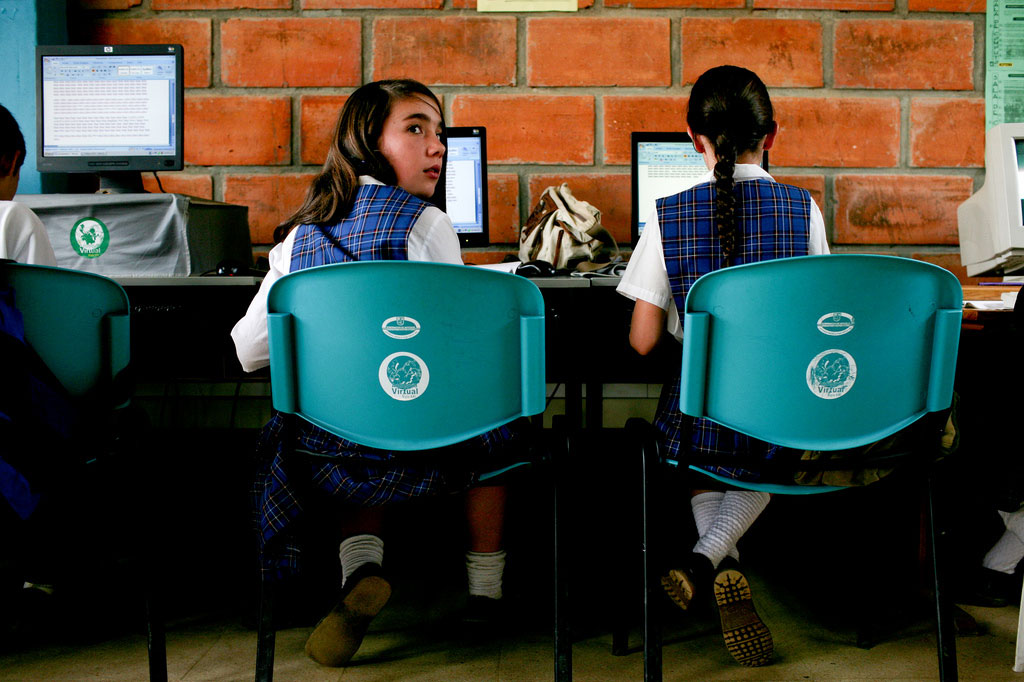
(A computer class at San Jose, a rural secondary school in La Ceja del Tambo, Antioquia, Colombia. Photo: World Bank/Charlotte Kesl)
Support Our Journalism
We cannot do without you.. your contribution supports unbiased journalism
IBNS is not driven by any ism- not wokeism, not racism, not skewed secularism, not hyper right-wing or left liberal ideals, nor by any hardline religious beliefs or hyper nationalism. We want to serve you good old objective news, as they are. We do not judge or preach. We let people decide for themselves. We only try to present factual and well-sourced news.
Support objective journalism for a small contribution.



Latest Headlines
Dammam airport attack: Indian killed, two compatriots injured as Saudi Arabia faces fresh strikes
Thu, Oct 22 2026
‘Among others’: Macron takes swipe at Trump over France unrest, calls foreign leaders’ remarks ‘stupid’
Thu, Oct 22 2026
Australian MP Helen Haines has both legs amputated after car attack described as political violence
Wed, Oct 21 2026
Meloni makes Italian parents liable for children's vandalism after Milan riots: ‘Demonstrating is a right, devastating our cities is not’
Wed, Oct 21 2026
Italy, Spain, Belgium, Portugal: Europe hit by wave of protests as energy costs soar, housing crisis deepens
Tue, Oct 20 2026
India–New Zealand free trade agreement takes effect on October 20
Mon, Oct 19 2026
Ecuador: Priest dies after giant crucifix falls on him during mass, video goes viral
Sun, Oct 18 2026