October 20, 2026 02:03 pm (IST)

Follow us:


UN official lays out challenges, priorities for future of peacekeeping
New York, June 18 (IBNS) A top official of the United Nations presented to a Washington, DC-based think tank Tuesday a broad survey of new challenges, priorities and strategies for UN peacekeeping as the world Organization embarks on a major review of its operations, requested by Secretary-General Ban Ki-moon.
“As the world around us changes, it is essential that the diverse stakeholders who authorize, finance and contribute personnel to peacekeeping operations collectively reflect on the role of peacekeeping in a changing global landscape,” Hervé Ladsous, Under-Secretary-General for Peacekeeping Operations told the Brookings Institution.
Ladsous said that over the decades, conflicts have become fewer in number but are likely to be “more intractable,” with some countries, like the Democratic Republic of Congo(DRC) and South Sudan confronting a second or third wave of struggle.
“UN peacekeeping is striving to provide a dynamic response in some of the planet’s most complicated and difficult places,” he said, describing the circumstances in which, he added, nearly 120,000 personnel serve in some 17 missions around the world – a number which would increase as the newest operation, in the Central African Republic, is deployed and the mission in South Sudan is reinforced.
He pointed to the latter operation as a prime example of how UN missions adapt in tough circumstances to new crises, in this case, rapidly transforming to protect civilians, some 90,000 of which are now seeking shelter on the mission’s sites.
Mr. Ladsous also presented innovations of the UN mission in the DRC, known as MONUSCO, which has introduced unmanned unarmed aerial vehicles to cover greater territory and has gone after armed groups in the east with “determination and vigour.”
“These examples of innovation have demonstrated our willingness to innovate and seek creative solutions. But a more systemic and collective effort is needed to further strengthen UN peacekeeping going forward,” he said.
More dangerous environments, the frequent absence of a viable peace process, organized crime and terrorism are some of the factors that must be taken into consideration in that process, he said.
As such, more robust mandates, reconciliation tasks, better protection strategies, increased capability of peacekeepers, more rapid deployment and more attention to extension of State authority and effective stewardship of resources are some of responses that need to be honed into best practices.
However, he added they all must be underpinned by international solidarity, with the contributions from countries broadened and deepened, stronger coordination with regional actors, and, most importantly, aunified international stance behind peacekeeping and the changes needed to make it more effective.
“When the UN can speak in one voice, the result will be a strengthened and renewed instrument for the advancement of international peace and security in an increasingly complex and challenging world,” Mr. Ladsous said.
“UN peacekeeping is striving to provide a dynamic response in some of the planet’s most complicated and difficult places,” he said, describing the circumstances in which, he added, nearly 120,000 personnel serve in some 17 missions around the world – a number which would increase as the newest operation, in the Central African Republic, is deployed and the mission in South Sudan is reinforced.
He pointed to the latter operation as a prime example of how UN missions adapt in tough circumstances to new crises, in this case, rapidly transforming to protect civilians, some 90,000 of which are now seeking shelter on the mission’s sites.
Mr. Ladsous also presented innovations of the UN mission in the DRC, known as MONUSCO, which has introduced unmanned unarmed aerial vehicles to cover greater territory and has gone after armed groups in the east with “determination and vigour.”
“These examples of innovation have demonstrated our willingness to innovate and seek creative solutions. But a more systemic and collective effort is needed to further strengthen UN peacekeeping going forward,” he said.
More dangerous environments, the frequent absence of a viable peace process, organized crime and terrorism are some of the factors that must be taken into consideration in that process, he said.
As such, more robust mandates, reconciliation tasks, better protection strategies, increased capability of peacekeepers, more rapid deployment and more attention to extension of State authority and effective stewardship of resources are some of responses that need to be honed into best practices.
However, he added they all must be underpinned by international solidarity, with the contributions from countries broadened and deepened, stronger coordination with regional actors, and, most importantly, aunified international stance behind peacekeeping and the changes needed to make it more effective.
“When the UN can speak in one voice, the result will be a strengthened and renewed instrument for the advancement of international peace and security in an increasingly complex and challenging world,” Mr. Ladsous said.
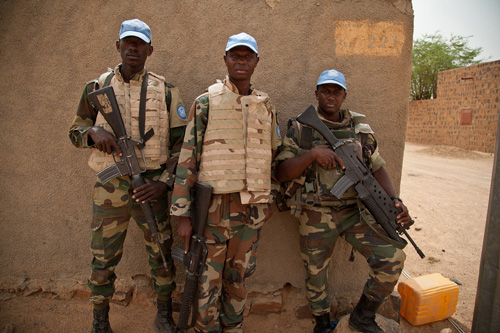
MINUSMA peacekeepers in Kidal, Mali. Photo: MINUSMA/Blagoje Grujic
Support Our Journalism
We cannot do without you.. your contribution supports unbiased journalism
IBNS is not driven by any ism- not wokeism, not racism, not skewed secularism, not hyper right-wing or left liberal ideals, nor by any hardline religious beliefs or hyper nationalism. We want to serve you good old objective news, as they are. We do not judge or preach. We let people decide for themselves. We only try to present factual and well-sourced news.
Support objective journalism for a small contribution.



Latest Headlines
India–New Zealand free trade agreement takes effect on October 20
Mon, Oct 19 2026
Ecuador: Priest dies after giant crucifix falls on him during mass, video goes viral
Sun, Oct 18 2026
Planning a Bali trip? Fuel shortage triggers odd-even rule, Indian tourist shares nightmare
Sat, Oct 17 2026
Air France bans Pakistani pilots from Israel flights after security crackdown; United Airlines follows suit
Wed, Oct 14 2026
flydubai cockpit attack probe widens: Two Maldivian pilots detained in UAE over links to Omani co-pilot
Wed, Oct 14 2026