UN Member States receive report on finance for sustainable development
The report, Forwarded to the Assembly by the Intergovernmental Committee of Experts on Sustainable Development Financing,established that, with appropriate reallocation, a robust $22 trillion in annual global savings could meet the financing needs for sustainable development in the future.
Asserting that most resources were not allocated to where they are most needed, the Committee noted that even a small shift in appropriations would have an enormous impact – improving people’s lives and protecting the planet for future generations.
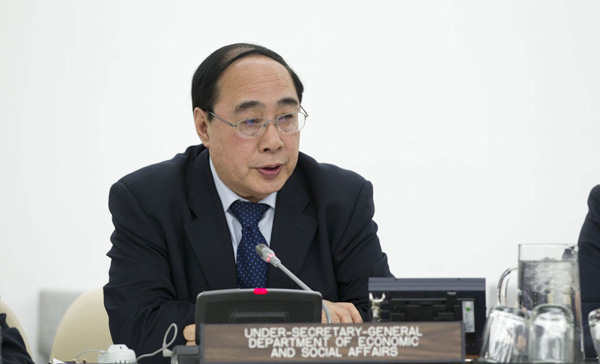
At the conclusion of the Committee’s fifth and final session at UN Headquarters, Under-Secretary-General for Economic and Social Affairs Wu Hongbo praised the body’s work and the leadership of its two co-chairs, Pertti Majanen of Finland and Mansur Muhtar of Nigeria, in guiding its efforts.
“I have not the slightest doubt that the report you have adopted will provide a significant contribution to the post-2015 development agenda,” he said.
The report outlines an analytical framework for financing sustainable development; proposes various policy options at the country level; and suggests advancing global partnerships for sustainable development.
World leaders have called for an ambitious long-term sustainability agenda to succeed and address the unfinished business of the Millennium Development Goals (MDGs), which are to be achieved by 2015 – beginning with the eradication of extreme poverty.
Building on MDG successes, in addition to promoting sustained and inclusive economic growth in poor countries to permanently wipe out poverty, the new agenda will also need to encompass sustainable development challenges, such as environmental degradation.
As part of the broader post¬-2015 development agenda, the Expert Committee’s report provides a foundation for continued intergovernmental discussions leading up to the third International Conference on Financing for Development – in Addis Ababa, Ethiopia in July 2015 – and the Summit – in New York, September 2015 – where world leaders are expected to adopt the post-2015 development agenda.
To best meet diverse financial needs, the Committee suggests an approach built on key principles, such as: country ownership of sustainable development financing strategies; the public sector’s central role and the importance of official development assistance; efficiently blending domestic, international, public and private financing sources; and mainstreaming sustainable development criteria in financing and implementing strategies.
Based on these principles, the Committee suggests “a toolkit of policy options and financial instruments to be used within a cohesive national sustainable development strategy.” With a wide range of options proposed, the report says, “the choice of specific policy measures should be determined by domestic political considerations and other country-specific circumstances.”
The Committee also considered the most recent proposal of the UN General Assembly's Open Working Group on Sustainable Development Goals for a set of goals on economic, social and environmental dimensions to improve people’s lives and protect the planet for future generations.
Under-Secretary-General for Economic and Social Affairs. UN Photo/Rick Bajornas
Support Our Journalism
We cannot do without you.. your contribution supports unbiased journalism
IBNS is not driven by any ism- not wokeism, not racism, not skewed secularism, not hyper right-wing or left liberal ideals, nor by any hardline religious beliefs or hyper nationalism. We want to serve you good old objective news, as they are. We do not judge or preach. We let people decide for themselves. We only try to present factual and well-sourced news.
Support objective journalism for a small contribution.