 UN General Assembly
UN General Assembly mandates meeting in wake of any Security Council veto
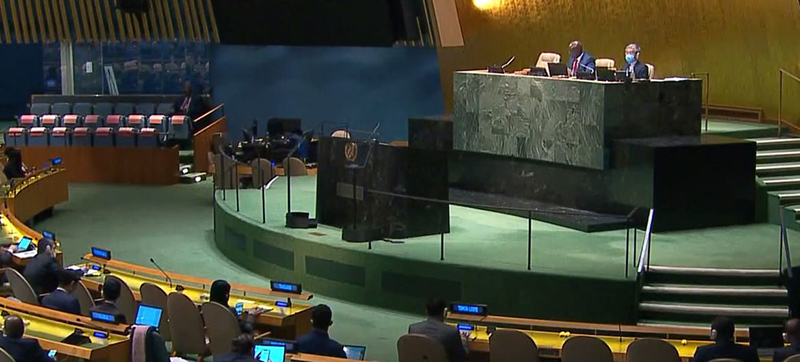
New York: The UN General Assembly decided on Tuesday to automatically meet within 10 days, if the veto is used in the Security Council by one of its five permanent members.
China, France, Russia, the United Kingdom and the United States have the power to veto Security Council resolutions, enshrined in the UN Charter – a right accorded to them because of their key roles in establishing the United Nations.
Following the resolution adopted by consensus, any such use will now trigger a General Assembly meeting, where all UN members can scrutinize and comment on the veto.
The resolution comes in the wake of Russia’s use of the veto in the Council, the day after it invaded Ukraine, calling for it’s unconditional withdrawal from the country.
On behalf of 83 cosponsors, Liechtenstein’s UN Ambassador, Christian Wenaweser, introduced the draft entitled Standing mandate for a General Assembly debate when a veto is cast in the Security Council, adopted without a vote.
The resolution, which will take immediate effect, accords on an exceptional basis, precedence to the veto-casting States in the speakers list, of the subsequent General Assembly debate, thereby inviting them to account for the circumstances behind the use of the veto.
Cause to act
Liechtenstein began work on the initiative to scrutinize the veto more than two years ago, together with a core group of States, said Ambassador Wenaweser, “out of a growing concern” that the Council had found it “increasingly difficult” to carry out its work in accordance with its mandate under the UN Charter, “of which the increase in the use of the veto is but the most obvious expression”.
Noting that all Member States had given the Council the primary responsibility for the maintenance of international peace and security, and agreed that it acts on their behalf, he underscored that the veto power comes with the responsibility to work to achieve “the purposes and principles of the UN Charter at all times”.
“We are, therefore, of the view that the membership as a whole should be given a voice when the Security Council is unable to act, in accordance with this Assembly’s functions and powers reflected in the Charter,” particularly Article 10, he said.
Article 10 spells out that the Assembly may discuss any questions or matters within the scope of the Charter or the powers and functions of any organs provided for within it, and, except as provided in Article 12, “may make recommendations to the Members of the United Nations or to the Security Council or to both on any such questions or matters.”
Multilateralism commitment
In putting the text forward, the Liechtenstein Ambassador described it “as an expression of our commitment to multilateralism, with this Organization and its principal organs at the forefront,” adding that “there has never been a stronger need for effective multilateralism than today”.
“And there has never been a stronger need for innovation in order to secure the central role and voice of the United Nations in this respect”.
After extensive individual and collective outreach and consultations, in bilateral and various group settings, he explained that the text was first circulated to the Member States on 3 March and made available to a wider public on 12 April.
On 19 April it was discussed in an open format with all interested States, who have helped to refine and improve it.
The adopted text stands as a “straightforward, legally sound and politically meaningful” resolution, the Ambassador said, which will shine a light on the use of the veto moving forward, and allow input from all Member States.
Support Our Journalism
We cannot do without you.. your contribution supports unbiased journalism
IBNS is not driven by any ism- not wokeism, not racism, not skewed secularism, not hyper right-wing or left liberal ideals, nor by any hardline religious beliefs or hyper nationalism. We want to serve you good old objective news, as they are. We do not judge or preach. We let people decide for themselves. We only try to present factual and well-sourced news.
Support objective journalism for a small contribution.