


 Iran War
'Send warships': Trump urges global naval deployment to break Iran’s Strait of Hormuz blockade
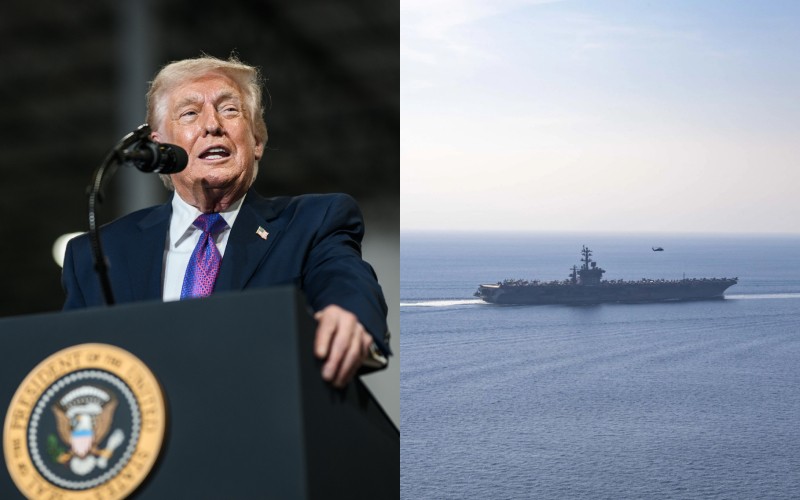
As the conflict with Iran entered its fifteenth day, US President Donald Trump urged countries around the globe to deploy naval forces to help secure the Strait of Hormuz, one of the most critical maritime corridors for global energy supplies.
In a message posted on his social media platform, Trump said several nations affected by Iran’s attempt to restrict shipping through the waterway should join the United States in sending warships to the region.
He stated that the US Navy is preparing to begin escorting oil tankers travelling through the narrow passage to ensure safe transit.
Trump said multiple countries would work alongside the United States to keep the strait open and secure for international shipping.
US Navy preparing tanker escort ops
The US president emphasised that countries whose economies rely on the Strait of Hormuz should participate in safeguarding the route.
Trump specifically mentioned nations such as China, France, Japan, South Korea and the United Kingdom as potential contributors to a multinational naval effort.
According to Trump, these countries are directly affected by the disruption caused by Iran’s restrictions on the strait and therefore have a strong interest in restoring normal shipping operations.
He argued that a coordinated international naval presence would ensure that the waterway no longer remains vulnerable to threats from Tehran.
Trump claims Iran’s military severely damaged
Trump also claimed that Iran’s military capability had been “100 percent destroyed” during the ongoing conflict.
At the same time, he acknowledged that even a weakened Iranian force could still threaten shipping in the Strait of Hormuz.
He warned that Tehran could deploy drones, lay naval mines or launch short-range missiles capable of targeting vessels passing through the corridor.
According to Trump, such tactics could disrupt traffic in the narrow channel despite the heavy damage inflicted on Iranian military infrastructure.
Kharg Island strikes escalate energy war
The call for global naval action came shortly after the United States launched strikes on Kharg Island, the main hub of Iran’s oil export infrastructure.
Trump said American forces had destroyed military sites on the island, which hosts the terminal responsible for handling most of Iran’s crude shipments.
He warned that additional attacks on Iran’s oil infrastructure could follow if Tehran continued interfering with shipping through the Strait of Hormuz.
Kharg Island plays a critical role in Iran’s energy sector, making it a key target in the escalating conflict.
Strait of Hormuz and global energy trade
Iran reportedly moved to shut down parts of the Strait of Hormuz around March 1.
The narrow waterway links the Persian Gulf with global shipping lanes and normally handles about 20 million barrels of oil shipments each day.
It also carries roughly 20 percent of global liquefied natural gas trade, making it one of the most strategically significant maritime routes in the world.
Any disruption in the strait can immediately affect global energy markets and shipping routes.
New leader signals continued pressure
In his first public message since assuming power, Iran’s new Supreme Leader Mojtaba Khamenei signalled that Tehran intends to keep pressure on the United States by maintaining restrictions on the strait.
The statement was delivered through Iran’s state television, where a news presenter read the message on air. Mojtaba Khamenei did not appear on camera.
He warned that the closure of the Strait of Hormuz would remain a strategic tool in Iran’s confrontation with Washington.
Khamenei also cautioned that American military bases in the region could face attacks if they continue operating during the conflict.
According to his statement, the presence of US forces in the region had failed to bring stability and peace.
Support Our Journalism
We cannot do without you.. your contribution supports unbiased journalism
IBNS is not driven by any ism- not wokeism, not racism, not skewed secularism, not hyper right-wing or left liberal ideals, nor by any hardline religious beliefs or hyper nationalism. We want to serve you good old objective news, as they are. We do not judge or preach. We let people decide for themselves. We only try to present factual and well-sourced news.
Support objective journalism for a small contribution.


