


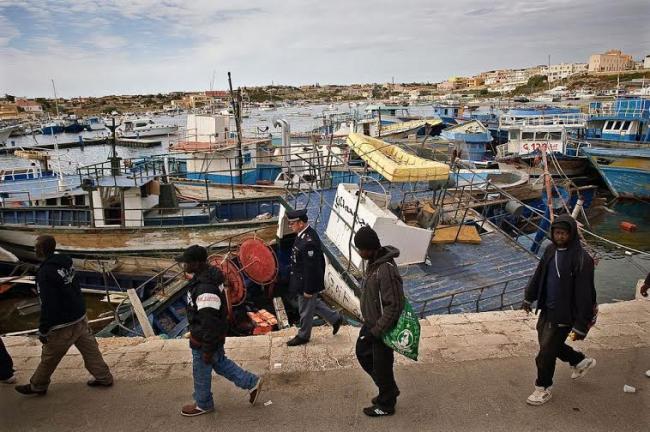
Sealing borders 'will continue to fail on massive scale,' UN rights expert tells European countries
In 2014 more than 150,000 migrants and asylum seekers arrived in Europe by sea, compared with 80,000 in 2013, according to a press release issued on Thursday by the UN Office of the High Commissioner for Human Rights (OHCHR).
The Rapporteur, François Crépeau, at end of an official visit to Brussels to follow up on a study on the management of European Union (EU) external borders that was launched in 2012, warned: “Any attempt at sealing borders – as the nationalist populist discourse stridently calls for – will continue to fail on a massive scale.”
“Sealing international borders is impossible,” he said. “Migrants will continue arriving despite all efforts to stop them, at a terrible cost in lives and suffering if nothing else is put in place.”
Migrants and asylum seekers move due to the ‘push factors’ in their countries of origin, which may include war, conflict, natural disasters, persecution or extreme poverty, as well as in response to ‘pull factors’ such as the unrecognized needs in the labour markets of EU Member States, said the release.
“These push and pull factors are unlikely to change in the foreseeable future,” the expert said.
“I urge the EU and EU Member States to progressively establish a human-rights-based, coherent and comprehensive migration policy which addresses these issues and makes mobility its central asset,” Crépeau said. “A common narrative celebrating mobility and diversity, recognizing real labour market needs, as well as the needs of migrants, based on human rights guarantees and access to justice, must be developed.”
He also said “the European Union must bank on mobility in order to regain control over its borders,” and explained that meant “that the overall goal is to have migrants using official channels to enter and stay in Europe.”
“For that, EU Member States must accept that migrants will continue to come, no matter what, and offer them incentives to use regular channels, because these will respond to their needs, as well as to the economic and social needs of Europe,” the Rapporteur said.
Emphasizing that “the status quo isn’t sustainable,” Crépeau said that “by continuing to invest financial and human resources mostly on securing its borders, Europe will certainly continue to lose control of its borders.”
During his visit to Brussels from 2 to 5 February 2015, the independent expert met with a range of EU officials responsible for border management, international organizations and civil society organizations, to discuss the complex management of the EU border, focusing particularly on the issue of migrants and asylum seekers arriving by boat. It was the third and final component of his follow-up study on the management of the EU external borders launched in 2012.
Crépeau was appointed Special Rapporteur on the human rights of migrants in June 2011 by the UN Human Rights Council, for an initial period of three years. As Special Rapporteur, he is independent from any Government or organization and serves in his individual capacity.
Photo: UNHCR/F. Noy
Support Our Journalism
We cannot do without you.. your contribution supports unbiased journalism
IBNS is not driven by any ism- not wokeism, not racism, not skewed secularism, not hyper right-wing or left liberal ideals, nor by any hardline religious beliefs or hyper nationalism. We want to serve you good old objective news, as they are. We do not judge or preach. We let people decide for themselves. We only try to present factual and well-sourced news.
Support objective journalism for a small contribution.


